


Search results
Search for "overall yield" in Full Text gives 525 result(s) in Beilstein Journal of Organic Chemistry. Showing first 200.
Recent synthesis of thietanes
Beilstein J. Org. Chem. 2020, 16, 1357–1410, doi:10.3762/bjoc.16.116
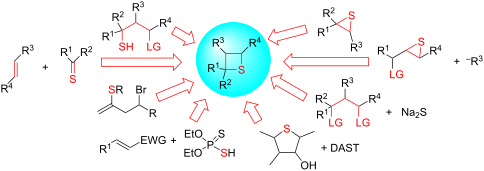
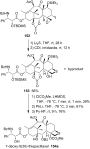
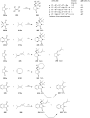
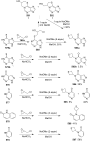
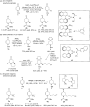
- second displacement was an intramolecular SN2 process performed under mild basic conditions, affording the desired thietane 116 in 92% yield. After deprotection, oxidative cleavage, and reduction, a thietanose 117 was obtained in 63% overall yield. The thietanose 117 was further applied to synthesize a














Fluorinated phenylalanines: synthesis and pharmaceutical applications
Beilstein J. Org. Chem. 2020, 16, 1022–1050, doi:10.3762/bjoc.16.91
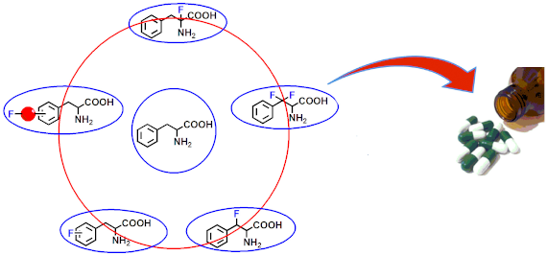
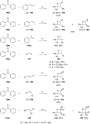
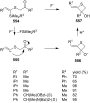
- nitrile 48a with 30% HCl aq/acetic acid, gave the 4-fluorophenylalanine·HCl 49a in a good overall yield (67%) [47] (Scheme 11). 1.4. Hydrolysis of Erlenmeyer’s azalactone A multistep Erlenmeyer azalactone synthesis was reported as an important method for the synthesis of fluorinated α-amino acids 53a–h


Copper-catalysed alkylation of heterocyclic acceptors with organometallic reagents
Beilstein J. Org. Chem. 2020, 16, 1006–1021, doi:10.3762/bjoc.16.90
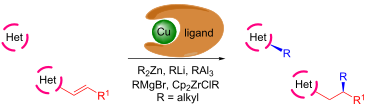
- the total synthesis of the natural product (+)-myrtine with 14% overall yield (Scheme 1B) [17]. For this application, the highest yield (73%) and enantioselectivity (96% ee) were obtained using the chiral ligand L3 and a copper salt as the catalyst. Despite the fact that examples of high yield and



Recent applications of porphyrins as photocatalysts in organic synthesis: batch and continuous flow approaches
Beilstein J. Org. Chem. 2020, 16, 917–955, doi:10.3762/bjoc.16.83
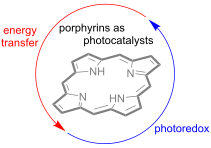
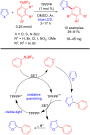
- photoarylation of isopropenyl acetate. The corresponding α-aryl ketone was obtained in 28–53% overall yield depending on the scale. An 8 h experiment was conducted in a continuous steady-state mode, producing the same α-aryl ketone in 48% yield on a 3 gram-scale (Scheme 5B). Photoredox catalysis is not limited
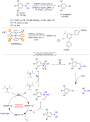
- -methoxyphenyl)porphyrin (CoTMPP) in the dark, furnishing the alkoxycarbonyl intermediate in 92% yield. The combination of this intermediate with a thiophenol derivative and Hantzsch ester (HEH) afforded ethylbenzene in 94% yield (86% overall yield) under both blue and green LED irradiation. The thiophenol and
- rearrangement (Scheme 39) [89]. Further photochemical [2 + 2] cycloaddition and hydrolysis allowed them to obtain rhodonoid A in 30% overall yield. Other similar natural products (rhodonoid B, E and F) were also prepared by the same synthetic strategy. Singlet oxygen has also been efficiently used for






Synthesis of new asparagine-based glycopeptides for future scanning tunneling microscopy investigations
Beilstein J. Org. Chem. 2020, 16, 888–894, doi:10.3762/bjoc.16.80
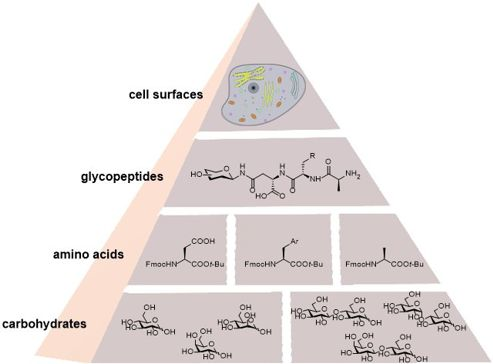
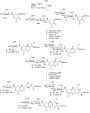
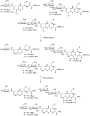
- is well known that Fmoc-protected tryptophane can lead to unwanted side products when the NH group in the indole ring remains unprotected, we decided to refrain from additional protection of the indole moiety because the removal of that protecting group would have reduced the overall yield in the end


Efficient synthesis of piperazinyl amides of 18β-glycyrrhetinic acid
Beilstein J. Org. Chem. 2020, 16, 798–808, doi:10.3762/bjoc.16.73
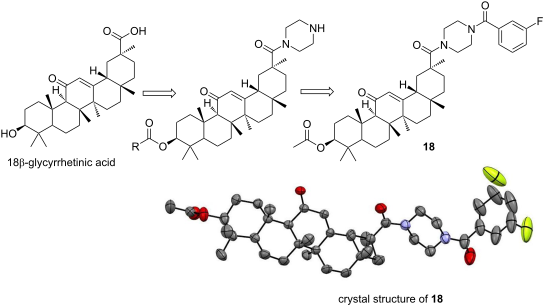
- higher reaction temperature of the solvent mixture contributed to the synthesis of compound 8. To promote the yield of compound 8 and improve the overall yield of the reaction, an optimization of the reaction conditions was performed (Table 2). First, by using low boiling point solvents, only low or no


Towards the total synthesis of chondrochloren A: synthesis of the (Z)-enamide fragment
Beilstein J. Org. Chem. 2020, 16, 670–673, doi:10.3762/bjoc.16.64
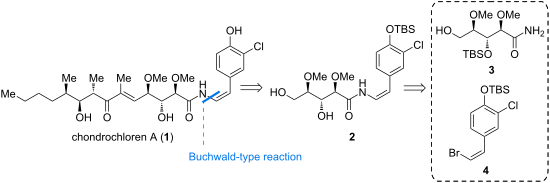
- provided alcohol 11 in an excellent yield which was subjected to aminolysis to provide amide 3 in seven steps and an overall yield of 16% [16][17][18][19][20]. Synthesis of (Z)-bromide 4 For the synthesis of (Z)-bromide 4 we chose a palladium-catalyzed, stereoselective dehalogenation as the key step
- double bonds into the corresponding (Z)-monohalogenated derivatives using palladium(II) acetate, triphenylphosphine and tributyltin hydride. Following this procedure, we were able to obtain (Z)-bromide 4 in four steps and an overall yield of 39% [21][22][23][24]. Cross coupling of fragments 3 and 4 The
- best results for the cross-coupling reaction. Conclusion In summary, we established a (Z)-selective Buchwald-type coupling reaction as a key step in the synthesis of an advanced fragment of chondrochloren A (1). The required amide 3 can be synthesized in seven steps with a 16% overall yield [16][17][18


Design and synthesis of diazine-based panobinostat analogues for HDAC8 inhibition
Beilstein J. Org. Chem. 2020, 16, 628–637, doi:10.3762/bjoc.16.59
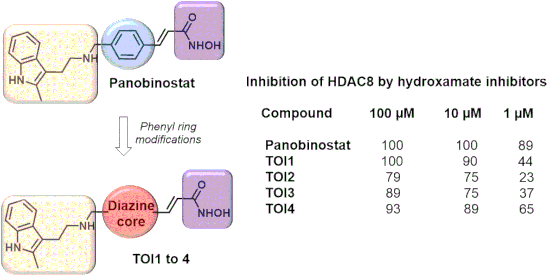
- literature procedure [39]. The intermediate 21 was then subjected to the Suzuki reaction using conditions already developed to provide the ester aldehyde 17 in overall yield of 16% for two steps. Having identified synthetically suitable conditions for compound 17, we scaled up the reaction to complete the




Synthesis of disparlure and monachalure enantiomers from 2,3-butanediacetals
Beilstein J. Org. Chem. 2020, 16, 616–620, doi:10.3762/bjoc.16.57
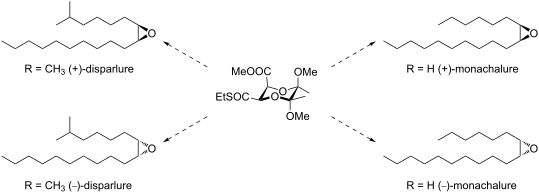
- –8 are obtained. We therefore decided to apply this compound for the synthesis of both enantiomers of disparlure and both enantiomers of monachalure. Results and Discussion Compound 14 was prepared and converted to 15 by Fukuyama reduction as described previously [37]. The overall yield for the


Exploring the scope of DBU-promoted amidations of 7-methoxycarbonylpterin
Beilstein J. Org. Chem. 2020, 16, 509–514, doi:10.3762/bjoc.16.46
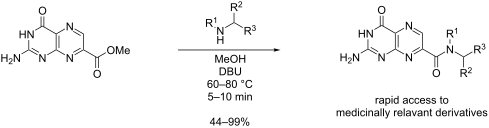
- modifications to the pteridine core which disrupt the hydrogen-bond assembly, such as benzylation of the lactam oxygen or conversion of the exocyclic amine to the pivalic amide [12][13]. The installation and subsequent removal of these groups naturally affects the overall yield and time necessary to generate


Architecture and synthesis of P,N-heterocyclic phosphine ligands
Beilstein J. Org. Chem. 2020, 16, 362–383, doi:10.3762/bjoc.16.35
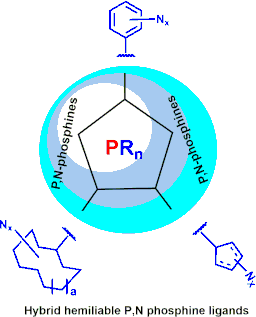
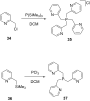
- addition of chlorophosphine resulted in the desired ligand 58. However, the overall yield was lower than the yield obtained through the other method. Imidazole can be regioselectively deprotonated at the more acidic C2 position. The mono- and diphosphine imidazole ligands 62 and 63 were conveniently




Copper-catalyzed enantioselective conjugate addition of organometallic reagents to challenging Michael acceptors
Beilstein J. Org. Chem. 2020, 16, 212–232, doi:10.3762/bjoc.16.24
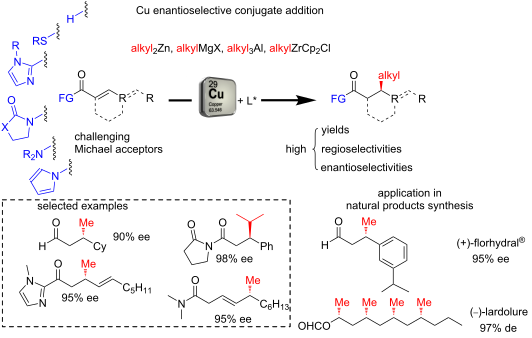
- CuBr∙SMe2/(R,S)-Josiphos (L9). However, the catalytic system was poorly selective toward sterically hindered organomagnesium nucleophiles (15–25% ee). The synthetic versatility of the thioester function was illustrated in the synthesis of (−)-lardolure (26% overall yield over 12 steps) via a relevant




Combination of multicomponent KA2 and Pauson–Khand reactions: short synthesis of spirocyclic pyrrolocyclopentenones
Beilstein J. Org. Chem. 2020, 16, 200–211, doi:10.3762/bjoc.16.23
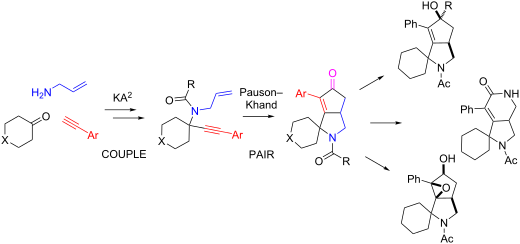
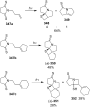
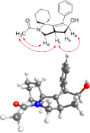
- one-pot, resulting in the generation of the stereochemically dense epoxyalcohol 37 in 68% overall yield. The treatment of compound 5 with EtMgBr as a Grignard reagent in the presence of CeCl3 gave the corresponding tertiary alcohol 38 with similar stereochemical features as of 36 in the formation of




Convenient synthesis of the pentasaccharide repeating unit corresponding to the cell wall O-antigen of Escherichia albertii O4
Beilstein J. Org. Chem. 2020, 16, 106–110, doi:10.3762/bjoc.16.12
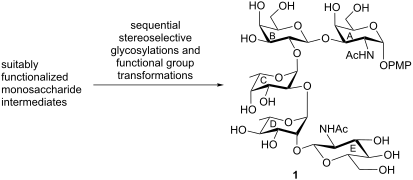
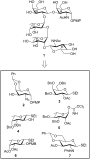
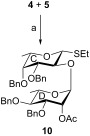
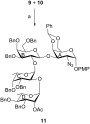
- ) hydrogenolysis of benzyl ethers and benzylidene acetals over Pearlman’s catalyst [36] to furnish the desired pentasaccharide 1 in 49% overall yield (Scheme 4). The structure of compound 1 was unambiguously characterized by its NMR spectral analysis [signals at δ 5.37 (d, J = 2.0 Hz, H-1A), 5.29 (d, J = 3.5 Hz, H



A green, economical synthesis of β-ketonitriles and trifunctionalized building blocks from esters and lactones
Beilstein J. Org. Chem. 2019, 15, 2930–2935, doi:10.3762/bjoc.15.287
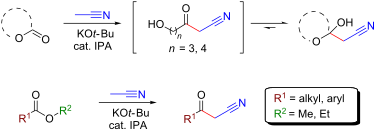
- diols 1 and 8, thereby indicating that the hemiketals are still fully reducible under standard ketone reduction conditions. Purification of 6 afforded only a 10% overall yield of the diol 8, but the direct conversion of crude intermediate product 6 resulted in a doubling of the overall yield of the diol


Chemical tuning of photoswitchable azobenzenes: a photopharmacological case study using nicotinic transmission
Beilstein J. Org. Chem. 2019, 15, 2812–2821, doi:10.3762/bjoc.15.274
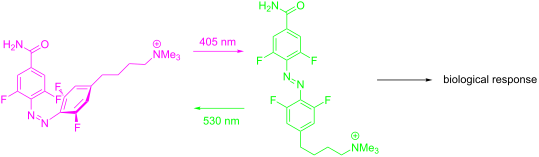
- catalytic hydrogenation to 4 followed by protection with TBDMS to give 5 in 63% yield for three steps. The synthesis of the other half of the photochrome started with bromination of difluorinated aniline to give 6 followed by copper-catalyzed cyanation to 7 in 62% overall yield. Diazonization of 7 with
- % overall yield. Installation of the cationic head was performed in two steps: first bromination of 11 via Appel reaction, followed by treatment with trimethylamine to give 2 in 35% overall yield. Photoswitch 2 is the first example of a bifunctional, asymmetrically substituted 4FAB chromophore that actually
- maleimide using hydroxymethylation with formaldehyde, followed by treatment with thionyl chloride to give a chloromethyl intermediate, which was reacted in situ with maleimide to give 1 in 6% overall yield. Crucially, photochrome 1 also maintained the near-ideal photochemical properties of Hecht’s 4FABs [12




An improved, scalable synthesis of Notum inhibitor LP-922056 using 1-chloro-1,2-benziodoxol-3-one as a superior electrophilic chlorinating agent
Beilstein J. Org. Chem. 2019, 15, 2790–2797, doi:10.3762/bjoc.15.271
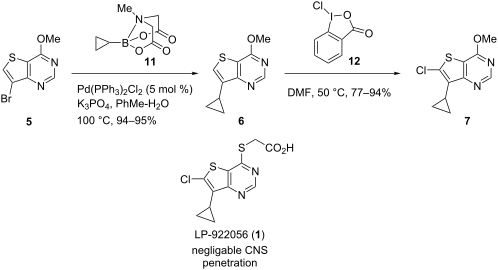
- to just 7 steps from 16 and improves the overall yield to 40–50 %. Mouse pharmacokinetics for 1 Assessment of 1 in mouse liver microsomes (MLM) showed excellent metabolic stability (Cli 1.0 μL/min/mg protein) which predicts for low clearance in vivo. Binding to mouse plasma proteins (mPPB) was very




Safe and highly efficient adaptation of potentially explosive azide chemistry involved in the synthesis of Tamiflu using continuous-flow technology
Beilstein J. Org. Chem. 2019, 15, 2577–2589, doi:10.3762/bjoc.15.251
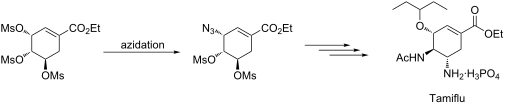
- ][10][11]. However, routes involving azide chemistry proved to be more superior in most instances than azide free alternatives [2][12]. Hayashi’s group developed highly efficient two ‘one-pot’ sequences towards Tamiflu at gram-scale, which proceeded in 10 steps with an outstanding 60% overall yield [1


Synthesis of novel sulfide-based cyclic peptidomimetic analogues to solonamides
Beilstein J. Org. Chem. 2019, 15, 2544–2551, doi:10.3762/bjoc.15.247
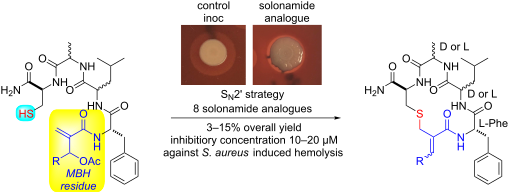
- after preparative HPLC purification and lyophilization. The overall yield for this 11-step synthesis ranged from 7% to 15% for almost all solonamide analogues 9, based on the initial resin’s molarity. The exception relays on those containing ᴅ-Ala and ʟ-Leu amino acid residues sequentially attached to


α,ß-Didehydrosuberoylanilide hydroxamic acid (DDSAHA) as precursor and possible analogue of the anticancer drug SAHA
Beilstein J. Org. Chem. 2019, 15, 2524–2533, doi:10.3762/bjoc.15.245
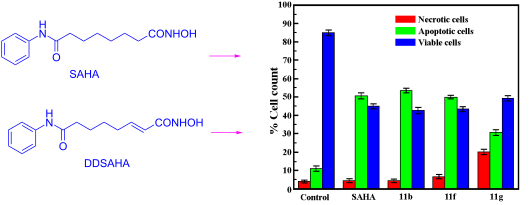
- has occasionally led to a mixture of isomers or even the Z-isomer as the predominant one [22]. Hydrogenation of 10a led to saturation of the double bond as well as concomitant removal of the O-benzyl group leading to SAHA (1) in an acceptable overall yield of 61% over three steps. On the other hand
- approach, cross metathesis of 8 was first done with methyl heptenoate to prepare compound 12 in good yield. This was then hydrolyzed to get the corresponding acid 13. An amide bond formation between this acid and aniline under usual conditions provided DDSAHA derivative 10a in an overall yield of 56% over


Chiral terpene auxiliaries V: Synthesis of new chiral γ-hydroxyphosphine oxides derived from α-pinene
Beilstein J. Org. Chem. 2019, 15, 2493–2499, doi:10.3762/bjoc.15.242

- borane–dimethyl sulfide adduct in THF at 50 ºC. Oxidation of the alkylborane with mCPBA gave the desired alcohol 27 in 51% overall yield. Finally, diastereomeric endocyclic allylic alcohols 16 and 18 were treated with chlorodiphenylphosphine in the presence of DMAP to produce diphenylphosphinites 28 and


Indium-mediated C-allylation of melibiose
Beilstein J. Org. Chem. 2019, 15, 2458–2464, doi:10.3762/bjoc.15.238
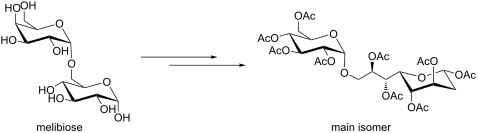
- optimization procedures (Scheme 2). The overall yield of the isolated epimers was 92%. According to Binder et al. [17] and our own experience [18], we expected the syn-product (2-syn) to be the main diastereomer. However, the determination of the configuration is not possible by NMR analysis. Consequently, the
- -acetylation was conducted leading to a mixture of all four species, indicated by NMR analysis (Scheme 3). In the case of 2-syn the β-pyranose species 5-syn-β was obtained as the main product, besides α-pyranose (5-syn-α) as well as both anomers of the furanoid form (Scheme 4). The overall yield obtained over
- three steps was 72% (4 species), from this mixture the main product 5-syn-β was isolated in 58% yield and could be fully characterized by NMR (Supporting Information File 1). In the case of 2-anti the same reaction sequence gave an overall yield of 65%, which is a slightly lower conversion compared to 2


Combining the Ugi-azide multicomponent reaction and rhodium(III)-catalyzed annulation for the synthesis of tetrazole-isoquinolone/pyridone hybrids
Beilstein J. Org. Chem. 2019, 15, 2447–2457, doi:10.3762/bjoc.15.237

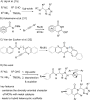
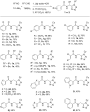
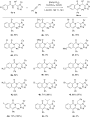
- ), isocyanide (1.1 equiv) and TMSN3 (1.1 equiv) in EtOH at 100 °C (MW radiation, two cycles of 15 min each). Influence of substituents R and R2 on the reaction outcome. For compounds 4k–m the overall yield in parentheses refers to the mixture of regioisomers. Influence of the alkyne and R1 substituent on the




Synthesis of acremines A, B and F and studies on the bisacremines
Beilstein J. Org. Chem. 2019, 15, 2271–2276, doi:10.3762/bjoc.15.219

- both secondary allylic alcohols and afforded 2 in good overall yield (Scheme 3). Bisacremine E (7) was proposed to be formed in nature via [4 + 2] cycloaddition involving two acremine F (5) units [4]. Although dimerization of 5 through a Diels–Alder cycloaddition is not electronically favorable, we


A review of the total syntheses of triptolide
Beilstein J. Org. Chem. 2019, 15, 1984–1995, doi:10.3762/bjoc.15.194
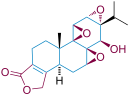
- isomerization of olefin 43, the benzylic oxidation of 8, the use of m-CPBA to introduce the C-9,11 epoxide and the non-stereoselective reduction of the C-14 carbonyl group using sodium borohydride, caused an unacceptable overall yield (1.6%). This pioneering work undoubtedly established the basis for the future
- 18.5% overall yield. Importantly, by late-stage installation of the C-13 isopropyl group, this synthesis also provided a useful approach for the synthesis of other structurally relevant derivatives of triptolide such as C-15 and C-16 modified derivatives of triptolide. In 1980, van Tamelen and co
- the reported procedure finalized the synthesis of triptolide. Overall, the first asymmetric total synthesis of (−)-triptonide (19 steps, 0.06% yield) and formal synthesis of triptolide were realized from ʟ-dehydroabietic acid (26). Although the overall yield of the synthesis is very low, the authors





