Search results
Search for "potassium" in Full Text gives 648 result(s) in Beilstein Journal of Organic Chemistry. Showing first 200.
Design, synthesis and application of carbazole macrocycles in anion sensors
Beilstein J. Org. Chem. 2020, 16, 1901–1914, doi:10.3762/bjoc.16.157
- calibration and pH-sensitivity measurements. Both the control and MC005 sensors were more selective for chloride than for acetate. When these sensors were combined with the reference electrode, which had a 1 M potassium chloride outer filling solution, the chloride interfered and caused drifting




When metal-catalyzed C–H functionalization meets visible-light photocatalysis
Beilstein J. Org. Chem. 2020, 16, 1754–1804, doi:10.3762/bjoc.16.147

- single electron-transfer process (Figure 36). In the first place, a bidentate chelated species is formed by the coordination of 1-naphthylamine derivatives with copper salt. The subsequent oxidation of this intermediate with potassium persulfate produces a Cu(III) species, furnishing a radical cation on


Et3N/DMSO-supported one-pot synthesis of highly fluorescent β-carboline-linked benzothiophenones via sulfur insertion and estimation of the photophysical properties
Beilstein J. Org. Chem. 2020, 16, 1740–1753, doi:10.3762/bjoc.16.146
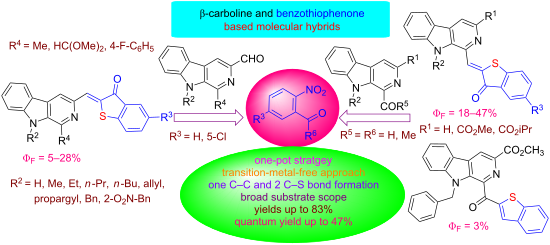
- amine/base with DMSO as an activator. Potassium ethylxanthate [64][65] and sodium sulfide as a sulfur sources in the presence of Et3N in DMSO (Table 1, entries 8 and 9) also did not furnish the desired product 2bA. A decomposition of the product was observed in the case of Na2S. Interestingly, the


Facile synthesis of 7-alkyl-1,2,3,4-tetrahydro-1,8-naphthyridines as arginine mimetics using a Horner–Wadsworth–Emmons-based approach
Beilstein J. Org. Chem. 2020, 16, 1617–1626, doi:10.3762/bjoc.16.134
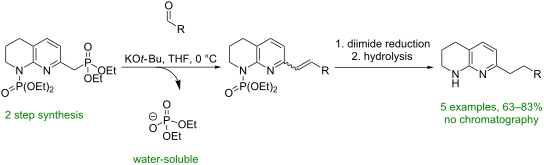
- , exploiting the base stability of the phosphoramidate protecting group. A variety of bases were trialed at 0 °C for the initial N-phosphorylation, with 10 minutes allowed for complete deprotonation to occur (Table 1). Only minimal phosphorylation was observed when using potassium tert-butoxide (Table 1, entry
- (1.5–2.4 equiv) and proceeded in <1 h. Sodium hydride was investigated as a heterogeneous alternative to potassium tert-butoxide, although a lower isolated yield of the final amine was obtained. All amines were formed in high NMR and LC–MS purity without the need for purification by column
- taking place (Scheme 8) [24][25][26]. The autoxidation of phosphonates under THF/potassium tert-butoxide has been reported previously [27]. In order to circumvent racemisation of aldehyde 22 during the Horner–Wadsworth–Emmons olefination, alkylation of phosphoramidate 13 was explored using commercially



Recent synthesis of thietanes
Beilstein J. Org. Chem. 2020, 16, 1357–1410, doi:10.3762/bjoc.16.116
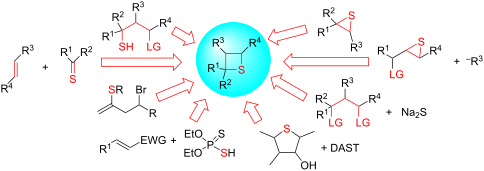
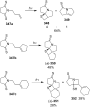
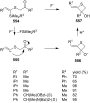
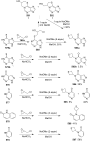
- chloromethylthiirane (epithiochlorohydrin, 398a), with hard and weak nucleophiles [105][106][107][108][109], including phenoxides [105], carboxylates and dicarboxylates [106][107], potassium cyanide, sodium azide, hydroxylamine, trifluoromethanesulfonamide, and pyridine [108]. However, the method could only applied to




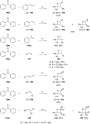
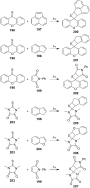


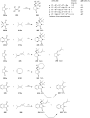
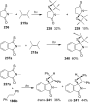








Highly selective Diels–Alder and Heck arylation reactions in a divergent synthesis of isoindolo- and pyrrolo-fused polycyclic indoles from 2-formylpyrrole
Beilstein J. Org. Chem. 2020, 16, 1320–1334, doi:10.3762/bjoc.16.113
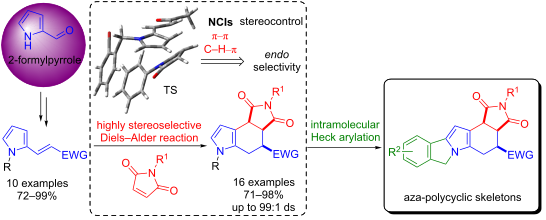
- intramolecular Heck cross-coupling reaction of the octahydroindoles 9/10 to the pentacycles 11, the process was explored with the simple substrates 8c,d and 8g (Scheme 4). Thus, the Pd(0)-catalyzed cyclization of the latter vinylpyrroles with potassium acetate and using acetonitrile or dimethylacetamide (DMA) as
- ). Optimized reaction conditions were established by using 9j as the model substrate and changing the catalyst, base and solvent. Palladium acetate was not efficient for the conversion, even though the base was modified (Table 3, entries 1 and 2). Pd(PPh3)4 was a better catalyst when employing potassium


Synthesis of 3-substituted isoxazolidin-4-ols using hydroboration–oxidation reactions of 4,5-unsubstituted 2,3-dihydroisoxazoles
Beilstein J. Org. Chem. 2020, 16, 1313–1319, doi:10.3762/bjoc.16.112
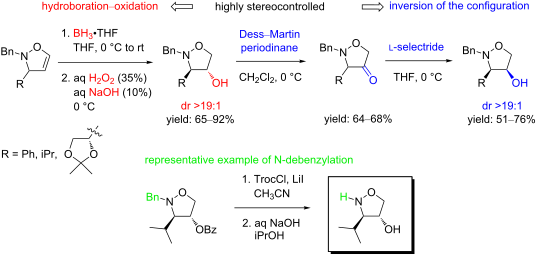
- , respectively, according to our procedure [7][10]. The compounds 5a and 5b were first converted into the isoxazolidine-4,5-diols by the treatment with potassium osmate/N-methylmorpholine N-oxide (NMO). The dihydroxylation reactions proceeded with an excellent trans selectivity with respect to the substituent at


Photocatalytic trifluoromethoxylation of arenes and heteroarenes in continuous-flow
Beilstein J. Org. Chem. 2020, 16, 1305–1312, doi:10.3762/bjoc.16.111
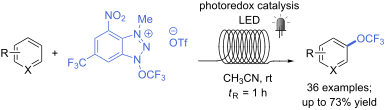
- soluble bases such as amines and tetrabutylammonium salts (Table 2, entries 1–5) proved unfortunately not successful, neither in batch nor flow, so we extended the investigation to inorganic bases. Among the bases tested, potassium hydrogenphosphates K2HPO4 and KH2PO4 led to increased yields, reaching up



Activated carbon as catalyst support: precursors, preparation, modification and characterization
Beilstein J. Org. Chem. 2020, 16, 1188–1202, doi:10.3762/bjoc.16.104
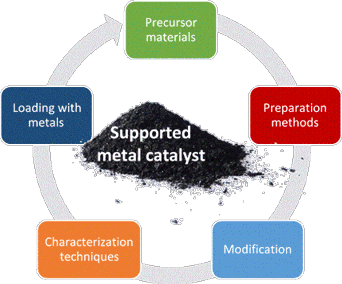
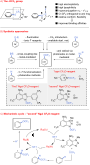
- . investigated the chemical activation with sodium or potassium hydroxide by the use of an anthracite precursor [8][13][14]. Wood Non-fossil precursors for the preparation of activated carbons are of great interest due to an increasing demand of these materials. Wood and the lignocellulosic wastes from forestry
- solutions Xu et al. used energy-rich carbon precursors for the spherical carbon preparation via ultrasonic spray pyrolysis. Lithium, sodium or potassium propiolates are one class of such energy rich materials and exhibit leaving groups such as CO, CO2 or C2H2 eliminated by decarbonylation or decarboxylation
- found that KOH plays a crucial role in the formation of porosity. Metallic potassium is formed during the carbonization of the carbon precursor, which intercalates in the carbon structure and is responsible for further release of carbon dioxide, carbon monoxide and hydrogen [71]. According to Marsh and


Photocatalysis with organic dyes: facile access to reactive intermediates for synthesis
Beilstein J. Org. Chem. 2020, 16, 1163–1187, doi:10.3762/bjoc.16.103
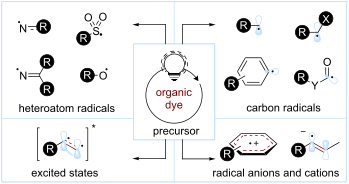
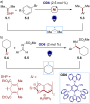
- salt 6.1 was promoted by the acridinium photocatalyst OD2. The resulting alkyl radical can be intercepted by a protonated heteroarene 6.2. The addition of potassium persulfate leads to the regeneration of the photocatalyst and the rearomatization of the intermediate, delivering the desired alkylated





Synthesis of novel multifunctional carbazole-based molecules and their thermal, electrochemical and optical properties
Beilstein J. Org. Chem. 2020, 16, 1066–1074, doi:10.3762/bjoc.16.93
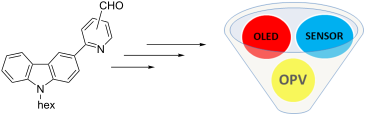
- potassium acetate (KOAc) and dichlorobis(triphenylphosphine)palladium(II) in 1,4-dioxane [36][37]. Upon chromatography (9-hexylcarbazole-3-yl)boronic acid pinacol ester (5) was obtained as a liquid in good yield. (9-Hexylcarbazole-3-yl)boronic acid pinacol ester (5) was subjected to Suzuki–Miyaura reaction
- either with 2-bromopyridine-4-carbaldehyde (6a) or 2-bromopyridine-5-carbaldehyde (6b) in the presence of potassium carbonate and bis(triphenylphosphine)palladium(II) dichloride in tetrahydrofuran [2]. Upon repeated purification by chromatography, compounds 7a and 7b were obtained as liquids in good
- ), 0.86 (t, J = 7.0 Hz, 4H). (9-Hexylcarbazole-3-yl)boronic acid pinacol ester (5): 5 was synthesised as reported previously [36][37]. Bis(pinacolato)diboron (423 mg, 1.7 mmol), potassium acetate (446 mg, 4.5 mmol) and dichlorobis(triphenylphosphine)palladium(II) (35 mg, 0.05 mmol) catalyst were added to


Fluorinated phenylalanines: synthesis and pharmaceutical applications
Beilstein J. Org. Chem. 2020, 16, 1022–1050, doi:10.3762/bjoc.16.91
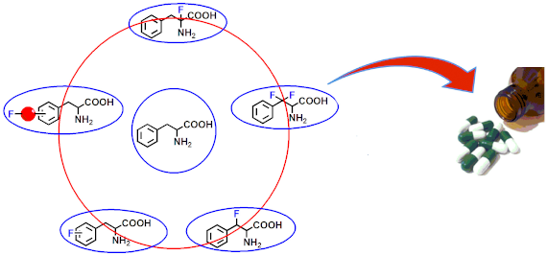
- the free amines gave amides 28a,b. Treatment of the latter with aqueous potassium hydroxide finally afforded (S)-2-amino-3-(2,3,4,5-tetrafluorophenyl)propionic acid (29a) and (S)-2-amino-3-(2,3,5,6-tetrafluorophenyl)propionic acid (29b) [42] (Scheme 6). Alternatively, phenylalanines 29a,b were also


Suzuki–Miyaura cross coupling is not an informative reaction to demonstrate the performance of new solvents
Beilstein J. Org. Chem. 2020, 16, 1001–1005, doi:10.3762/bjoc.16.89
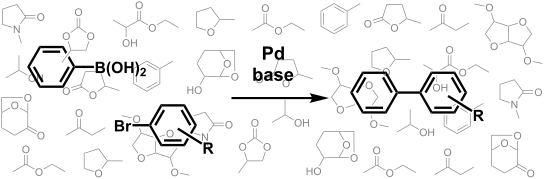
- 1b) [13]. Here, palladium acetate without an auxiliary ligand was used for a pre-catalyst and the base changed to potassium carbonate. Reaction conditions of 20 hours at 65 °C were decided after observing 11% conversion after 2 hours and 33% after 20 hours in NMP at room temperature. The majority of
- ™, GVL, and 2-MeTHF were poor solvents. Replacing potassium carbonate with triethylamine, the conversion in Cyrene™ rose slightly to 10%. Despite the variation between experiments no discernible correlation between any solvent properties and the observed conversions was found. The results achieved in DMI


Aryl-substituted acridanes as hosts for TADF-based OLEDs
Beilstein J. Org. Chem. 2020, 16, 989–1000, doi:10.3762/bjoc.16.88
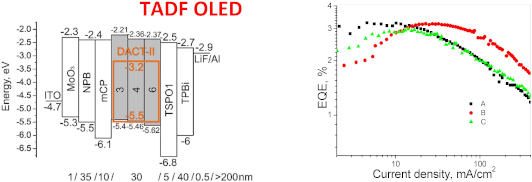
- bromide (0.06 g, 0.1 mmol) and potassium hydroxide (0.31 g, 5.7 mmol) were added and the mixture stirred for 30 min. Then, bromoethane (0.31 g, 2.85 mmol) was added dropwise to the reaction mixture with constant stirring and the mixture refluxed for 1 h. The reaction mixture was then poured into ice water


Bipyrrole boomerangs via Pd-mediated tandem cyclization–oxygenation. Controlling reaction selectivity and electronic properties
Beilstein J. Org. Chem. 2020, 16, 895–903, doi:10.3762/bjoc.16.81
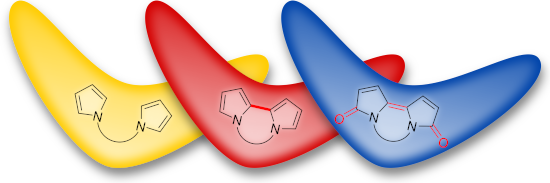
- of NDAnH and NMInH carried out in the presence of 6 equiv of potassium acetate produced the corresponding dilactams in higher yields (53–73%) with complete conversion (Table 1, entries 2, 7, 12, and 18). Under these conditions, the cNMI2H and cNMI3H intermediates were not isolated. When the same


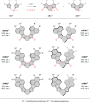


Photocatalytic deaminative benzylation and alkylation of tetrahydroisoquinolines with N-alkylpyrydinium salts
Beilstein J. Org. Chem. 2020, 16, 809–817, doi:10.3762/bjoc.16.74
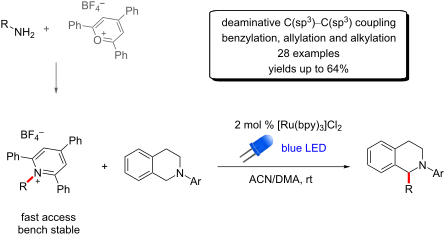
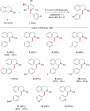
- ). Eosin Y was inefficient under these conditions (Table 1, entry 20). Since [Ru(bpy)3]Cl2 is significantly cheaper than the iridium catalyst, the former was used in further reactions. Regarding the addition of different bases, the yield remained unchanged, when lutidine was added. Potassium carbonate and




Reaction of indoles with aromatic fluoromethyl ketones: an efficient synthesis of trifluoromethyl(indolyl)phenylmethanols using K2CO3/n-Bu4PBr in water
Beilstein J. Org. Chem. 2020, 16, 778–790, doi:10.3762/bjoc.16.71
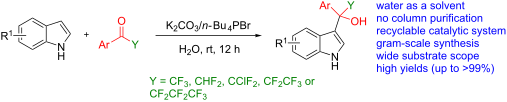
- of potassium carbonate and tetrabutylphophonium bromide, which mediate the reaction in water through the formation of the interface between organic and aqueous phases. The advantageous of this reaction include high yields, no column chromatography, broad substrate scope, multiscale synthesis, and


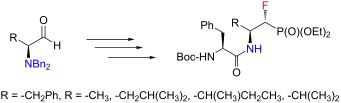
Efficient synthesis of dipeptide analogues of α-fluorinated β-aminophosphonates
Beilstein J. Org. Chem. 2020, 16, 756–762, doi:10.3762/bjoc.16.69
- developing systems, and products were detected by inspection under UV light (254 nm) and with a solution of potassium permanganate. Merck Kieselgel 60 (0.063–0.200 μm), Merck Kieselgel 60 (0.040–0.063 μm), and Merck Kieselgel 60 (0.015–0.004 μm), were used for column chromatography. X-ray diffraction data


Recent advances in Cu-catalyzed C(sp3)–Si and C(sp3)–B bond formation
Beilstein J. Org. Chem. 2020, 16, 691–737, doi:10.3762/bjoc.16.67
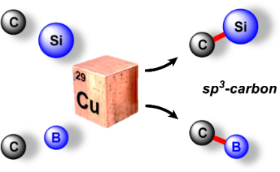
- ) as atom-economical boron sources leading to the desired products 432–435 in moderate to good ees (Scheme 69) [132]. In addition, the reaction of potassium N-(4-methoxyphenyl)-3-(trifluoroborato)butanamide (436) as the nucleophilic coupling partner was investigated with heteroarylchlorides 437 leading


Synthesis of organic liquid crystals containing selectively fluorinated cyclopropanes
Beilstein J. Org. Chem. 2020, 16, 674–680, doi:10.3762/bjoc.16.65
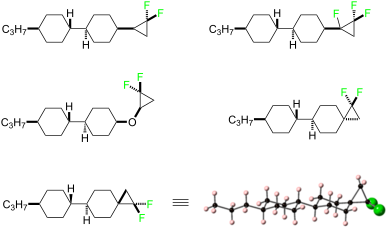
- to generate 13a and 13b as a mixture of regioisomers in a ratio of 4:1. There was no requirement to separate these isomers at this stage. Subsequent addition of potassium tert-butoxide into a mixture of 13a and 13b in dichloromethane (DCM) resulted in an efficient elimination to generate vinyl


Towards the total synthesis of chondrochloren A: synthesis of the (Z)-enamide fragment
Beilstein J. Org. Chem. 2020, 16, 670–673, doi:10.3762/bjoc.16.64
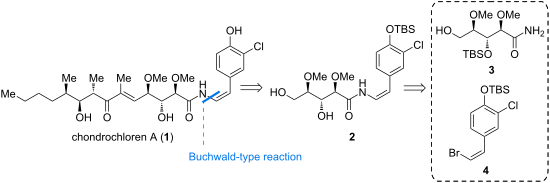
- choice in this type of coupling reaction. Potassium carbonate was chosen due to the sensitivity of the amide 3 towards harsh basic conditions. With these conditions we were able to couple (Z)-bromide 4 with amide 3 selectively to yield (Z)-enamide 16. The obtained double bond geometry was confirmed by
- the indicative NMR coupling constants of 9.6 Hz. Moreover, we observed a concentration dependent formation of the undesired desilylated (Z)-enamide 17 (Table 1). The best results were achieved using a 65 mM solution of the amide 3. Using dry potassium carbonate, purified copper(I) iodide provided the


Regio- and stereoselective synthesis of new ensembles of diversely functionalized 1,3-thiaselenol-2-ylmethyl selenides by a double rearrangement reaction
Beilstein J. Org. Chem. 2020, 16, 515–523, doi:10.3762/bjoc.16.47
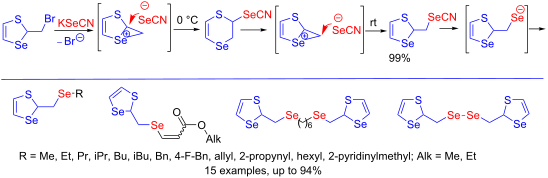
- potassium selenocyanate proceeded via a rearrangement with ring expansion, leading to a six-membered 2,3-dihydro-1,4-thiaselenin-2-yl selenocyanate (kinetic product) which in turn underwent rearrangement with ring contraction to a 1,3-thiaselenol-2-ylmethyl selenocyanate (thermodynamic product). These
- 1 with potassium selenocyanate was studied in detail. We found that the reaction of thiaselenole 1 with KSeCN at room temperature afforded a five-membered heterocycle, selenocyanate 4, in a quantitative yield. This result was unusual since previously studied substitution reactions of thiaselenole 1
- potassium selenocyanate led to the six-membered thiaselenine 5 (kinetic product), which underwent a rearrangement to a five-membered thiaselenole selenocyanate 4 (thermodynamic product). These rearrangements proceeded by a nucleophilic attack of the selenocyanate anion on two different carbon atoms of the


KOt-Bu-promoted selective ring-opening N-alkylation of 2-oxazolines to access 2-aminoethyl acetates and N-substituted thiazolidinones
Beilstein J. Org. Chem. 2020, 16, 492–501, doi:10.3762/bjoc.16.44
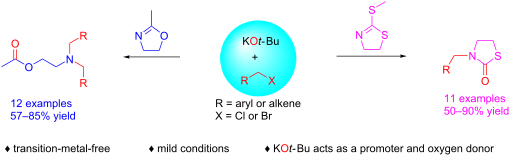
- important role to promote this ring-opening N-alkylation, but also acts as an oxygen donor. Keywords: N-alkylation; oxazolines; potassium tert-butoxide; ring opening; thiazolidinones; Introduction 2-Oxazolines are important structural units in pharmaceutical applications and efficient ligands in
- to synthesize thiazolidinone derivatives through a Barton–McCombie pathway in 2015 [17] (Scheme 1b). Recently, potassium tert-butoxide has been shown to be an efficient promoter for C–C-bond formation reactions [18][19][20][21][22]. However, only few reports described C–N-bond cross-coupling
- reactions using potassium tert-butoxide as promoter. Wu developed an efficient protocol for the KOt-Bu-promoted synthesis of 1-aminoisoquinolines from 2-methylbenzonitriles and benzonitriles [23], and the carbonylative cyclization of propargylic amines with selenium under CO gas-free conditions [24]. Based


Synthesis of 4-amino-5-fluoropyrimidines and 5-amino-4-fluoropyrazoles from a β-fluoroenolate salt
Beilstein J. Org. Chem. 2020, 16, 445–450, doi:10.3762/bjoc.16.41
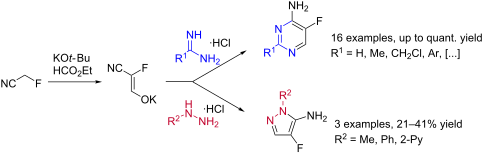
- potassium 2-cyano-2-fluoroethenolate was developed. A broad substrate scope was tested and mostly excellent yields were obtained. The synthesis of fluorinated aminopyrazoles from the same fluorinated precursor could be demonstrated but proceeded with lower efficiency. Keywords: cyclization; fluorinated
- fluorinated C3 building block recently described and used by our laboratory for the synthesis of 2 [36]. Herein, we present the synthesis of fluorinated pyrimidines and pyrazoles from the same precursor. Potassium (Z)-2-cyano-2-fluoroethenolate (8) was synthesized in three steps starting from chloroacetamide
- ) of potassium formate, which could not easily be removed without risking the decomposition of the enolate salt (Scheme 1). As the fluorine atom is part of a building block, harsh conditions for a late-stage fluorination can be avoided, and even products with sensitive functionalities are accessible


Architecture and synthesis of P,N-heterocyclic phosphine ligands
Beilstein J. Org. Chem. 2020, 16, 362–383, doi:10.3762/bjoc.16.35
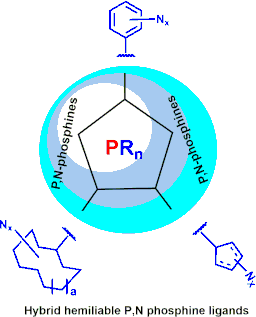
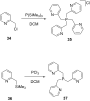
- the red phosphorus with 2-bromopyridine in potassium hydroxide/dimethyl sulfoxide emulsion, pyridylphosphine was obtained in moderate yields. Traces of phosphine oxide were present as evidenced by the observation of two phosphorus peaks in the 15P NMR spectrum. An optimized method via Grignard
- chiral acetal ligands have been reported by Lyle et al. where the fluorine–metal exchange was achieved by treatment with potassium tert-butoxide for a relatively long period (24 h) (Scheme 4) [65]. Acid-catalyzed condensation of compound 20 with enantiomerically pure C2-symmetric 1,2-tosylate analogs 21
- phosphorylation with diphenylphosphine in the presence of potassium tert-butoxide and 18-crown-6. The use of silyl and dialkylamine as reagents Organosilyl, silylphosphine derivatives, along with dialkylamines can also be used as alternative substrates to halogen-based reagents. These compounds are more stable