


Search results
Search for "dihydroxylation" in Full Text gives 113 result(s) in Beilstein Journal of Organic Chemistry.
Synthetic strategies of phosphonodepsipeptides
Beilstein J. Org. Chem. 2021, 17, 461–484, doi:10.3762/bjoc.17.41
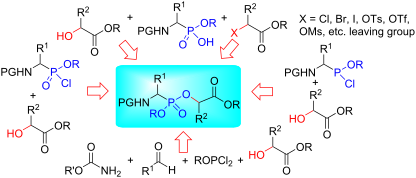
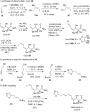
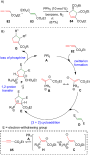
- shown in Scheme 11. First, dibenzyl allylphosphonate (65) was converted to benzyl allylphosphonochloridate (66), which was then coupled with benzyl 2-azido-3-hydroxy-2-methylpropanoate (67) producing benzyl [allyl(benzyloxy)phosphoryl)oxy]propanoate (68). After the dihydroxylation with osmium tetroxide


Regioselective chemoenzymatic syntheses of ferulate conjugates as chromogenic substrates for feruloyl esterases
Beilstein J. Org. Chem. 2021, 17, 325–333, doi:10.3762/bjoc.17.30
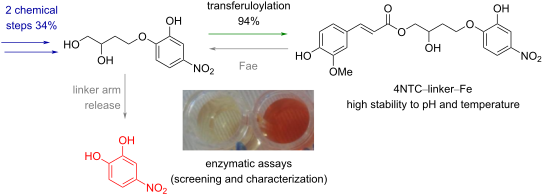
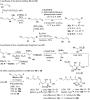
- tetroxide-mediated dihydroxylation in the presence of N-methylmorpholine N-oxide (NMMO) afforded 11 in 90% yield. Finally, the regioselective transferuloylation of the primary hydroxy group of the triol derivative 11 with Lipozyme® TL IM was performed, and the expected chromogenic substrate 12 was isolated


Diels–Alder reaction of β-fluoro-β-nitrostyrenes with cyclic dienes
Beilstein J. Org. Chem. 2021, 17, 283–292, doi:10.3762/bjoc.17.27

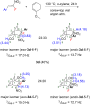
- straightforward way to numerous fluorine-containing bicyclic compounds not previously available. The syn-dihydroxylation of compound 2f with the N-methylmorpholine-N-oxide (NMO)–OsO4 system resulted in a mixture of the corresponding diols 5 in a 36:64 ratio in 65% yield. Again, exo-dihydroxylation is to be



Progress in the total synthesis of inthomycins
Beilstein J. Org. Chem. 2021, 17, 58–82, doi:10.3762/bjoc.17.7
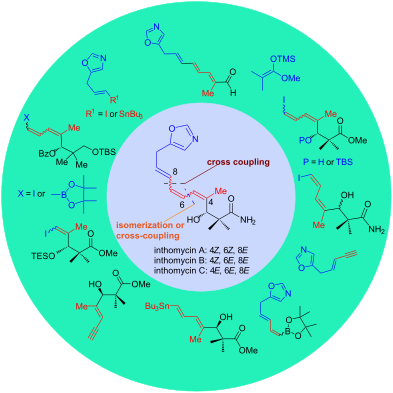
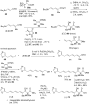
- transformed into (−)-101 using a three-step sequence. Upon iodination of (−)-101 produced iodide (+)-102 in excellent yield. Deiodination of (+)-102 followed by regioselective dihydroxylation with Sharpless’ AD mix-β reagent [64][65] provided diol (−)-103 as a mixture of stereoisomers. Significantly, the diol









Recent progress in the synthesis of homotropane alkaloids adaline, euphococcinine and N-methyleuphococcinine
Beilstein J. Org. Chem. 2021, 17, 28–41, doi:10.3762/bjoc.17.4
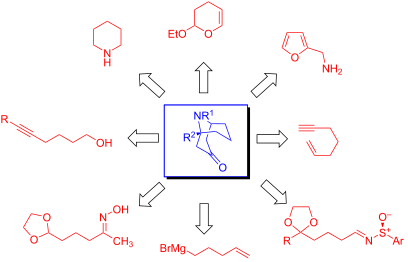
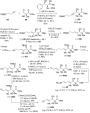
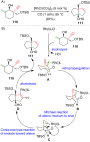
- second generation Grubbs catalyst 57 in 99% yield. The azabicyclic system (+)-51 underwent dihydroxylation with the OsO4-NMO system to form diol (+)-52 as the only product in 97% yield. Diol (+)-52 was regioselectively protected in the presence of tert-butyldimethylsilane triflate, and triethylamine


All-carbon [3 + 2] cycloaddition in natural product synthesis
Beilstein J. Org. Chem. 2020, 16, 3015–3031, doi:10.3762/bjoc.16.251
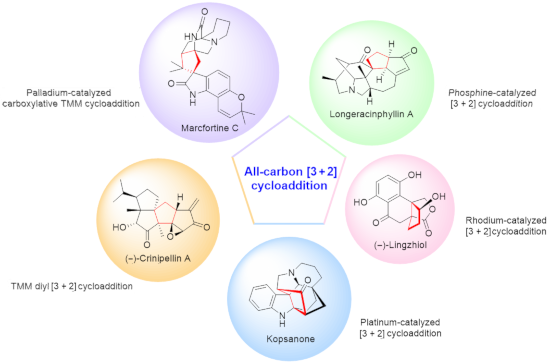
- tetracyclic compound 56. Dihydroxylation of freshly prepared 56 with OsO4 and then selective tosylation afforded 57 in 39% yield over two steps. Exposure of 57 to DBU upon heating gave the elimination product 58, which was subjected to an oxidative rearrangement with PDC to give enone 59 in 68% yield. Copper
- produce 135 and 136 in 85% yield in the ratio of 1:1.16. A six-step synthesis from the major product 136 gave lactone 137. This compond was subjected to successive desilylation, OsO4-mediated dihydroxylation and subsequent oxidative cleavage of the C=C double bond with Pb(OAc)4 to give ketoaldehyde 138 in







Vicinal difluorination as a C=C surrogate: an analog of piperine with enhanced solubility, photostability, and acetylcholinesterase inhibitory activity
Beilstein J. Org. Chem. 2020, 16, 2663–2670, doi:10.3762/bjoc.16.216
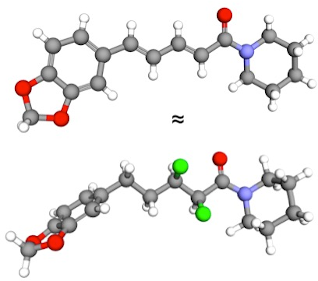
- ] was protected as the benzyl ether then subjected to a Sharpless asymmetric dihydroxylation reaction to furnish the diol 8 in modest yield. The diol 8 was then converted into the cyclic sulfate 9, which was ring-opened using TBAF to furnish the fluorohydrin 10. A Mosher ester analysis of the
- fluorohydrin 10 suggested that the earlier dihydroxylation reaction had proceeded with 90% ee. The deoxyfluorination of 10 was then attempted using several reagents including DeoxoFluor, DeoxoFluor in combination with TMS-morpholine [29], and PyFluor [30]. The optimal yield of the threo-difluoroalkane 11 was
- moiety throughout (Scheme 3). Thus, the α,β-unsaturated ester 15 [25] was carried through a similar sequence to that previously described, i.e., dihydroxylation, cyclic sulfate formation, ring-opening with TBAF (although note the regioselectivity [31]), deoxyfluorination, and deprotection to deliver the


Synthesis of 3-substituted isoxazolidin-4-ols using hydroboration–oxidation reactions of 4,5-unsubstituted 2,3-dihydroisoxazoles
Beilstein J. Org. Chem. 2020, 16, 1313–1319, doi:10.3762/bjoc.16.112
- isoxazolidines by means of dihydroxylation [9][10] and epoxidation [11][12] reactions. Regarding the stereochemistry, almost all of the realized additions proceed with an excellent trans stereoselectivity relative to the substituent at C-3, giving isoxazolidine-4,5-diols and isoxazolidinyl epoxides with a C-3/4
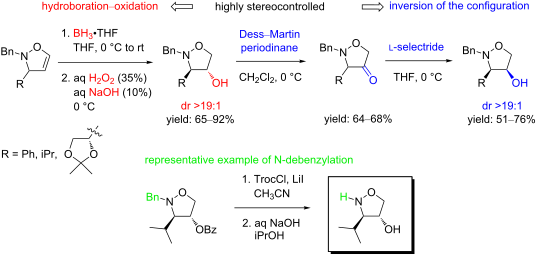
- , respectively, according to our procedure [7][10]. The compounds 5a and 5b were first converted into the isoxazolidine-4,5-diols by the treatment with potassium osmate/N-methylmorpholine N-oxide (NMO). The dihydroxylation reactions proceeded with an excellent trans selectivity with respect to the substituent at
- stereochemical results are consistent with our previous findings on the direct dihydroxylation and epoxidation reactions of 4,5-unsubstituted 2,3-dihydroisoxazoles [9][10][11][12]. To invert the relative C-3/4-trans stereochemistry, the isoxazolidin-4-ols 5a–c were first oxidized to the corresponding ketones


Combining enyne metathesis with long-established organic transformations: a powerful strategy for the sustainable synthesis of bioactive molecules
Beilstein J. Org. Chem. 2020, 16, 738–755, doi:10.3762/bjoc.16.68
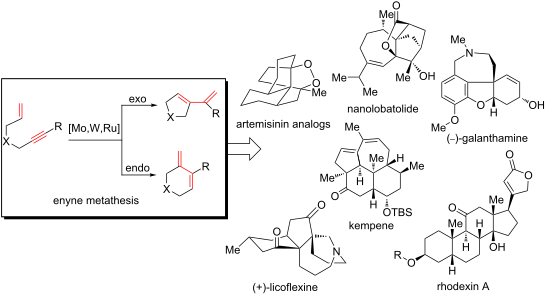
- , an intramolecular Ru-catalyzed alkene-alkyne (Ru-AA) coupling and a late-stage epoxidation were readily accomplished, while the installation of the α,α′-dihydroxy ketone through a dihydroxylation proved difficult. Noteworthy, the structural elucidation of the THP ring of des-epoxy-amphidinolide N




Synthesis of disparlure and monachalure enantiomers from 2,3-butanediacetals
Beilstein J. Org. Chem. 2020, 16, 616–620, doi:10.3762/bjoc.16.57
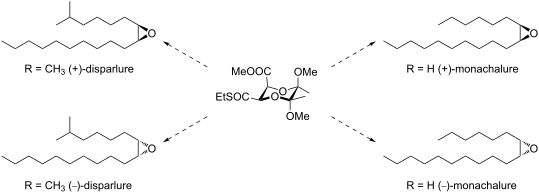
- enantioselective reactions, such as the Sharpless epoxidation [19][20][21][22][23][24], asymmetric dihydroxylation [25][26], chloroallyloboronation [27], or iodolactonization [28]. Most recently a method using the asymmetric chlorination of dodecanal by LiCl in the presence of a chiral imidazolidinone catalyst has


A review of asymmetric synthetic organic electrochemistry and electrocatalysis: concepts, applications, recent developments and future directions
Beilstein J. Org. Chem. 2019, 15, 2710–2746, doi:10.3762/bjoc.15.264
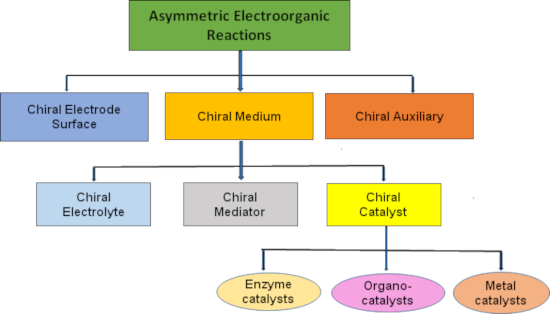
- improvements of these methods have recently been achieved by Moeller et al. who designed a photovoltaic apparatus for the efficient Sharpless dihydroxylation of styrene in up to 94% enantiomeric excess [65]. Tanaka and co-workers explored the catalytic applicability of optically active Mn-salen complex 72






Synthesis of acremines A, B and F and studies on the bisacremines
Beilstein J. Org. Chem. 2019, 15, 2271–2276, doi:10.3762/bjoc.15.219

- isolated from fungi of the genus Acremonium. Here, we present the asymmetric total synthesis of acremine F which hinges on a modestly enantioselective dihydroxylation and a subsequent kinetic resolution via a highly selective asymmetric reduction. Chemoselective oxidation of acremine F gave access to
- traced back to silyl enol ether 10. Ent-10 was first reported by Herzon and co-workers [9] and is derived from phenol silyl ether 11 via Birch reduction and dihydroxylation. Results and Discussion Our synthesis started with meta-cresol (12) which was protected as a TIPS ether and then subjected to Birch
- reduction conditions to afford cyclohexa-1,4-diene 13 [9]. Enantioselective Sharpless dihydroxylation proceeded in good chemoselectivity but with modest yield and optical purity (25% ee). Unfortunately, all attempts to improve the enantioselectivity of this reaction failed. We discovered, however, that at a


Bipolenins K–N: New sesquiterpenoids from the fungal plant pathogen Bipolaris sorokiniana
Beilstein J. Org. Chem. 2019, 15, 2020–2028, doi:10.3762/bjoc.15.198
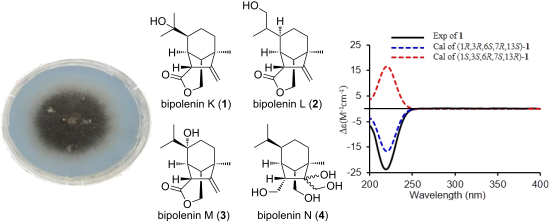
- with reduction of the lactone ring to the dialcohol and dihydroxylation of the Δ2,12 double bond. Detailed analysis of the 2D NMR data for 4 (Figure 2) confirmed the seco-sativene-type scaffold. The relative configurations at C-1, C-3, C-6, C-7 and C-13 were determined to be the same as those of 1–3


A review of the total syntheses of triptolide
Beilstein J. Org. Chem. 2019, 15, 1984–1995, doi:10.3762/bjoc.15.194
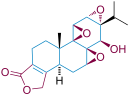
- include the regioselective dihydroxylation and etherification to introduce the C-14 hydroxy group and the construction of the butenolide moiety. Particularly, the characteristics of Li’s route are low cost, high yield (9 steps, 44% yield) and easy handling (all intermediates could be scaled up to 100


N-(1-Phenylethyl)aziridine-2-carboxylate esters in the synthesis of biologically relevant compounds
Beilstein J. Org. Chem. 2019, 15, 1722–1757, doi:10.3762/bjoc.15.168

- secured in the starting aldehyde introduction of the two others required cis-dihydroxylation of the Z-alkene 111. The highest diastereoselectivity (99:1) was observed at −10 °C providing the aziridine diol (2S,1'S,2'R,1''R)-112 as a major diastereoisomer. The regioselective aziridine ring opening combined
- (Scheme 37) [32]. The major product (2S,1'R)-69b was subjected to Sharpless asymmetric dihydroxylation in the presence of AD-mix-α to give the diol 145a as a major (10:1) diastereoisomer. The ester moiety in 145a was reduced and hydroxy groups were protected to give the tribenzyloxy aziridine (2R,1'S,2'S
- phosphatase 1 and 2A inhibitors [93]. An interesting structural feature of calyculins is a C33–C37 fragment γ-amino acid (2S,3S,4S)-159. Its stereocontrolled synthesis involved cis-dihydroxylation of the aziridine cis-acrylate (2R,1'R)-156a which led to the formation of a 91:9 mixture of diastereoisomeric


The LANCA three-component reaction to highly substituted β-ketoenamides – versatile intermediates for the synthesis of functionalized pyridine, pyrimidine, oxazole and quinoxaline derivatives
Beilstein J. Org. Chem. 2019, 15, 655–678, doi:10.3762/bjoc.15.61
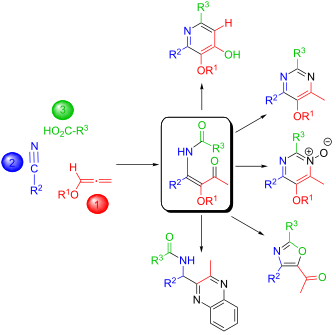
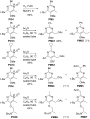
- . The easily introduced C-2 alkenyl groups may also be oxidized. Thus, dihydroxylation of the vinyl group in PM7 followed by oxidative cleavage afforded pyrimidine derivative PM50 having a formyl group at C-2 (Scheme 12) [31]. Next, the conversion of the 5-alkoxy groups of the pyrimidine derivatives PM




A chemoenzymatic synthesis of ceramide trafficking inhibitor HPA-12
Beilstein J. Org. Chem. 2019, 15, 490–496, doi:10.3762/bjoc.15.42
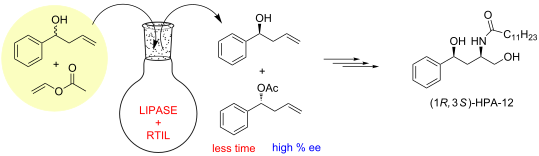
- synthesis of the title compound has been developed using an efficient and highly enantioselective lipase-catalyzed acylation in a hydrophobic ionic liquid, [bmim][PF6], followed by a diastereoselective asymmetric dihydroxylation as the key steps for incorporating the stereogenic centers. The further
- (S)-4 with benzyl bromide (BnBr) and Bu4NI in the presence of NaH produced compound 6 (Scheme 2). This was subjected to asymmetric dihydroxylation (ADH) using AD mix-β [K2OsO2(OH)4 and (DHQD)2-PHAL]. The reaction proceeded predominantly from the α-face, resulting in the formation of the 1,3-anti diol


Synthesis of nonracemic hydroxyglutamic acids
Beilstein J. Org. Chem. 2019, 15, 236–255, doi:10.3762/bjoc.15.22
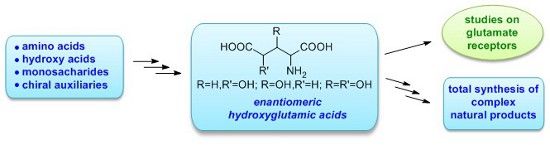
- acid [(2S,3S,4R)-4] was obtained as the hydrochloride. To avoid racemization at Cα in sensitive amino acids the carboxy group was frequently masked as an orthoester. To illustrate this strategy dihydroxylation of the orthoester 92 (derived from L-pyroglutamic acid [97]) was performed to afford a single
- ). Dihydroxylation of the C=C bond gave a 10:1 mixture with (2S,3S,4R)-121 as a major product which was transformed into the isopropylidene derivative (2S,3S,4R)-122 to facilitate purification. Hydrogenolysis allowed to remove the N- and O-protecting groups and was followed by the spontaneous cyclization to a
- pyrrolidine-2-one (3S,4S,5R)-123 [111]. Oxidation of the hydroxymethyl group and acid hydrolysis gave (2S,3S,4S)-4 [112]. By enantioselective conjugate addition and asymmetric dihydroxylation An orthogonally protected 3,4-dihydroxy-L-glutamic acid was envisioned as an intermediate in the projected synthesis


Systematic synthetic study of four diastereomerically distinct limonene-1,2-diols and their corresponding cyclic carbonates
Beilstein J. Org. Chem. 2019, 15, 130–136, doi:10.3762/bjoc.15.13
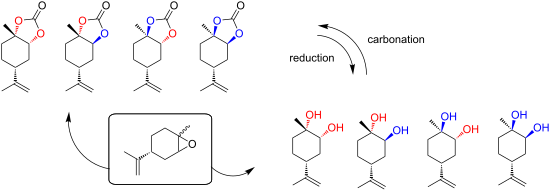
- . Dihydroxylation of (a) (R)-limonene and (b) (R)-dihydrolimonene. Reduction of LM5CC (1a) and carbonation of LMdiol (2a). Overall synthetic routes to LM5CCs and LMdiols. The 93% value (standing for *) from 1d to 2d was cited from ref [27]. Reagents and conditions: (a) 5 MPa CO2, 10 mol % TBAC, 100 °C, 72 h; (b


Synthesis of pyrrolidine-based hamamelitannin analogues as quorum sensing inhibitors in Staphylococcus aureus
Beilstein J. Org. Chem. 2018, 14, 2822–2828, doi:10.3762/bjoc.14.260
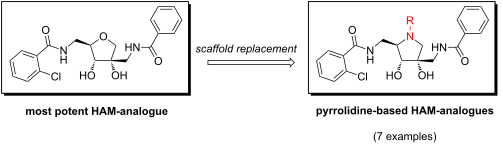
- ’-homoazanucleosides. This possible precursor was synthesized convergently in 12 steps [20]. The pyrrolidine ring was constructed via alkylation of 6 and 7, followed by ring-closing metathesis. Stereoselective dihydroxylation of the resulting alkene then furnished the protected iminosugar 5. However, using
- -closing metathesis of 24 now smoothly afforded 25 in high yield. Dihydroxylation selectively yielded the desired stereoisomer of diol 26, which was subsequently protected as isopropylidene acetal. In the next step, after removal of the TBS group and mesylation, attempted substitution with NaN3 resulted


A stereoselective and flexible synthesis to access both enantiomers of N-acetylgalactosamine and peracetylated N-acetylidosamine
Beilstein J. Org. Chem. 2018, 14, 856–860, doi:10.3762/bjoc.14.71
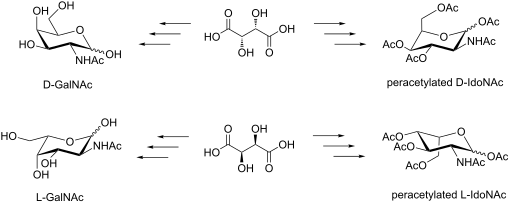
- )- or (S)-2,3-isopropylideneglyceraldehyde with a second chiral building block containing the amine function, followed by dihydroxylation [13][14]. Despite the compounds already available through these and other approaches, novel synthetic concepts to fill the remaining methodological gaps for accessing


Acid-catalyzed ring-opening reactions of a cyclopropanated 3-aza-2-oxabicyclo[2.2.1]hept-5-ene with alcohols
Beilstein J. Org. Chem. 2017, 13, 2888–2894, doi:10.3762/bjoc.13.281
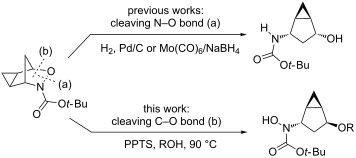
- includes the reduction to form alkane 8 [3], oxidative cleavage of the C=C bond to form 9 [4], ring-opening metathesis to form functionalized alkenes 10 and 11 [4], dihydroxylation to form diol 12 [5], ruthenium-catalyzed [2 + 2] cycloaddition with unsymmetrical alkynes to form regioisomers 13 and 14 [6


The use of 4,4,4-trifluorothreonine to stabilize extended peptide structures and mimic β-strands
Beilstein J. Org. Chem. 2017, 13, 2842–2853, doi:10.3762/bjoc.13.276
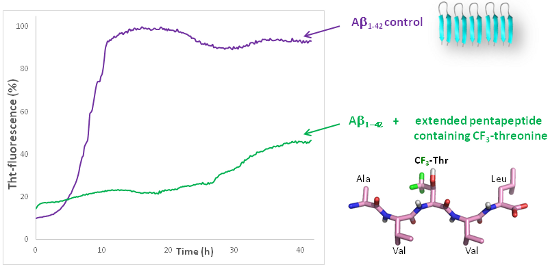
- ] from propargylic alcohol in ten steps, based on the trifluoromethylation key step of 1-(((E)-3-bromoallyloxy)methyl)benzene to obtain (E)-1-benzyloxy-4,4,4-trifluoro-2-butene. The sequence then involved Sharpless asymmetric dihydroxylation, nucleophilic opening of cyclic sulfate with NaN3, palladium




Fluorination of some highly functionalized cycloalkanes: chemoselectivity and substrate dependence
Beilstein J. Org. Chem. 2017, 13, 2364–2371, doi:10.3762/bjoc.13.233
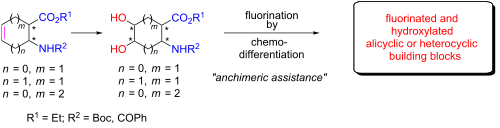
- our synthetic investigations by selecting some cyclohexane β-amino acid esters as model compounds. Thus, diol (±)-8 [23][24][25][26] derived from dihydroxylation of cis-2-aminocyclohex-4-ene carboxylic acid was treated with 1 equiv of Deoxofluor in CH2Cl2. Again, through chemodiscrimination of the


Synthesis of ergostane-type brassinosteroids with modifications in ring A
Beilstein J. Org. Chem. 2017, 13, 2326–2331, doi:10.3762/bjoc.13.229
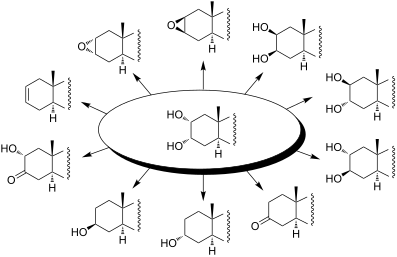
- the epimerization of the hydroxy group at C-2/C-3 is the inactivation process contributing to a constant level of the active phytohormone. 2β,3β-Diols 6 are available through Woodward–Prévost cis-dihydroxylation of Δ2-steroids 3 [21]. The diaxial diols 7 can be easily synthesized by an acid-catalyzed





