


Search results
Search for "enone" in Full Text gives 182 result(s) in Beilstein Journal of Organic Chemistry.
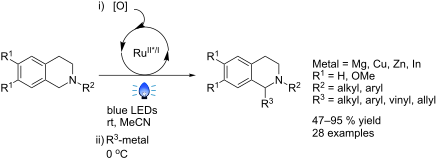
One-pot functionalisation of N-substituted tetrahydroisoquinolines by photooxidation and tunable organometallic trapping of iminium intermediates
Beilstein J. Org. Chem. 2014, 10, 2981–2988, doi:10.3762/bjoc.10.316
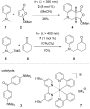
- allylzinc reagent and no reaction was observed. When the allylzinc reagent was premixed (1:1) with MeCN before adding to 5a, 6aj was not observed. Instead, enone 8a was observed as the sole product. Conversely, when the allylzinc reagent was added to 5a, suspended in anhydrous THF, 8a was not observed. The
- electrophilic aromatic substitution at the 2-position of the N-aryl moiety. (The isolation of enone 8a and the fact that 5a does not react with oct-1-ene under the same conditions rules out a Diels–Alder-type pathway to 8b.) Formation of side-products 7a and 7b can be rationalised by dimerisation of allylzinc


Morita–Baylis–Hillman reaction of acrylamide with isatin derivatives
Beilstein J. Org. Chem. 2014, 10, 2975–2980, doi:10.3762/bjoc.10.315
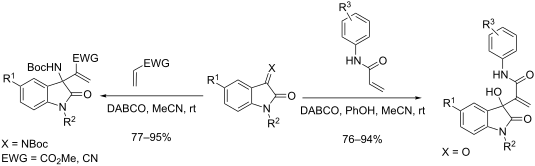
- , the acryl system shows differences in reactivity upon slight structural modifications. In such a system, the enone and acrylonitrile are more reactive, while with the acrylate reaction is relatively slow. Furthermore, there is a decrease of reactivity with acrylamide due to the reduced Michael


Aspergiloid I, an unprecedented spirolactone norditerpenoid from the plant-derived endophytic fungus Aspergillus sp. YXf3
Beilstein J. Org. Chem. 2014, 10, 2677–2682, doi:10.3762/bjoc.10.282
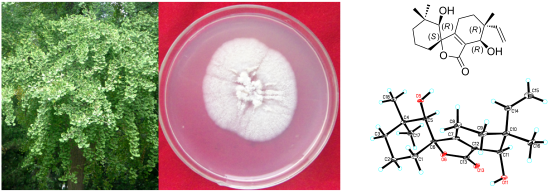
- enone fragment. HMBC correlations from H2-8 to C-7 and C-12 secured the connectivity of the C-8 to C-7. The connectivity of C-6 to the ketone carbon C-13 through an ester linkage, which was also supported by the downfield chemical shift of C-6 (δC 88.6) completed the structure of 6/5/6 tricyclic


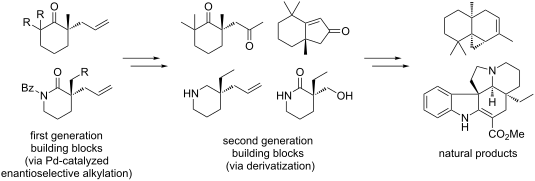
Formal total syntheses of classic natural product target molecules via palladium-catalyzed enantioselective alkylation
Beilstein J. Org. Chem. 2014, 10, 2501–2512, doi:10.3762/bjoc.10.261
- was crossed with methyl vinyl ketone in 62% yield [34]. Reduction of enone 34 was achieved in the presence of Pd/C with H2 in EtOAc to furnish diketone 35 [34]. Chemoselective Wittig mono-olefination of 35 provided ω-enone (−)-32, spectroscopically identical to the material in Danishefsky’s racemic
- enantioselective synthesis of the (4aS,8aR,8S)-hydrolilolidone core 37 [63][64] present in aspidospermine (36), and thus a formal total synthesis of the alkaloid itself, intercepting Stork’s classic route [61]. One precursor described in the core synthesis is enone 38, which bears the quaternary stereocenter of
- of installing the γ-stereocenter of the target 38 was addressed as follows: LiAlH4 treatment of (+)-43 gave exclusive 1,2-reduction. When the crude product was hydrolyzed, β-elimination gave the desired enone 38. The overall formal synthesis represents a rare example of enantioselective Stork


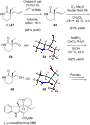

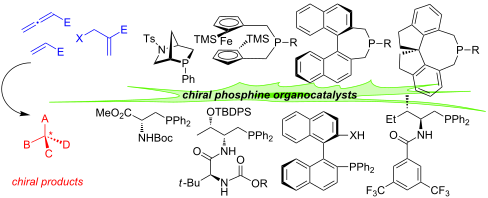
Chiral phosphines in nucleophilic organocatalysis
Beilstein J. Org. Chem. 2014, 10, 2089–2121, doi:10.3762/bjoc.10.218


Application of cyclic phosphonamide reagents in the total synthesis of natural products and biologically active molecules
Beilstein J. Org. Chem. 2014, 10, 1848–1877, doi:10.3762/bjoc.10.195
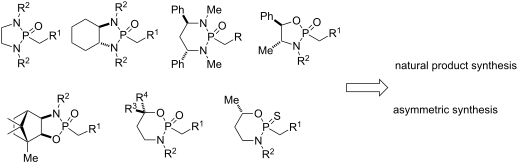
- enolization. Thus, treatment of Δ5-cholestenone with 24a yielded the unconjugated olefin 27a in addition to recovered unreacted enone, whereas phosphorus ylides would form Δ4-cholestenone via enolization and double bond conjugation [20]. Other monocyclic phosphonamides with application in olefination
- palladium catalysis and subsequent decarboxylation yielded enone 118 as a single diastereomer. Addition of the Li anion of phosphonamide 24c to enone 118 afforded adduct 119 as a single isomer, with the attack occurring to the less hindered face of the enone. Further elaboration of the side chain was
- chiral auxiliary through ozonolysis followed by protection of the side chain as TBDPS ether afforded cyclopentanone 155. Saegusa–Ito oxidation followed by epoxidation of the formed enone gave 156 as the major isomer (dr 9:1). Regioselective reductive opening of the epoxide with Na[PhSeB(OEt)3] produced


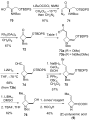






Sacrolide A, a new antimicrobial and cytotoxic oxylipin macrolide from the edible cyanobacterium Aphanothece sacrum
Beilstein J. Org. Chem. 2014, 10, 1808–1816, doi:10.3762/bjoc.10.190
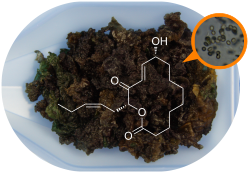
- , a precooking treatment to manually deactivate 1 was desired. We hypothesized that the modification of the reactive enone functionality or the degradation of the cyclic structure may eliminate the bioactivity of 1, and envisioned that the treatment with an alkaline solution may serve this purpose. In


Streptopyridines, volatile pyridine alkaloids produced by Streptomyces sp. FORM5
Beilstein J. Org. Chem. 2014, 10, 1421–1432, doi:10.3762/bjoc.10.146
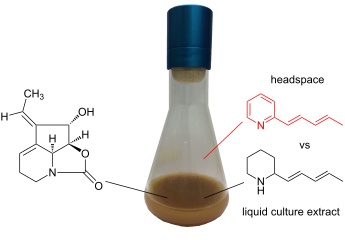
- as presented in Scheme 2. Cyclohept-4-enone (49) has recently been reported from several actinomycetes [2]. Some terpenes could be identified as well. 2-Methylisoborneol (60) and geosmin (62) are commonly produced by Streptomyces and other actinomycetes [3][30]. In addition, the sesquiterpene


Stereoselective synthesis of carbocyclic analogues of the nucleoside Q precursor (PreQ0)
Beilstein J. Org. Chem. 2014, 10, 1333–1338, doi:10.3762/bjoc.10.135
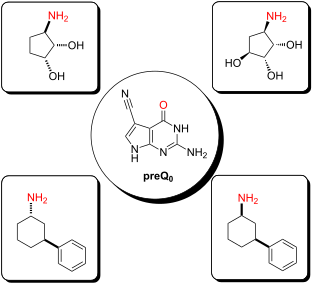
- -phenylcyclohexanamines, although with poor diastereomeric control [37][38]. 1-Cyclohex-2-enone provided the two required synthetic handles: a sp2 carbon for Pd chemistry and a ketone for further derivatization into an amine group (Figure 6). The synthesis of cis- and trans-3-arylcyclohexylamines 23 and 24 started with a




Synthesis of a sucrose dimer with enone tether; a study on its functionalization
Beilstein J. Org. Chem. 2014, 10, 1246–1254, doi:10.3762/bjoc.10.124
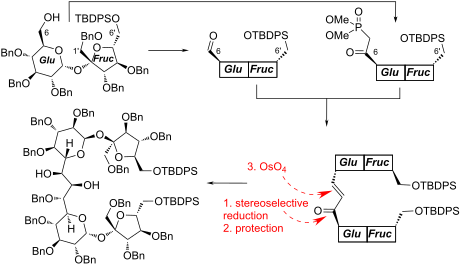
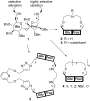
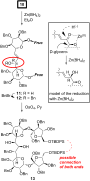
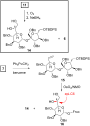
- sucrose aldehyde afforded a dimer composed of two sucrose units connected via their C6-positions (‘the glucose ends’). The carbonyl group in this product (enone) was stereoselectively reduced with zinc borohydride and the double bond (after protection of the allylic alcohol formed after reduction) was
- shown in Figure 2. The properly activated sugar is converted into phosphorane or phosphonate which – upon reaction with an aldehyde derived from another monosaccharide – provides higher carbon sugar (HCS) enone [16][17][18]. Application of this methodology to selectively protected 2,3,3’,4,4’-penta-O
- the ‘fructose end’ providing alcohol 6 [8]. This alcohol was converted into aldehyde 7 [21] (route a in Scheme 1) and separately into phosphonate 9 (route b). Reaction of both synthons under the mild PTC conditions [22][23][24] afforded the respective enone 10 in good yield (Scheme 1




Visible-light-induced, Ir-catalyzed reactions of N-methyl-N-((trimethylsilyl)methyl)aniline with cyclic α,β-unsaturated carbonyl compounds
Beilstein J. Org. Chem. 2014, 10, 890–896, doi:10.3762/bjoc.10.86
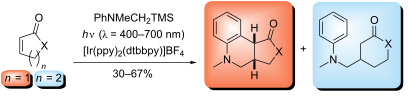
- -aminomethyl radicals [43][44][45] to enones. N-Methyl-N-((trimethylsilyl)methyl)aniline (5) for example served as substrate for the alkylation of 2-cyclohexenone (6) employing iridium catalyst 7. When using the amine as the limiting reagent and an excess of enone (1.5 equiv) product 8 was obtained in 70
- and delivered product 14 in 41% yield. Addition to cyclic α,β-unsaturated ketones Based on the results obtained with five-membered lactone 9, it was suprising to note that the related five-membered enone, 2-cyclopentenone (15), delivered mainly the direct addition product 17 instead of the tricyclic



Simple two-step synthesis of 2,4-disubstituted pyrroles and 3,5-disubstituted pyrrole-2-carbonitriles from enones
Beilstein J. Org. Chem. 2014, 10, 466–470, doi:10.3762/bjoc.10.44
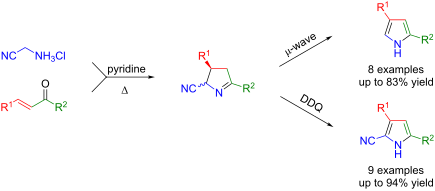
- closure to furnish 3,4-dihydro-2H-pyrrole-2-carbonitriles 6 after reprotonation [36]. If the products are devoid of an additional substituent in 2-position, the cyclocondensation can be simply effected by refluxing a mixture of the enone 1 and aminoacetonitrile hydrochloride (2) in pyridine. The base


Additive-assisted regioselective 1,3-dipolar cycloaddition of azomethine ylides with benzylideneacetone
Beilstein J. Org. Chem. 2014, 10, 352–360, doi:10.3762/bjoc.10.33
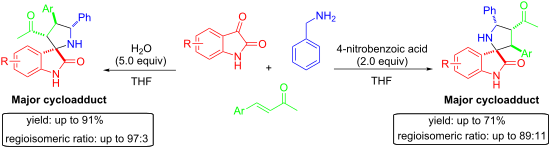
- -donating groups (Table 3, entries 6, 10 and 11). When the hydroxy group was introduced to the para-position on the phenyl ring of enone, the best regioisomeric ratio was obtained and only one single regioisomer 4k was isolated (Table 3, entry 11). Surprisingly, the addition of 4-nitrobenzoic acid only


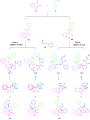


Synthesis of the B-seco limonoid core scaffold
Beilstein J. Org. Chem. 2014, 10, 194–208, doi:10.3762/bjoc.10.15
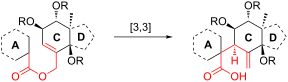
- quaternary centers at the ring junction. We decided to start the sequence with known enone 15 [39] and intended to construct the all-carbon quaternary center at C13 by substrate controlled α-functionalization. The second quaternary center at C14 might be established by 1,2-addition and finally, ring-closing
- systems, presenting appropriate stereogenic substitution at the C ring system. After merging these alcohols with an undecorated A ring, the resulting allyl vinyl ethers could serve as suitable rearrangement precursors. The synthesis of 19 and 20 commenced with enone 15 [39], which was prepared from
- rearrangements of the model substrates with an undecorated A ring, we attempted to access the B-seco limonoid scaffold by an analogous rearrangement of bicyclic precursor 66 (Scheme 8). The elaboration of the required bicyclic system commenced with enone 15 (Scheme 8). Initially, we envisaged an α-vinylation via




Recent applications of the divinylcyclopropane–cycloheptadiene rearrangement in organic synthesis
Beilstein J. Org. Chem. 2014, 10, 163–193, doi:10.3762/bjoc.10.14
- to give tricycle 111. The enol ether moiety was reduced using NaCNBH3, followed by allylic Riley oxidation and PCC-mediated enone formation. Copper-catalyzed conjugate addition in the presence of TMSCl [105] yielded silyl enol ether 112. Subsequent introduction of the side chain in 113 via a Claisen
- , reduction of the remaining double bond and subsequent Krapcho decarboxylation [132] resulted in less functionalized ketone 150. Aldol condensation with furfural followed by O-allylation and Claisen rearrangement furnished enone 151. Standard functional group interconversiones were used to access TIPS
- yielded intermediate cis-divinylcyclopropane 164, which underwent the desired rearrangement at remarkably low temperature to yield bicycle 165. Selective hydroboration/oxidation (directed through participation of the untouched double bond) followed by Swern oxidation gave ketone 166. The enone system 167




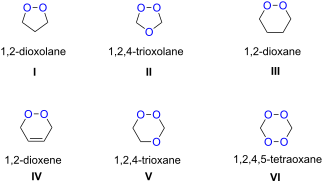
Synthesis of five- and six-membered cyclic organic peroxides: Key transformations into peroxide ring-retaining products
Beilstein J. Org. Chem. 2014, 10, 34–114, doi:10.3762/bjoc.10.6






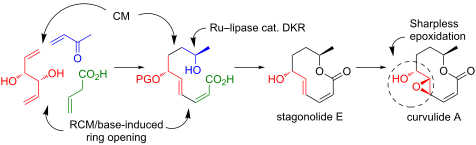
Bidirectional cross metathesis and ring-closing metathesis/ring opening of a C2-symmetric building block: a strategy for the synthesis of decanolide natural products
Beilstein J. Org. Chem. 2013, 9, 2544–2555, doi:10.3762/bjoc.9.289
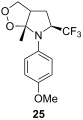
- -butanol solvent mixture than the analogous enone reductions outlined in Scheme 3 and Table 2. Compared to these reactions, the saturated ester 25 was obtained in a nearly quantitative yield using half the amount of Cu precatalyst and BDP ligand. In order to obtain enantiomerically pure 21, an enzyme






A combined continuous microflow photochemistry and asymmetric organocatalysis approach for the enantioselective synthesis of tetrahydroquinolines
Beilstein J. Org. Chem. 2013, 9, 2457–2462, doi:10.3762/bjoc.9.284
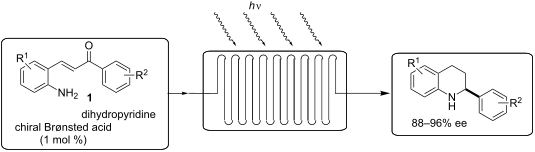
- hand, the substrate scope of this new photocyclization–asymmetric transfer hydrogenation sequence was examined. The results are summarized in Table 2. In general, different 2-aminochalcones bearing substituted aromatic residues on both ketone and enone moieties underwent the desired photocyclization


An overview of the synthetic routes to the best selling drugs containing 6-membered heterocycles
Beilstein J. Org. Chem. 2013, 9, 2265–2319, doi:10.3762/bjoc.9.265
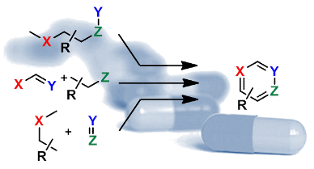
- pyridines can be furnished by employing an amino-enone or aminonitrile compound with a 1,3-dicarbonyl moiety. In both cases a subsequent oxidation step is usually required to convert the initially formed dihydropyridine intermediate into the desired aromatic pyridine. Some additional but much less common
- condenses by Michael addition of the enol to the corresponding enone to give after further dehydration and lactonisation coumalic acid (Scheme 10). Returning to the main discussion, a recent synthesis of rosiglitazone [41] exemplifies the advantages of employing resin-bound agents in order to increase
- ) resulting in the formation of enone 2.23, this material was subsequently condensed with enamide 2.22 to directly yield clevidipine (2.3, Route B, [71]). A final strategy is depicted in Scheme 26 (Route C, [72]). This approach is similar to route B, however, it introduces the amine as part of the readily


Gold(I)-catalyzed enantioselective cycloaddition reactions
Beilstein J. Org. Chem. 2013, 9, 2250–2264, doi:10.3762/bjoc.9.264
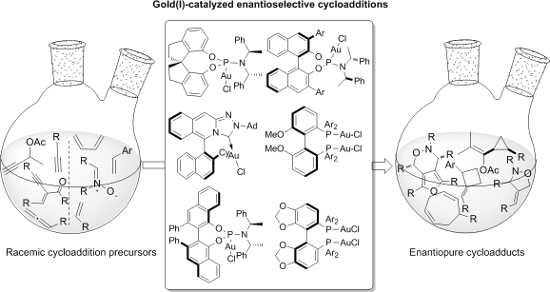
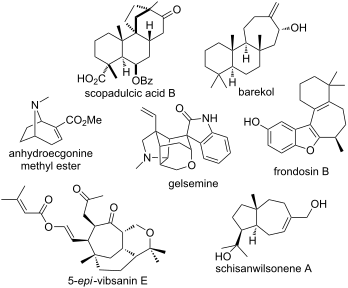
- core of frondosins (for example, 5a), in 68% yield and 90% ee (Scheme 4). Since this bicyclic enone was previously elaborated into frondosin A and B, the approach represented a streamlined formal enantioselective synthesis of both molecules. Analogous to other transition metals from groups eight to


Elucidation of the regio- and chemoselectivity of enzymatic allylic oxidations with Pleurotus sapidus – conversion of selected spirocyclic terpenoids and computational analysis
Beilstein J. Org. Chem. 2013, 9, 2233–2241, doi:10.3762/bjoc.9.262
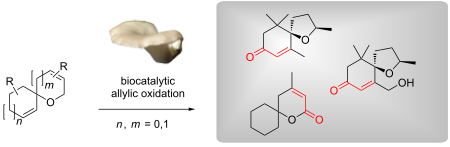
- clean and gives the enone 2 in good yield along with minor amounts of the corresponding allyl alcohol 3 and the epoxide 4a. This successful conversion of theaspirane (1) encouraged us to investigate the oxidation of other spirocyclic terpenoids. Many oxidized spiroethers are valuable flavor compounds or
- oxidation of allyl ether 7 may follow two alternative pathways either to the α,β-unsaturated lactone 14 or to the enone 15 (allylic oxidations at exocyclic positions are generally less favorable if radical mechanisms are operating) [35]. Due to sterical hindrance at position 5 and the strong activation for
- should thus be privileged for oxidation. As a consequence, the α,β-unsaturated lactone 17 is indeed the major product along with some unidentified more complex oxidation products. Again, oxidation in 5-position of 11 to the enone 18 was not observed. In addition, the allylic hydrogens in 9-position are


Regioselective 1,4-trifluoromethylation of α,β-unsaturated ketones via a S-(trifluoromethyl)diphenylsulfonium salts/copper system
Beilstein J. Org. Chem. 2013, 9, 2189–2193, doi:10.3762/bjoc.9.257
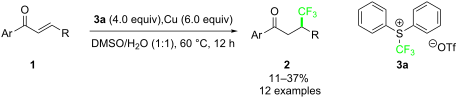
- –Hillman adducts (via SN2’ [16] or successive SN2’/SN2’ mode [17]). Sevenard and co-workers reported the nucleophilic 1,4-trifluoromethylation to chromones, coumarins and cyclohex-2-enone using the Ruppert–Prakash reagent, which was achieved by blocking the carbonyl moiety of the substrates with a bulky
- , aromatic rings substituted with either electron-donating or -withdrawing substituents, such as methyl, methoxy, fluoro and chloro were tolerated (Table 2, entries 2–4). A heteroaromatic, furanyl-substituted enone was compatible with the same reaction conditions (Table 2, entry 6). We next examined
- -substituted enone also produced the desired product 2l (Table 2, entry 12). Based on these results, we hypothesized the reaction mechanism as shown in Scheme 2. First, the conjugate trifluoromethylation of α,β-unsaturated ketones would be initiated by a single-electron transfer between S-(trifluoromethyl


A concise enantioselective synthesis of the guaiane sesquiterpene (−)-oxyphyllol
Beilstein J. Org. Chem. 2013, 9, 2028–2032, doi:10.3762/bjoc.9.239
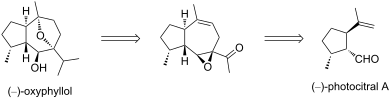
- Martin Zahel Peter Metz Fachrichtung Chemie und Lebensmittelchemie, Organische Chemie I, Technische Universität Dresden, Bergstrasse 66, 01069 Dresden, Germany 10.3762/bjoc.9.239 Abstract (−)-Oxyphyllol was prepared in only 4 steps from an epoxy enone that already served as an intermediate for
- 3 can be utilized to generate the isopropyl group, and a regioselective transannular epoxide opening would construct the oxygen-bridged bicyclic hydroazulene framework. Alcohol 3 was traced back to the known epoxy enone 4 that already served as an intermediate for the total synthesis of 5 [6]. As


The chemistry of amine radical cations produced by visible light photoredox catalysis
Beilstein J. Org. Chem. 2013, 9, 1977–2001, doi:10.3762/bjoc.9.234
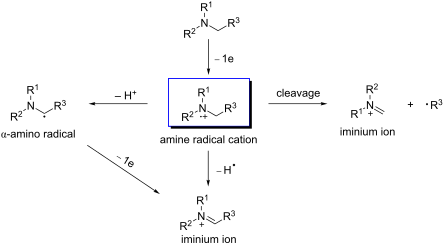
- found to be optimal, lie within a narrow range of pKa values. The authors suggested that TFA protonates the enone 83, thus accelerating the addition of the α-amino radical to the enone (84). The Nishibayashi group reported that α-amino radicals generated from a different class of amines, anilines 87




Gold-catalyzed regioselective oxidation of propargylic carboxylates: a reliable access to α-carboxy-α,β-unsaturated ketones/aldehydes
Beilstein J. Org. Chem. 2013, 9, 1925–1930, doi:10.3762/bjoc.9.227
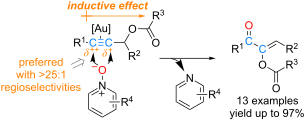
- the use of a P,S-bidentate ligand, which is proposed to enable the formation of tris-coordinated and hence less electrophilic gold carbene species. α-Carboxy α,β-unsaturated ketones/aldehydes can be obtained with fair to excellent yields. Keywords: enone; gold catalysis; oxidation; propargyl
- proceeded efficiently, yielding the α-acetoxyenone 5a-OAc (Z/E >50:1) and the isomeric β-acetoxyenone 5a-H in an excellent combined 92% yield along with a minute amount of the enone 6 (<0.5%, Scheme 3); moreover, 5a-OAc is favored over 5a-H by a ratio of ~7:1. Of particular importance is that the
- hydrolysis, only under thermal and anhydrous conditions products derived from the latter processes can be predominantly formed [32]; under our conditions (at ambient temperature and without exclusion of moisture), the enone 6 was indeed detected but in a minute amount, suggesting that the 1,2-acyloxy





