Search results
Search for "nitro" in Full Text gives 538 result(s) in Beilstein Journal of Organic Chemistry. Showing first 200.
The asymmetric Henry reaction as synthetic tool for the preparation of the drugs linezolid and rivaroxaban
Beilstein J. Org. Chem. 2022, 18, 438–445, doi:10.3762/bjoc.18.46
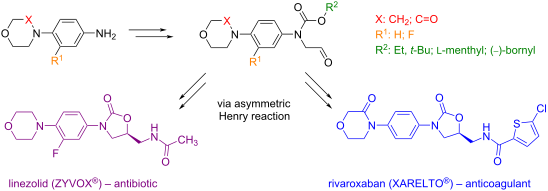
- 26 were chosen. The reduction of the nitro groups in 24 and 26 via the hydrogenation procedure proceeded smoothly with almost quantitative yields; the amine intermediates were immediately used in the next step. Hence, the N-acylation reactions were performed by the action of the corresponding


Recent developments and trends in the iron- and cobalt-catalyzed Sonogashira reactions
Beilstein J. Org. Chem. 2022, 18, 262–285, doi:10.3762/bjoc.18.31
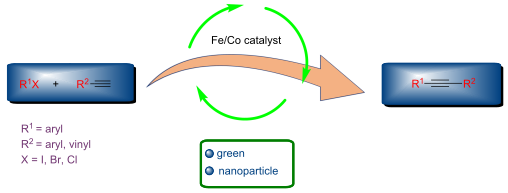
- recovered by applying an external magnet and reused for successive five runs. Functional groups including nitro, carbonyl, and methoxy on the aryl halide were compatible with the catalyst. Aryl iodides gave better yields when compared to aryl bromides. A good synergistic effect of the nanoparticles with the




Flow synthesis of oxadiazoles coupled with sequential in-line extraction and chromatography
Beilstein J. Org. Chem. 2022, 18, 232–239, doi:10.3762/bjoc.18.27
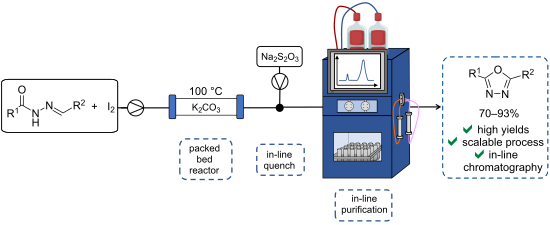
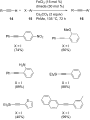
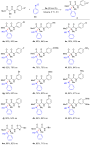
- -substituted system (2a and 2c vs 2b and 2d). Both electron-rich and electron-deficient acyl hydrazones afforded high yields, with a slight decrease observed with the presence of the electron-withdrawing CF3 group in the case of the electron poor nitro-substituted substrate 2g. The reaction was also


Organocatalytic asymmetric nitroso aldol reaction of α-substituted malonamates
Beilstein J. Org. Chem. 2022, 18, 217–224, doi:10.3762/bjoc.18.25

- optimal reaction conditions, we proceeded to evaluate the generality of this nitroso aldol reaction with respect to the amide component of malonamate (Scheme 2). Pleasingly, our strategy was found to be operational with malonamates bearing electronically different substituents such as halo, nitro, acetyl




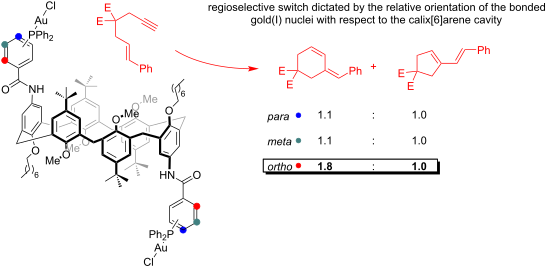
Diametric calix[6]arene-based phosphine gold(I) cavitands
Beilstein J. Org. Chem. 2022, 18, 190–196, doi:10.3762/bjoc.18.21
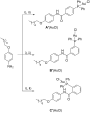
- attempted starting from the known dioctyloxydinitro derivative DN (Scheme 1) [33]. Reduction of the nitro groups with hydrazine, in the presence of catalytic amounts of Pd/C (10 mol %) led to the corresponding diamino intermediate. This latter could be subsequently reacted with the desired phosphino benzoic


Asymmetric organocatalytic Michael addition of cyclopentane-1,2-dione to alkylidene oxindole
Beilstein J. Org. Chem. 2022, 18, 167–173, doi:10.3762/bjoc.18.18
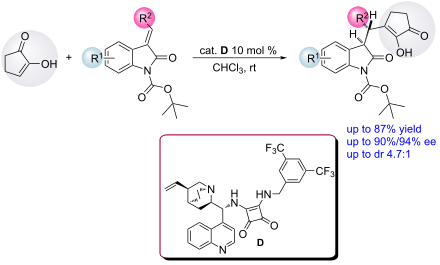
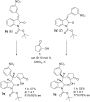
- diastereomer, meaning vicinal hydrogens were in anti-configuration. In all previous experiments only E-isomers were used. In the case of the 3-nitro-substituted starting material 2q we managed to separate isomers and carried out the reaction with both the E- and Z-isomer. In these experiments, both isomers


Ready access to 7,8-dihydroindolo[2,3-d][1]benzazepine-6(5H)-one scaffold and analogues via early-stage Fischer ring-closure reaction
Beilstein J. Org. Chem. 2022, 18, 143–151, doi:10.3762/bjoc.18.15
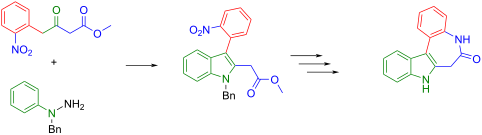
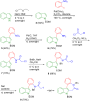
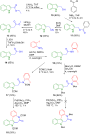
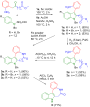
- led exclusively to the desired isomer 5 with the nitrophenyl group in position 3, most likely due to the steric effect. Then, the nitro group in 5 was reduced by hydrogenation under 4 bar using Pd/C as catalyst to yield the desired amine 6 in 78% yield. Subsequently, the desired chloroacetyl
- previous observations [38]. Reduction of the nitro group by palladium-catalyzed hydrogenation in dry methanol gave 2a in 92% yield. Interestingly compound 2a undergoes ring-closure reaction spontaneously at room temperature to give trace amounts of 3a (59 mg, 2%) after column chromatography, when a 3.1 g
- the nitro group but also to cyclization and the reductive elimination of bromine to afford 3a. The synthesis of 3b could be realized in 58% yield by using iron powder under acidic conditions. Reaction of methyl 5-(2-nitrophenyl)-4-oxopentanoate [44] and 1-benzyl-1-phenylhydrazine [36] hydrochloride in






Mechanistic studies of the solvolysis of alkanesulfonyl and arenesulfonyl halides
Beilstein J. Org. Chem. 2022, 18, 120–132, doi:10.3762/bjoc.18.13
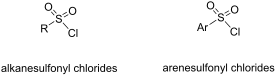
- solvent composition. In a very early 1927 study [4] of the solvolyses of benzenesulfonyl chloride (C6H5SO2Cl) and its p-methyl and m-nitro derivatives, solvolyzing in 50% acetone/50% water (v/v) at 25.0 °C, it was found that the differences in specific rates were quite small, at 0.0106 min−1 for the p
- value of +0.82 for the para-methyl derivative and of +0.71 for the meta-nitro derivative. and, for the study in 47.5% ethanol/52.5% water the corresponding values are +0.22 and +0.38, respectively. These small reaction constant ρ values depend only on the type of reaction but not on the substituent used
- at least four orders of magnitude slower than the chloride as regards the solvolytic replacement of the halogen present in the benzenesulfonyl halide. For the reactions of the fluoride in 20% dioxane at 91 °C, the m-nitro derivative was shown to be subject to a strong nucleophilic catalysis by


Tenacibactins K–M, cytotoxic siderophores from a coral-associated gliding bacterium of the genus Tenacibaculum
Beilstein J. Org. Chem. 2022, 18, 110–119, doi:10.3762/bjoc.18.12
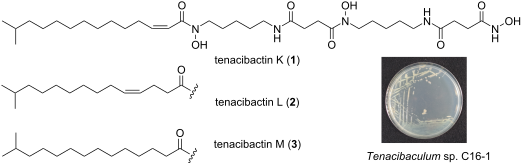
- [30], terminal blocking by acylation [29][31][32], formation of sugar ester [33], imine oxide [34], oxime [35], or functional group transformation into a hydroxy [33] or nitro group [35]. To the best of our knowledge, compounds 1–3 are the first to have a hydroxamic acid terminus. Similar to the


Efficient N-arylation of 4-chloroquinazolines en route to novel 4-anilinoquinazolines as potential anticancer agents
Beilstein J. Org. Chem. 2021, 17, 2968–2975, doi:10.3762/bjoc.17.206
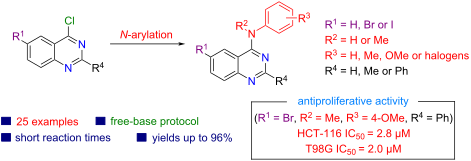
- 8b were reacted with 4-cyano- or 4-nitro-N-methylaniline (Table 1, entries 19–21). Given our interest in preparing 4-anilinoquinazolines 10g, 10h, 10q, and 10r, we decided to investigate a two-step strategy starting by N-arylation using o-methyl- and o-fluoro-substituted primary anilines, followed by


Synthesis of a novel aminobenzene-containing hemicucurbituril and its fluorescence spectral properties with ions
Beilstein J. Org. Chem. 2021, 17, 2840–2847, doi:10.3762/bjoc.17.195
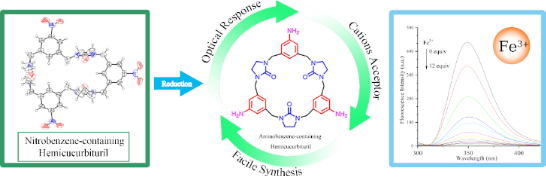
- hemicucurbituril-based macrocycle, alternately consisting of amidobenzene and 2-imidazolidione moieties was designed and synthesized. Based on the fragment coupling strategy, nitrobenzene-containing hemicucurbituril was firstly prepared facilely under alkaline environment, and reduction of the nitro groups
- imidazolidinone components were observed at rt. This indicated that the formed macrocycle is highly symmetric in solution. After successful construction of macrocycle 9, the aminobenzene-containing hemicucurbituril 4 was obtained by reduction of the nitro groups in 9 with Fe powder in H2O/EtOH at 86 °C for 2 h


Host–guest interaction and properties of cucurbit[8]uril with chloramphenicol
Beilstein J. Org. Chem. 2021, 17, 2832–2839, doi:10.3762/bjoc.17.194
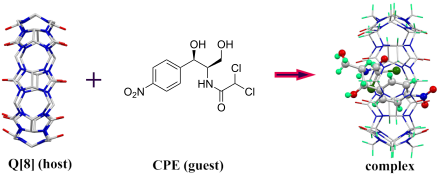
- peaks of the O–H bonds were observed at 1106 and 1066 cm−1. The nitro-symmetric tensile vibration peak observed at 1503 cm−1 and the nitro-asymmetric tensile vibration peak at 1320 cm−1 disappeared in the spectrum (d). At the same time, the fingerprint region peak of the benzene ring observed from 500


Photophysical, photostability, and ROS generation properties of new trifluoromethylated quinoline-phenol Schiff bases
Beilstein J. Org. Chem. 2021, 17, 2799–2811, doi:10.3762/bjoc.17.191
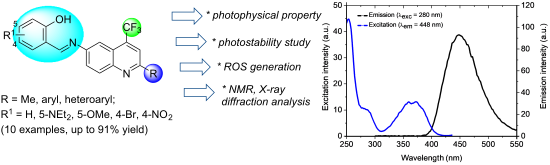
- the series of compounds 3aa–fa and 3bb–be was carried out using chloroform (CHCl3), methanol (MeOH) or dimethyl sulfoxide (DMSO) solutions. As comparison, the UV–vis absorption spectra of compounds 3ea and 3be, which contain the nitro group in two different ring positions of the molecules recorded in
- shifting the emission maxima to lower energy values (Figure 4). Another possible comparison is between substituents with electron-donating and accepting properties in the same solvent media. Therefore, when the compounds containing a diethylamino group (3bb, R = Ph, R1 = 5-NEt2) and a nitro group (3be, R
- ; H, 2.99; N, 5.94; found: C, 58.04; H, 2.73; N, 6.26. (E)-4-Nitro-2-(((2-phenyl-4-(trifluoromethyl)quinolin-6-yl)imino)methyl)phenol (3be): Orange solid, yield 89%; mp 253–256 °C; 1H NMR (600 MHz, CDCl3) δ 14.01 (s, 1H, OH), 8.85 (s, 1H, CH=N), 8.48 (d, J = 2.7 Hz, 1H, 4-NO2C6H3OH), 8.35 (d, J = 9.0




Synthesis of highly substituted fluorenones via metal-free TBHP-promoted oxidative cyclization of 2-(aminomethyl)biphenyls. Application to the total synthesis of nobilone
Beilstein J. Org. Chem. 2021, 17, 2668–2679, doi:10.3762/bjoc.17.181
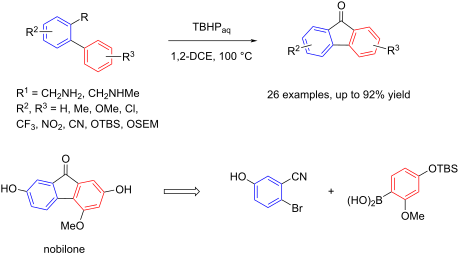
- good yields via metal- and additive-free TBHP-promoted cross-dehydrogenative coupling (CDC) of readily accessible N-methyl-2-(aminomethyl)biphenyls and 2-(aminomethyl)biphenyls. This methodology is compatible with numerous functional groups (methoxy, cyano, nitro, chloro, and SEM and TBS-protective
- % combined yield) and 10q1/2 (57% combined yield) further illustrates, how electron-withdrawing substituents negatively impact the yield of the reaction. As evident from Scheme 5, the cyclization protocol is compatible with several functional groups (chloro, nitro, cyano, trifluoromethyl). In contrast, the
- Suzuki cross-coupling reactions, followed by reduction or reductive amination. The oxidative cyclization conditions are compatible with many functional groups on the aromatic rings (methoxy, chloro, cyano, nitro, and phenol protecting groups like TBS and SEM – but not benzyl and methylenedioxy


Recent advances in organocatalytic asymmetric aza-Michael reactions of amines and amides
Beilstein J. Org. Chem. 2021, 17, 2585–2610, doi:10.3762/bjoc.17.173
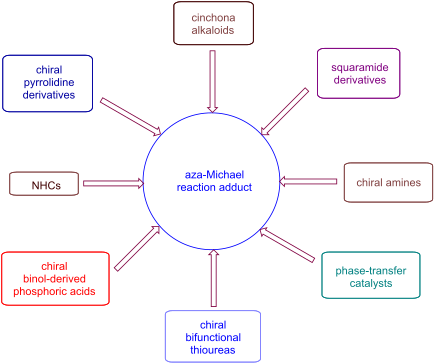
- reactions between 2-aminobenzaldehydes 42 and β-nitrostyrenes 43 to obtain chiral 3-nitro-1,2-dihydroquinolines 45 in good yields with up to 98% ee (Table 9) [43]. 1.4 Reactions catalyzed by chiral phase-transfer catalysts Chiral phase-transfer catalysts (PTC) have been recognized as versatile catalysts for
- to good yield of 53–99% with an ee of 74–93% [54]. Liu et al. accomplished a catalytic cascade aza-Michael–Henry-dehydration protocol for the preparation of chiral 3-nitro-1,2-dihydroquinolines 83 from the reaction of N-protected aminobenzaldehydes 80 with substituted nitroolefins 81 by using


α-Ketol and α-iminol rearrangements in synthetic organic and biosynthetic reactions
Beilstein J. Org. Chem. 2021, 17, 2570–2584, doi:10.3762/bjoc.17.172
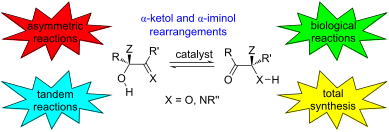
- % yield), para-alkoxy and para-halogen substituents (45–69%), ortho-methyl (74%), and meta-methyl (80% as a 65:35 mixture of regioisomers). Electron-withdrawing groups (nitro, cyano, and methyl ester) stopped at the ketone intermediate. Interestingly, another tandem sequence that exploits the relief of


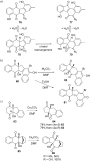


Silica gel and microwave-promoted synthesis of dihydropyrrolizines and tetrahydroindolizines from enaminones
Beilstein J. Org. Chem. 2021, 17, 2543–2552, doi:10.3762/bjoc.17.170
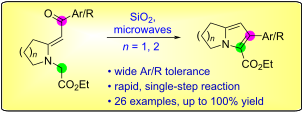
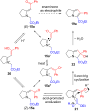
- the putative pyrrolizine product appears to be faster than the rate of cyclization of the enaminone. In particular, decomposition occurred during the attempted cyclization of the 2-nitrophenyl- and 2-iodophenylenaminones 15k and 15l even before all of the precursor had been consumed. In the 2-nitro
- and 4-nitro congeners in acetonitrile, followed by sulfide contraction of the resulting thioiminium ether salts with triethylamine and triethyl phosphite, afforded the (E)-enaminones 25a–c in yields of 86–89%. The E-geometry of 25a was again confirmed by NOESY NMR spectroscopy, which showed an




Recent advances in the tandem annulation of 1,3-enynes to functionalized pyridine and pyrrole derivatives
Beilstein J. Org. Chem. 2021, 17, 2462–2476, doi:10.3762/bjoc.17.163
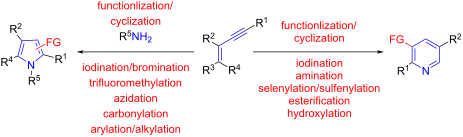
- (such as n-propyl and n-hexyl) groups under the standard conditions. 2-En-4-ynyl azides 1 bearing electron-donating substituents (such as methyl and methoxy groups) obviously worked better than those with electron-withdrawing (such as nitro, cyano, acetyl, and trifluoromethyl) groups. Meanwhile, they
- previous studies on heterocycle synthesis, Punniyamurthy and co-workers designed the electrophilic iodocyclization of 2-nitro-1,3-enynes 34 for the synthesis of pyrrole derivatives. In 2013, they reported an efficient route to pentasubstituted pyrroles from 2-nitro-1,3-enynes 34, amines, and iodine under
- dibromopyrroles 38, respectively. Subsequently, Punniyamurthy and co-workers also described the copper-catalyzed cascade cyclization of 2-nitro-1,3-enynes 34 to tetrasubstituted pyrroles 39 (Scheme 14) [58]. Through screening the conditions, the Cu(OTf)2-promoted (5 mol %) annulation addition reaction of 2-nitro




Enantioselective PCCP Brønsted acid-catalyzed aminalization of aldehydes
Beilstein J. Org. Chem. 2021, 17, 2433–2440, doi:10.3762/bjoc.17.160
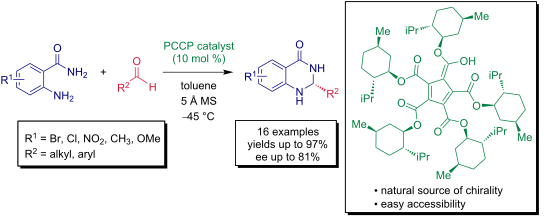
- corresponding aminal 3o exceeded 80%. Next, the effect of a strongly electron-withdrawing nitro group present on anthranilamide moiety was investigated. The reaction carried out in toluene did not reach a complete conversion even after a prolonged reaction time. When more polar THF was used as the solvent, the


Efficient synthesis of polyfunctionalized carbazoles and pyrrolo[3,4-c]carbazoles via domino Diels–Alder reaction
Beilstein J. Org. Chem. 2021, 17, 2425–2432, doi:10.3762/bjoc.17.159
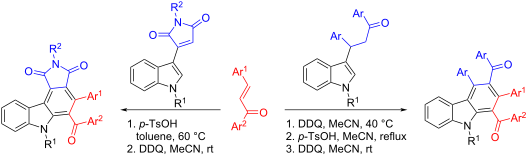
- and electron-withdrawing m-chloro and p-chloro substituents gave the products in good yields. However, the nitro-substituted chalcone gave the product 4h in a slightly lower yield. The structures of the pyrrolo[3,4-c]carbazoles 4a–l were established by various spectroscopy methods. Further, the single


A novel methodology for the efficient synthesis of 3-monohalooxindoles by acidolysis of 3-phosphate-substituted oxindoles with haloid acids
Beilstein J. Org. Chem. 2021, 17, 2321–2328, doi:10.3762/bjoc.17.150
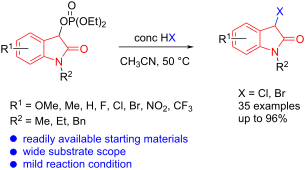
- , i.e., benzyl and ethyl, slightly decreased the yields of the products (see 4n and 4o). Regrettably, when a substrate 2 bearing a strong electron-withdrawing nitro or trifluoromethyl group on the phenyl ring was employed, the reaction gave very complex side products under the standard conditions, and




Regioselective N-alkylation of the 1H-indazole scaffold; ring substituent and N-alkylating reagent effects on regioisomeric distribution
Beilstein J. Org. Chem. 2021, 17, 1939–1951, doi:10.3762/bjoc.17.127
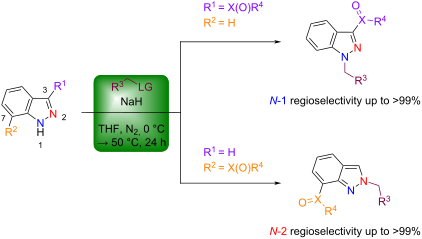
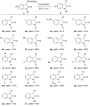
- conditions A and B, highlights the steric influence of the halogen C-3 substituent. Furthermore, Bookser et al. have noted comparable regioselectivity with related C-3 bromo substituted N-containing heterocycles, under similar reaction conditions [24]. Marked N-1 regioselectivity was achieved with 3-nitro
- the corresponding N-2 regioisomer (Table 4, entries 1 and 2). This latter preference for N-2 alkylation is likely due to the proximal steric bulk of both the C-7 Me and Br substituents, respectively, to the N-1 position. The presence of a nitro or methyl carboxylate group at the C-7 position of the
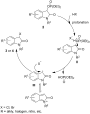
- ) was extended to indazoles bearing a nitro (19) or carbonyl (21–24) functional group, the desired N-1 regioisomer was obtained with a very high degree of regioselectivity. In the case of C-3 substituted indazoles 9, 19 and 21–24 (those bearing a X=O α to the indazole C-3 position), we postulate that in


Development of N-F fluorinating agents and their fluorinations: Historical perspective
Beilstein J. Org. Chem. 2021, 17, 1752–1813, doi:10.3762/bjoc.17.123
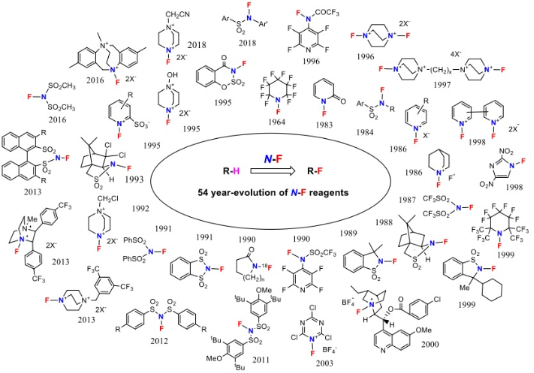
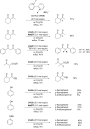
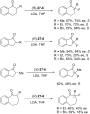
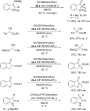
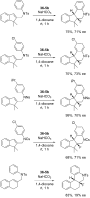
- )-27-6. Enantioselective fluorinations of typical enolates were then performed (Scheme 63). The (R)-27-6 reagent gave up to 79% yield and 88% enantiomeric excess in the case of 2-benzyl-α-tetralone. 1-28. (R)- and (S)-N-fluoro-3-tert-butyl-7-nitro-benzothiazine 1,1-dioxides and spiro-type analogues In
- 2000, the Takeuchi group reported their second series of chiral N-fluorosultam reagents, (R)- and (S)-N-fluoro-3-tert-butyl-7-nitro-3,4-dihydro-2H-benzo[e][1,2]thiazine 1,1-dioxides 28-3 [93] (Scheme 64). Racemic 28-1 reacted with (+)-10-camphorsulfonyl chloride to give a mixture of the diastereomers

























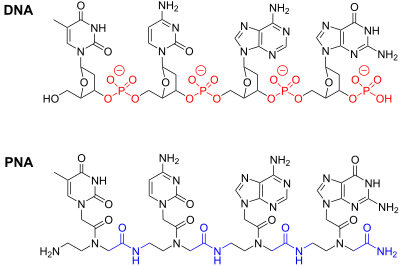
Chemical approaches to discover the full potential of peptide nucleic acids in biomedical applications
Beilstein J. Org. Chem. 2021, 17, 1641–1688, doi:10.3762/bjoc.17.116








Breaking paracyclophane: the unexpected formation of non-symmetric disubstituted nitro[2.2]metaparacyclophanes
Beilstein J. Org. Chem. 2021, 17, 1518–1526, doi:10.3762/bjoc.17.109
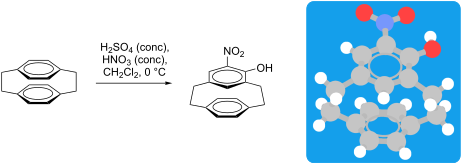
- undoubtedly the result of the lengthy syntheses of these compounds. We report the simple synthesis of a rare example of a non-symmetric [2.2]metaparacyclophane. Treatment of [2.2]paracyclophane under standard nitration conditions gives a mixture of 4-nitro[2.2]paracyclophane, 4-hydroxy-5-nitro[2.2
- obviously presents one of the most direct routes to 4-amino[2.2]paracyclophanes so we returned to this venerable reaction. In this paper, we disclose a simple synthesis of 4-hydroxy-5-nitro[2.2]metaparacyclophane (5), a side-product from our nitration reactions. This chemistry offers a rapid route to non
- polymerization. Extensive optimization led us to a set of conditions that routinely provided 4-nitro[2.2]paracyclophane (4) in good yields regardless of the scale of reaction (nitration has been performed on scales ranging from 0.5 g to 30 g). The 1H NMR of the crude reaction mixture invariably shows two other