


Search results
Search for "methodology" in Full Text gives 1032 result(s) in Beilstein Journal of Organic Chemistry. Showing first 200.
Facile access to 3-sulfonylquinolines via Knoevenagel condensation/aza-Wittig reaction cascade involving ortho-azidobenzaldehydes and β-ketosulfonamides and sulfones
Beilstein J. Org. Chem. 2023, 19, 800–807, doi:10.3762/bjoc.19.60
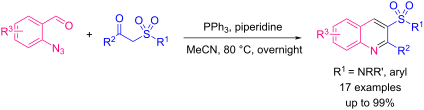
- leading to 2-alkoxyquinolines. Compounds 5l an 5q were obtained in 63 and 51% yield, respectively (Scheme 3). It is worth noticing that chromenopyridine-3-sulfonamide 5h derived from heterocyclic azidoaldehyde 1h was also successfully synthesized following the methodology designed. Some limitations on the


Honeycomb reactor: a promising device for streamlining aerobic oxidation under continuous-flow conditions
Beilstein J. Org. Chem. 2023, 19, 752–763, doi:10.3762/bjoc.19.55
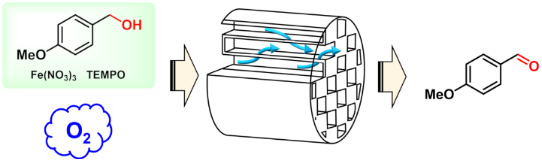
- , conversion, yield and availability of the catalysts. Because the honeycomb reactor is made of porous material, the homogeneous reaction solution is a key factor. Stahl and Steves have developed a highly reactive aerobic oxidation [38]. This promising methodology enables completion of the reaction in 30 min


Enolates ambushed – asymmetric tandem conjugate addition and subsequent enolate trapping with conventional and less traditional electrophiles
Beilstein J. Org. Chem. 2023, 19, 593–634, doi:10.3762/bjoc.19.44
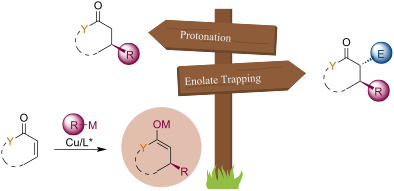
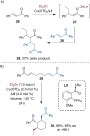
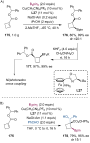
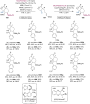
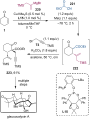
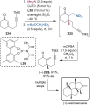
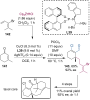
- using acyclic enones 14 [27]. Their tandem conjugate addition/Mannich reaction methodology offers access to various non-cyclic β-aminoketones 16 with multiple contiguous stereocenters in high diastereo- and enantioselectivity (Scheme 5a). Additionally, chiral isoindolinones 18 and 2,3,4-trisubstituted
- azetidines 19 were also synthesized using this methodology (Scheme 5b). Nitronate anions were also found suitable for Mannich-type trapping reactions [28][29]. Anderson and co-workers accomplished several Cu-catalyzed conjugate additions of R2Zn to nitroolefins 20, followed by subsequent reaction with p
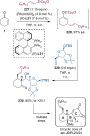
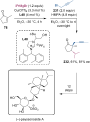
- ligands is that they can also promote the conjugate additions of aryl-based or branched Grignard reagents (Scheme 17) [49]. Further extending this methodology, we have investigated formaldehyde imine equivalents. These kinds of imines are not readily available, but they are highly important synthetic








Direct C2–H alkylation of indoles driven by the photochemical activity of halogen-bonded complexes
Beilstein J. Org. Chem. 2023, 19, 575–581, doi:10.3762/bjoc.19.42
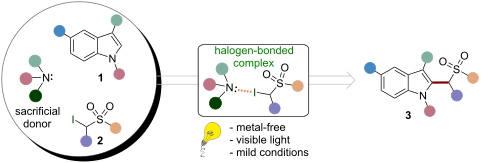
- to photochemically generate electrophilic radicals that can drive the functionalization of suitable electron-rich substrates [23]. Exploiting this strategy, here we report a novel metal-free methodology for the direct homolytic aromatic substitution (HAS) reaction of indoles 1 with α-iodosulfones 2


Phenanthridine–pyrene conjugates as fluorescent probes for DNA/RNA and an inactive mutant of dipeptidyl peptidase enzyme
Beilstein J. Org. Chem. 2023, 19, 550–565, doi:10.3762/bjoc.19.40
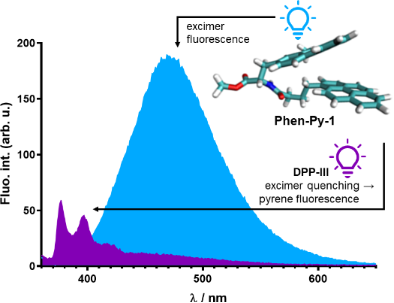
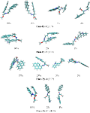
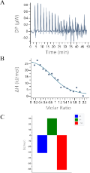
- further supported by the fact that using the same methodology, the isolated phenanthridine showed an absorption maximum of 256 nm at pH 7.0, which is in perfect agreement with the experimental value of 248 nm [34] and well-matched with 250 nm reported here for Phen-AA (Table 1). Interactions of Phen-Py-1




Transition-metal-catalyzed domino reactions of strained bicyclic alkenes
Beilstein J. Org. Chem. 2023, 19, 487–540, doi:10.3762/bjoc.19.38
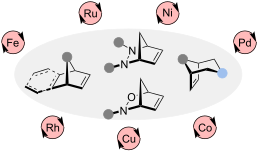
- sketched in red, with newly formed cyclic structures being highlighted. Review Earth-abundant metals Among the transition metal used in organic synthesis, the late transition metals like rhodium, palladium, and iridium have taken center stage when it comes to methodology development. Although these late
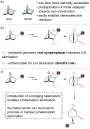
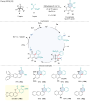
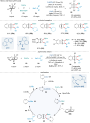
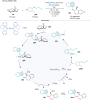
- equivalents of water interrupted the cyclization step and led entirely to reductively coupled alkenylated ring-opened products. Interestingly, when this methodology was applied to the ester-bearing oxabicyclic 1a, the anticipated reductive coupling product was not detected; instead, bicyclic γ-lactone 4 was
- oxanorbornenes; however, the latter two substrates did not undergo dehydrogenation, generating cis-selective annulated coumarins (10b and 10d). In 2006, the same group applied this methodology for the total synthesis of arnottin I (10h), a coumarin-type natural product isolated from the bark of the Xanthoxylum











Total synthesis: an enabling science
Beilstein J. Org. Chem. 2023, 19, 474–476, doi:10.3762/bjoc.19.36
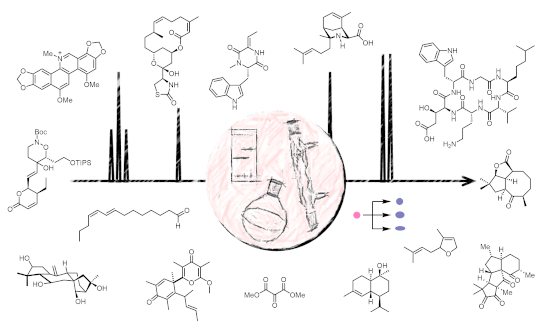
- synthetic methodology developments and to natural product isolation or biosynthesis. Thus, thematic issues dealing with total synthesis in the Beilstein Journal of Organic Chemistry have naturally been published in these fields, such as "Transition-metal and organocatalysis in natural product synthesis


Transition-metal-catalyzed C–H bond activation as a sustainable strategy for the synthesis of fluorinated molecules: an overview
Beilstein J. Org. Chem. 2023, 19, 448–473, doi:10.3762/bjoc.19.35
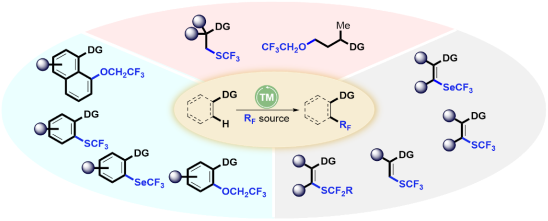
- aryl residue allowed the monofunctionalization to occur selectively. Also, amide 1g bearing a disubstituted arene was successfully functionalized in 59% yield. Finally, the difunctionalized thiophene derivative 2h was obtained in 56% yield. In 2016, Wang's group developed another methodology for the
- 2014, Shen and Xu [117] developed a new methodology for the selective functionalization of 2-arylpyridine derivatives using an electrophilic SCF3 reagent, the Haas reagent I (Scheme 5) [118]. A broad range of 2-arylpyridine derivatives were trifluoromethylthiolated in good to high yields (18 examples
- desired trifluoromethylthiolated product 12 is selectively afforded after a F/SCF3 ligand exchange. In 2015, Ye and Liu reported the palladium-catalyzed trifluoromethylthiolation of 2-arylpyridine derivatives using the Billard reagent II (Scheme 7) [120]. Unlike Shen's methodology (Scheme 5), the use of








CuAAC-inspired synthesis of 1,2,3-triazole-bridged porphyrin conjugates: an overview
Beilstein J. Org. Chem. 2023, 19, 349–379, doi:10.3762/bjoc.19.29
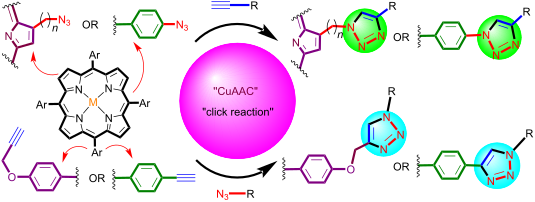
- ], nanoscience [12], and materials research [13][14]. Moreover, this review describes the use of the click methodology for the construction of various β- and meso-substituted 1,2,3-triazoloporphyrins by using azide or alkyne-substituted porphyrin as substrate (Figure 2). Every example mentioned in this review
- protected α-propargylglucose 42a or mannose 42b in the presence of CuCl in a toluene/H2O (4:1) (Scheme 7). Further a fully deprotected mannosyl residue 42c was also introduced via "click reaction”, yielding the glycoporphyrin 43c. Moreover, this methodology can also be utilized to introduce various




An efficient metal-free and catalyst-free C–S/C–O bond-formation strategy: synthesis of pyrazole-conjugated thioamides and amides
Beilstein J. Org. Chem. 2023, 19, 231–244, doi:10.3762/bjoc.19.22
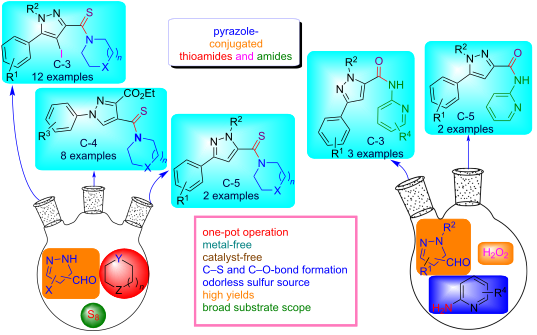
- synthetic flexibility of this methodology, we employed pyrazole C-5 carbaldehydes 9 and 10 for the synthesis of thioamide conjugates. It was noticed that the pyrazole-5-carbaldehydes 9 and 10 were more reactive as compared to pyrazole C-3 and C-4 carbaldehydes, leading to the formation of products 9C and
- 4F in good yields (61 and 70%), whereas, in the case of 5-nitro-2-aminopyridine (G), the anticipated product 1G was obtained in low yield (34%). To check the synthetic versatility of this oxidative amidation approach, we tested the scope of the methodology with pyrazole-5-carbaldehydes 9 and 10
- , and good to excellent yields of the desired molecules. Moreover, a practical synthetic utility of pyrazole-3/5-carbaldehydes has been explored through the formation of amide bond-tethered pyrazole-pyridine conjugates. This developed methodology was successfully carried out by employing commercially


Sequential hydrozirconation/Pd-catalyzed cross coupling of acyl chlorides towards conjugated (2E,4E)-dienones
Beilstein J. Org. Chem. 2023, 19, 176–185, doi:10.3762/bjoc.19.17
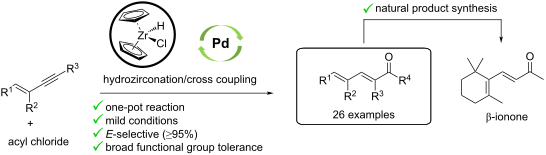
- ]. Since the early work by Wailes, Schwartz and Buchwald on the Schwartz reagent Cp2Zr(H)Cl and its reactivity towards alkynes, alkenes, and C–X double bonds particularly hydrozirconation has gained much attention [25][26][27][28][29][30]. It has been successfully employed in methodology studies [31][32



Practical synthesis of isocoumarins via Rh(III)-catalyzed C–H activation/annulation cascade
Beilstein J. Org. Chem. 2023, 19, 100–106, doi:10.3762/bjoc.19.10
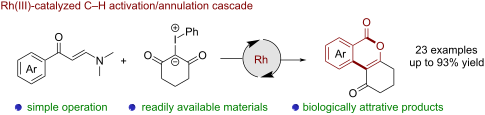
- , methyl, and phenyl groups underwent the current reaction efficiently, delivering the desired products 3ab–ae in moderate to good yields (43–93%). To demonstrate the synthetic utility of this methodology, a gram-scale synthesis of isocoumarin 3ia was firstly performed. Under the optimal conditions, the
- and diverse functionalization of the isocoumarin products highlight the tremendous synthetic potential of this methodology in chemical synthesis and drug discovery. Experimental A 10 mL screw-cap vial was charged with enaminone 1 (0.2 mmol), iodonium ylide 2 (0.6 mmol), [Cp*RhCl2]2 (6.2 mg, 5 mol


Redox-active molecules as organocatalysts for selective oxidative transformations – an unperceived organocatalysis field
Beilstein J. Org. Chem. 2022, 18, 1672–1695, doi:10.3762/bjoc.18.179
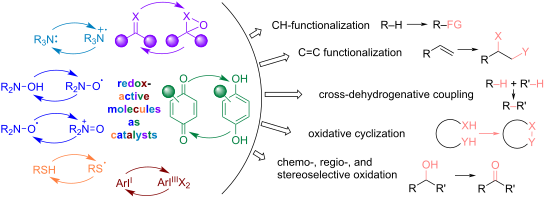
- Elena R. Lopat'eva Igor B. Krylov Dmitry A. Lapshin Alexander O. Terent'ev N. D. Zelinsky Institute of Organic Chemistry, Russian Academy of Sciences, Leninsky Prospect 47, Moscow, 119991, Russia 10.3762/bjoc.18.179 Abstract Organocatalysis is widely recognized as a key synthetic methodology in
- include their synthetic availability, wide opportunities for rational structure design, generally lower toxicity, air and water stability, metal-free nature, and the scalability of their production and use. These features have made organocatalysis a prospering area and an even more promising methodology



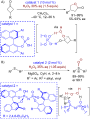








Rhodium-catalyzed intramolecular reductive aldol-type cyclization: Application for the synthesis of a chiral necic acid lactone
Beilstein J. Org. Chem. 2022, 18, 1642–1648, doi:10.3762/bjoc.18.176
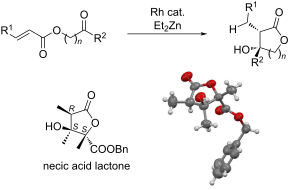
- described to give β-hydroxylactones with high diastereoselectivities. The stereoselectivity of this cyclization is highly solvent dependent and can give syn- or anti-β-hydroxylactones with high diastereoselectivity. This methodology was also applied to the synthesis of a chiral necic acid lactone which is a


Synthesis of (−)-halichonic acid and (−)-halichonic acid B
Beilstein J. Org. Chem. 2022, 18, 1629–1635, doi:10.3762/bjoc.18.174
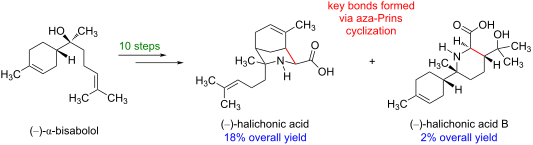
- [7], we viewed the halichonic acids as ideal targets to extend the scope of our synthetic methodology. Given the structural similarity between compounds (+)-1 and (+)-2 (and the fact that they were co-isolated from the same sponge), Tsukamoto et al. proposed that these natural products could be


Functionalization of imidazole N-oxide: a recent discovery in organic transformations
Beilstein J. Org. Chem. 2022, 18, 1575–1588, doi:10.3762/bjoc.18.168
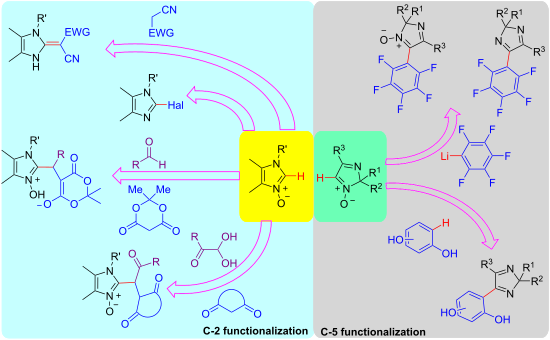
- proceeds through the nucleophilic substitution of a H-atom (SNH) at the C-5 position of the imidazole N-oxides. This reaction methodology can be considered as suitable process for the syntheses of bioactive imidazole compounds containing (poly)fluoroaryl moieties. Interestingly, in some of the
- containing both imidazole and phenolic moieties under mild conditions with two successive steps. The final products were obtained in good to excellent yields (70–95%). However, this methodology can be successfully used only for the polyphenols with at least two OH groups in one ring and is not applicable for
- %). Nucleophilic halogenation reactions In 2015, Evgeny I. Adiulin and co-workers reported a methodology for the deoxygenative nucleophilic halogenation of 2-unsubstituted imidazole N-oxides at the C-2 position using tosyl halogenides (TsHal) as halogen donor in THF as the solvent [18]. In this procedure, the







Cyclometalated iridium complexes-catalyzed acceptorless dehydrogenative coupling reaction: construction of quinoline derivatives and evaluation of their antimicrobial activities
Beilstein J. Org. Chem. 2022, 18, 1507–1517, doi:10.3762/bjoc.18.159
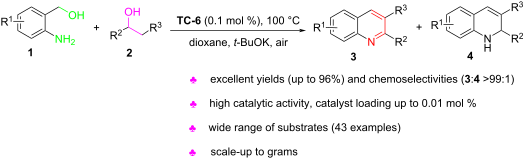
- were relatively lower (Table 3, entries 28, 29, 32, 33, 36, 37, and 40). It is worth noting that high conversions were also accomplished when 1-cyclohexylethanol and pentan-1-ol were employed in this catalytic system (Table 3, entries 43 and 44). The excellent developed methodology prompted us to


Design, synthesis, and evaluation of chiral thiophosphorus acids as organocatalysts
Beilstein J. Org. Chem. 2022, 18, 1471–1478, doi:10.3762/bjoc.18.154
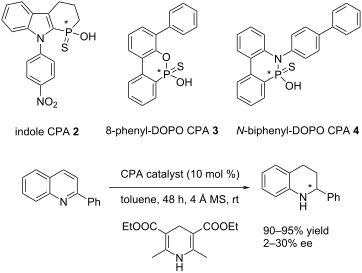
- cross-coupling [34] in excellent yield. Esterification of 6 with monomethyl H-phosphonate tert-butylamine salt [35] resulted in the mixed H-phosphonate ester 7 in excellent yield. Cyclization using our homolytic aromatic substitution methodology [36] gave P-heterocycle 8 in modest yield. Other methods
- -catalyzed hydrophosphinylation [45]. The key heterocyclization of 11 into 12 was accomplished using silver-promoted homolytic aromatic substitution [46], which was superior to our own manganese methodology (43% yield) [36]. Copper-catalyzed arylation [34] of 12 with iodobenzene and 4-nitroiodobenzene gave


Naphthalimide-phenothiazine dyads: effect of conformational flexibility and matching of the energy of the charge-transfer state and the localized triplet excited state on the thermally activated delayed fluorescence
Beilstein J. Org. Chem. 2022, 18, 1435–1453, doi:10.3762/bjoc.18.149
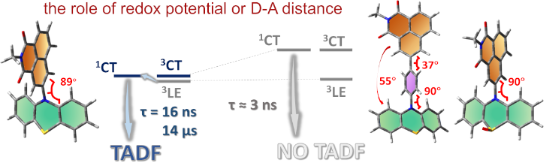
- ordering between the 3CT and 3LE states in NI-PTZ and NI-PTZ-O. The tuning of the energy order of the 3CT and 3LE state is achieved by the feasible oxidation of the PTZ unit in the dyads, while the other factors kept intact; this approach may become a promising methodology in the study of the entangled
Synthesis of C6-modified mannose 1-phosphates and evaluation of derived sugar nucleotides against GDP-mannose dehydrogenase
Beilstein J. Org. Chem. 2022, 18, 1379–1384, doi:10.3762/bjoc.18.142
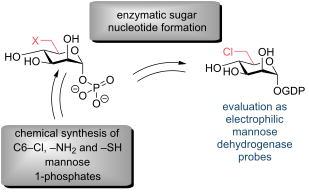
- dehydrogenase (GMD). We first synthesise C6-modified glycosyl 1-phosphates, incorporating 6-amino, 6-chloro and 6-sulfhydryl groups, followed by their evaluation as substrates for enzymatic pyrophosphorylative coupling. The development of this methodology enables access to GDP 6-chloro-6-deoxy-ᴅ-mannose and its


Dienophilic reactivity of 2-phosphaindolizines: a conceptual DFT investigation
Beilstein J. Org. Chem. 2022, 18, 1217–1224, doi:10.3762/bjoc.18.127
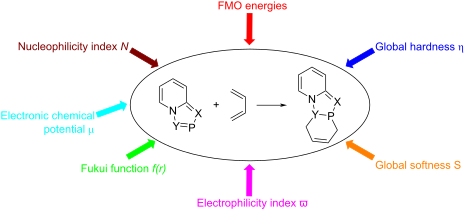
- , which was named as 2-phosphaindolizine perceiving it to result from a formal CH/P exchange at the 2-position of indolizine (2) (Figure 1) [1]. Subsequently a good library of these interesting compounds became accessible [1]. The methodology could be extended successfully to the synthesis of 1,3,4


From amines to (form)amides: a simple and successful mechanochemical approach
Beilstein J. Org. Chem. 2022, 18, 1210–1216, doi:10.3762/bjoc.18.126
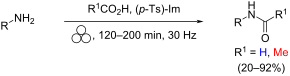
- compatible means in the view of a one-pot methodology for preparing isocyanides directly from amines [56]. When the amine 1 was reacted in the presence of Et3N, HCOOH, and p-Ts-Im [58] (Table 1, entry 5), the formamide was accompanied by a significant amount of sulfonamide (formamide/sulfonamide ratio: 70:30
- hand, the methodology was successfully applied to the synthesis of several formamides starting from a series of aromatic amines (Scheme 1). The N-formyl derivative 3 was prepared in good yields as well as formanilides bearing halogen substituents, which were well tolerated (Scheme 1, products 4 and 5
- outstanding results were achieved in the N-formylation of indoline (Scheme 1, formamide 10). The present methodology could also be effectively applied to the synthesis of N-formylmorpholine (Scheme 1, product 11). Aliphatic primary amines can be more challenging substrates [22]. In fact, when the reaction was
Mechanochemical bottom-up synthesis of phosphorus-linked, heptazine-based carbon nitrides using sodium phosphide
Beilstein J. Org. Chem. 2022, 18, 1203–1209, doi:10.3762/bjoc.18.125
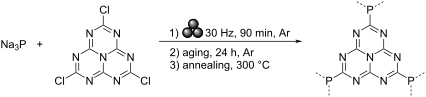
- 31P NMR chemical shifts were calculated using the plane-wave density function theory (DFT) code CASTEP v20.11 (see Supporting Information File 1 for full computational details) [45]. In the absence of an experimentally resolved crystal structure for g-h-PCN, we followed a similar methodology to our


First example of organocatalysis by cathodic N-heterocyclic carbene generation and accumulation using a divided electrochemical flow cell
Beilstein J. Org. Chem. 2022, 18, 979–990, doi:10.3762/bjoc.18.98
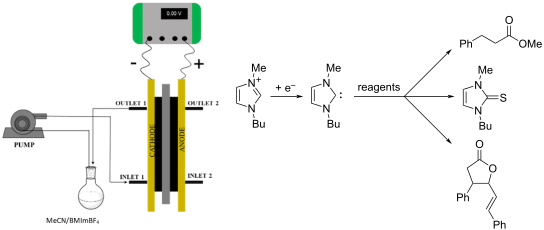
- in a continuous flow electrochemical process, the flow methodology was applied to the self-annulation of cinnamaldehyde, a classical NHC-catalyzed reaction (Scheme 4). All the experiments were carried out using a solution of 0.1 M BMImBF4 in acetonitrile (20 mL) as catholyte, stainless steel as


Morita–Baylis–Hillman reaction of 3-formyl-9H-pyrido[3,4-b]indoles and fluorescence studies of the products
Beilstein J. Org. Chem. 2022, 18, 926–934, doi:10.3762/bjoc.18.92
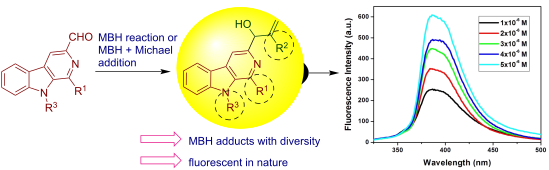
- methodology is decorated with several advantages like scalability and selectivity. Additionally, no column chromatographic purification was required at any stage and each step was high yielding. After the synthesis of starting materials, the Morita–Baylis–Hillman reaction was explored for C-3





