


Search results
Search for "environmentally friendly" in Full Text gives 205 result(s) in Beilstein Journal of Organic Chemistry. Showing first 200.
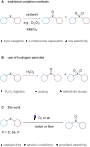
Selective and scalable oxygenation of heteroatoms using the elements of nature: air, water, and light
Beilstein J. Org. Chem. 2023, 19, 1146–1154, doi:10.3762/bjoc.19.82
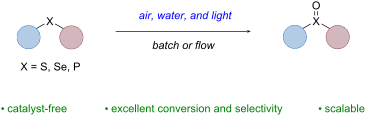
- , 9800 Deinze, Belgium 10.3762/bjoc.19.82 Abstract Sustainable oxidation protocols aim to provide an environmentally friendly and cost-effective method for the production of various chemicals and materials. The development of such protocols can lead to reduced energy consumption, fewer harmful





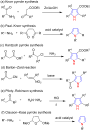
Clauson–Kaas pyrrole synthesis using diverse catalysts: a transition from conventional to greener approach
Beilstein J. Org. Chem. 2023, 19, 928–955, doi:10.3762/bjoc.19.71
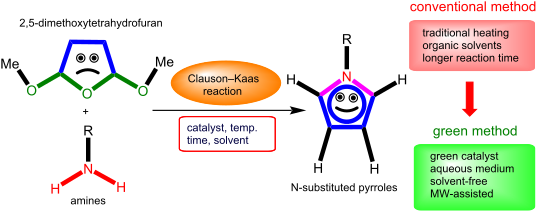
- well-known method for synthesizing a large number of N-substituted pyrroles. In recent years, due to global warming and environmental concern, research laboratories and pharmaceutical industries around the world are searching for more environmentally friendly reaction conditions for synthesizing
- afford various N-substituted pyrroles 27 in 89–94% yields (Scheme 12). A major advantage of this protocol is that in the case of chiral amines, pyrrole formation proceeds without detectable epimerization. In 2013 Azizi et al. [66] have demonstrated a simple and environmentally friendly protocol for the
- ] demonstrated a mild and environmentally friendly biomimetic Clauson–Kaas synthesis of N-substituted pyrroles 37 through the reaction between various arylamines 36 and 2,5-DMTHF (2) using a sustainable catalyst β-cyclodextrin-SO3H in the nontoxic green solvent H2O without the formation of side products (Scheme




Photoredox catalysis enabling decarboxylative radical cyclization of γ,γ-dimethylallyltryptophan (DMAT) derivatives: formal synthesis of 6,7-secoagroclavine
Beilstein J. Org. Chem. 2023, 19, 918–927, doi:10.3762/bjoc.19.70
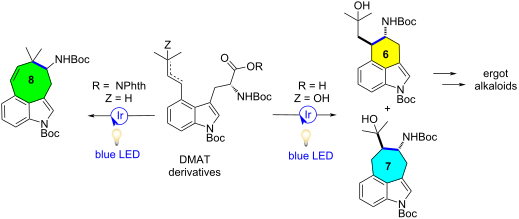
- accomplish by more conventional procedures, enables the synthesis of ergot alkaloid precursors. In addition, this work describes a mild, environmentally friendly method to activate, reductively and oxidatively, natural carboxylic acids for decarboxylative C–C bond formation by exploiting the same
- are usually more convergent, enabling a more diverse chemical space in a rapid fashion [1][2][3][4][5][6][7][8][9][10][11][12][13][14][15]. Currently, increasing numbers of synthetic chemists are developing photocatalytic processes to make molecules efficiently and in an environmentally friendly


Synthesis of aliphatic nitriles from cyclobutanone oxime mediated by sulfuryl fluoride (SO2F2)
Beilstein J. Org. Chem. 2023, 19, 901–908, doi:10.3762/bjoc.19.68
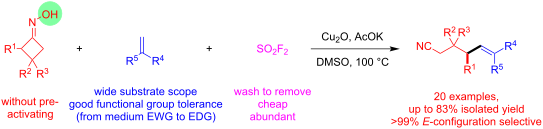
- ) carbon, which leads to side reactions of the alkyl intermediates [14][19][20]. Besides, most of the C(sp2)–C(sp3) reactions employ organic halides or organometallic reagents [21][22][23], which are not environmentally friendly. Recently, based on the activation effect of O-acyloximes on N–O bonds [24][25


Cyclodextrins as building blocks for new materials
Beilstein J. Org. Chem. 2023, 19, 889–891, doi:10.3762/bjoc.19.66
- fact that CDs are nontoxic to humans and to the environment and used to develop greener synthetic routes and strategies, CD-based materials are considered safe and environmentally friendly [18]. This includes, among other characteristics, that they are edible, biodegradable, ecological, and
Synthesis of substituted 8H-benzo[h]pyrano[2,3-f]quinazolin-8-ones via photochemical 6π-electrocyclization of pyrimidines containing an allomaltol fragment
Beilstein J. Org. Chem. 2023, 19, 778–788, doi:10.3762/bjoc.19.58
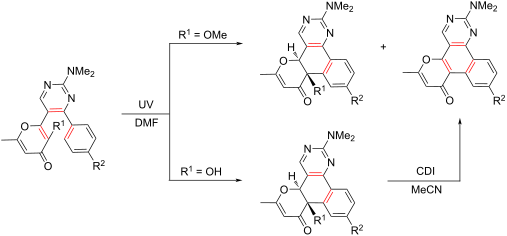
- systems which are unavailable by other methods. Wherein, usually UV-promoted reactions are environmentally friendly due to the absence of toxic reagents, which is especially perspective in context of green chemistry [9][10]. Thus, studies of the photochemical behavior of organic compounds play an


Honeycomb reactor: a promising device for streamlining aerobic oxidation under continuous-flow conditions
Beilstein J. Org. Chem. 2023, 19, 752–763, doi:10.3762/bjoc.19.55
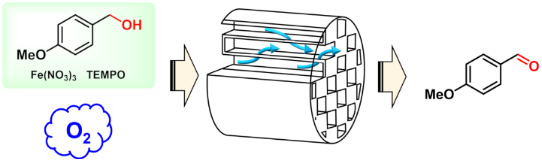
- for low-cost and environmentally friendly aerobic oxidation and further optimized it to improve the reaction rate. Reaction optimization for aerobic oxidation under batch conditions Based on entry 3 in Table 1, we next focused on optimizing the reaction to increase the reaction rate (Table 2). Open


Mechanochemical solid state synthesis of copper(I)/NHC complexes with K3PO4
Beilstein J. Org. Chem. 2023, 19, 440–447, doi:10.3762/bjoc.19.34
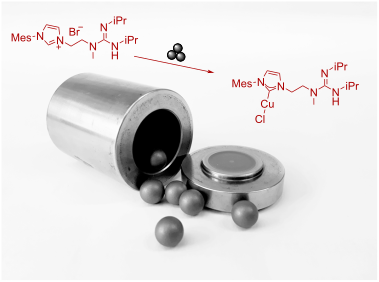
- challenge for syntheses is the development of green and environmentally friendly routes to access value-added products. One important way to more economical syntheses is the concept of catalysis to avoid stoichiometric amounts of reactants and to design reactions more atom efficient [1][2][3]. However, the


Investigation of cationic ring-opening polymerization of 2-oxazolines in the “green” solvent dihydrolevoglucosenone
Beilstein J. Org. Chem. 2023, 19, 217–230, doi:10.3762/bjoc.19.21
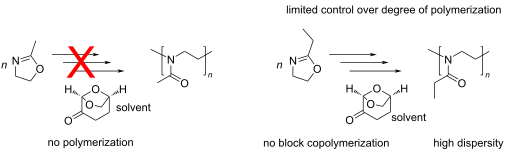
- ]. Therefore, choosing environmentally benign solvents becomes ever more relevant [27]. Accordingly, some research groups have been also looking for "green" and safer solvents suitable for CROP of 2-oxazolines. "Green" solvents are considered environmentally friendly, less hazardous solvents that make a
- , environmentally friendly, highly stable towards oxidation, yet degrades into water and carbon dioxide [27][38]. Therefore, DLG is an interesting candidate to investigate as solvent for the CROP of 2-oxazolines. Accordingly, in this work, we present the first examples of the successful CROP of POx and discuss the


From amines to (form)amides: a simple and successful mechanochemical approach
Beilstein J. Org. Chem. 2022, 18, 1210–1216, doi:10.3762/bjoc.18.126
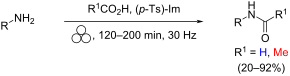
- substantial excess of formyl or acyl sources, often used as a solvent. Mechanochemistry has been established as a powerful tool for the rapid, clean, and environmentally friendly synthesis of organic compounds, avoiding bulk solvent and restrictions of solvent-based chemistry [27][28][29][30][31][32][33][34
Electrogenerated base-promoted cyclopropanation using alkyl 2-chloroacetates
Beilstein J. Org. Chem. 2022, 18, 1116–1122, doi:10.3762/bjoc.18.114
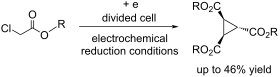
- electrochemical production of cyclopropane derivatives is an environmentally friendly and easy to perform synthetic procedure. Keywords: alkyl 2-chloroacetates; cyclopropane derivatives; divided cell; electro-reduction; Introduction In organic chemistry, cyclopropanes and their related compounds have been


Electrochemical vicinal oxyazidation of α-arylvinyl acetates
Beilstein J. Org. Chem. 2022, 18, 1026–1031, doi:10.3762/bjoc.18.103
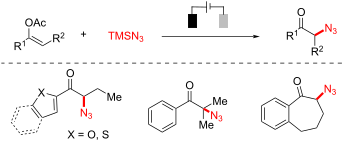
- 200240, China 10.3762/bjoc.18.103 Abstract α-Azidoketones are valuable and versatile building blocks in the synthesis of various bioactive small molecules. Herein, we describe an environmentally friendly and efficient electrochemical vicinal oxyazidation protocol of α-arylvinyl acetates to afford
- water to form the desired product E. According to our 18O labeling experiment, the oxygen source of the newly installed carbonyl group probably originates from the vinyl acetate, not from H2O. Conclusion In summary, we have developed an environmentally friendly and efficient electrochemical oxyazidation




Automated grindstone chemistry: a simple and facile way for PEG-assisted stoichiometry-controlled halogenation of phenols and anilines using N-halosuccinimides
Beilstein J. Org. Chem. 2022, 18, 999–1008, doi:10.3762/bjoc.18.100
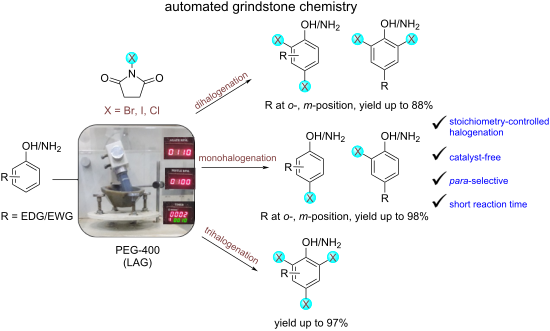
- ortho- and para-positions. The gram-scale reaction shows similar efficiency like smaller batches indicating easy scale-up of this protocol. The method is environmentally friendly and cost-effective having key attributes like simple instrumentation, no aqueous workup, short reaction time, and mild




Inductive heating and flow chemistry – a perfect synergy of emerging enabling technologies
Beilstein J. Org. Chem. 2022, 18, 688–706, doi:10.3762/bjoc.18.70
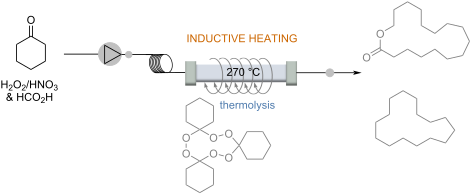
- hydrogenation. 2.3 Dry and steam methane reforming The commencement of the energy transformation is associated with the search for alternative and more environmentally friendly energy sources [27]. The dry reforming of methane is a particularly interesting process in this context (Scheme 2, reaction 1). A
- continuous process could be established by oxidation with molecular oxygen introduced into the reaction stream via a tube-in-tube membrane reactor, a process which should be very attractive for industrial applications, as oxygen or air act as cheap and environmentally friendly oxidants [82]. An interesting




Mechanochemical halogenation of unsymmetrically substituted azobenzenes
Beilstein J. Org. Chem. 2022, 18, 680–687, doi:10.3762/bjoc.18.69
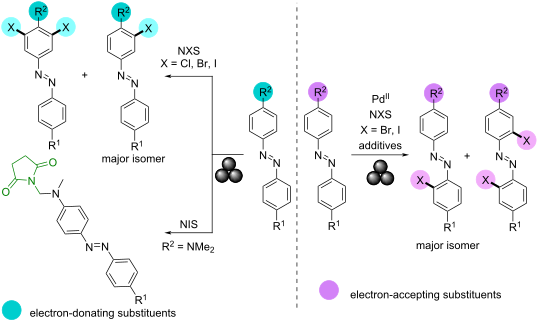
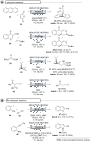
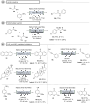
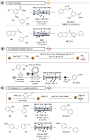
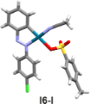
- application of solid-state methods [23][24][25][26][27][28][29][30][31][32][33][34][35][36][37][38][39][40][41][42][43][44][45][46], particularly ball milling [26][27][28][29][30][31][32][33][34][35][36][37][38][39][40][41][42][43][44][45][46], which has proven to be an environmentally friendly and powerful
- studied functional groups, and new methods for their preparation, especially by environmentally friendly protocols, are of great synthetic importance in organic chemistry [54]. The succinimide products L4-III and L5-III (Table 1, entries 11 and 12) were obtained within one and five hours in 39 and 38





DDQ in mechanochemical C–N coupling reactions
Beilstein J. Org. Chem. 2022, 18, 639–646, doi:10.3762/bjoc.18.64
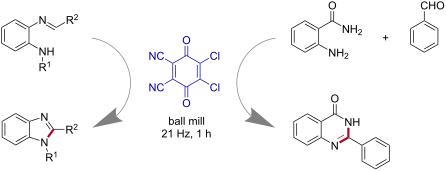
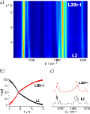
- practice by applying the strategies like domino, cascade, or tandem [11][12][13]. These environmentally friendly approaches set forth the journey of facilitating sustainable systems by using mechanochemical methods to access small organic compounds [3]. Due to the high reduction potential of the quinone


Synthesis of 3,4,5-trisubstituted isoxazoles in water via a [3 + 2]-cycloaddition of nitrile oxides and 1,3-diketones, β-ketoesters, or β-ketoamides
Beilstein J. Org. Chem. 2022, 18, 446–458, doi:10.3762/bjoc.18.47

- hours, which provides an environmentally friendly access to 3,4,5-trisubstituted isoxazoles, an important class of structures found in numerous bioactive natural products and pharmaceuticals. Additionally, we optimized the reaction conditions to produce trifluoromethyl-substituted isoxazoles, a
- chlorides to form furoxans also known as 1,2,5-oxadiazole 2-oxides, a class of structures with important biological activities due to their unique electronic nature and coordination ability. Keywords: environmentally friendly; furoxans; 1,2,5-oxadiazole 2-oxides; trifluoromethyl-substituted isoxazoles
- only is environmentally friendly, but also finds significant applications in biological systems (e.g., click reactions, bio-conjugation, and bio-orthogonal chemistry). One of such applications is ligation chemistry, in which “click” chemistry through a [3 + 2] biorthogonal cycloaddition between nitrile



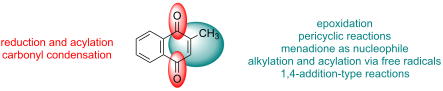
Menadione: a platform and a target to valuable compounds synthesis
Beilstein J. Org. Chem. 2022, 18, 381–419, doi:10.3762/bjoc.18.43
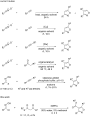
- Ti-based [65][67], Nb-based [68][69], and Au-based [70] heterogeneous systems. In addition to being more efficient, given the obtained atom economy, the reactions that use these catalytic heterogeneous systems are also presented as environmentally friendly. They are cleaner, either because of the low
- generation of waste or the use of environmentally friendly conditions, and they also allow recycling catalysts without losing efficiency [67][68][70]. Kholdeeva and co-workers reported the use of 30% aqueous H2O2 as oxidant and hydrothermally stable mesoporous mesophase titanium silicates (Ti-MMM-2) as
- generation of metallic residues that can be toxic to the environment or act as contaminants of the desired products, such as pharmaceuticals. This problem has led to the search for clean and environmentally friendly methods that reduce or do not generate metallic residues. In 2001, Tohma and co-workers


Synthesis of 5-unsubstituted dihydropyrimidinone-4-carboxylates from deep eutectic mixtures
Beilstein J. Org. Chem. 2022, 18, 331–336, doi:10.3762/bjoc.18.37
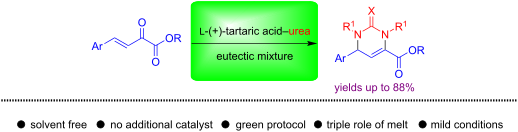
- ] based on carbohydrates, urea, and inorganic salts as an alternative to conventional solvents for carrying out a variety of organic transformations [32]. The stable melts are environmentally friendly as they are readily available from bulk renewable resources. Their simple production allows the


Recent developments and trends in the iron- and cobalt-catalyzed Sonogashira reactions
Beilstein J. Org. Chem. 2022, 18, 262–285, doi:10.3762/bjoc.18.31
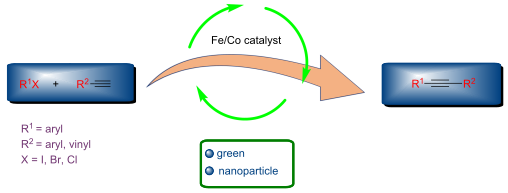
- original Sonogashira coupling. Both, iron and cobalt catalysts are considered environmentally friendly as they are non-toxic and inexpensive, and thus have significance in modern organic synthesis. The use of an aqueous medium in Fe-catalyzed reactions represents the most reasonable and green option for
- cross-coupling reactions Homogeneous green protocols Tsai et al. discussed an efficient, simple and environmentally friendly method for the coupling of arylynols 3 with an aryl halide [21]. This strategy discloses a one pot reaction catalyzed by FeCl3 in an aqueous medium associated with the cationic
- graphene and the promotional effect of Co-dopants which lay out more Pd active site for the reactants. Mahyari et al. reported a facile, efficient, and environmentally friendly protocol for the coupling of aryl halides and phenylacetylene using a diverse strategy. Third generation polypropyleneimine




Green synthesis of C5–C6-unsubstituted 1,4-DHP scaffolds using an efficient Ni–chitosan nanocatalyst under ultrasonic conditions
Beilstein J. Org. Chem. 2022, 18, 133–142, doi:10.3762/bjoc.18.14
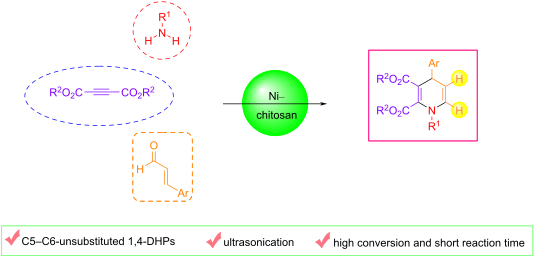
- new C5–C6-unsubstituted 1,4-DHPs under ultrasonic irradiation. The important focus of the methodology was to develop an environmentally friendly protocol with a short reaction time and a simple reaction procedure. The other advantages of this protocol are a wide substrate scope, a very good product
- . In contrast, our work unites various aspects of green chemistry, such as a minimal reaction time, a high conversion rate, a green solvent, environmentally friendly reaction conditions, and an effortless separation and recyclability of the catalyst. Altogether, the detailed summary in Table 3
- highlights the advantages of employing the Ni–chitosan NPs for the synthesis of C5–C6-unsubstituted 1,4-DHPs under ultrasonication compared to the previous methodologies. Conclusion In this protocol, our aim was to develop an environmentally friendly green methodology for the synthesis of biologically




Efficient N-arylation of 4-chloroquinazolines en route to novel 4-anilinoquinazolines as potential anticancer agents
Beilstein J. Org. Chem. 2021, 17, 2968–2975, doi:10.3762/bjoc.17.206
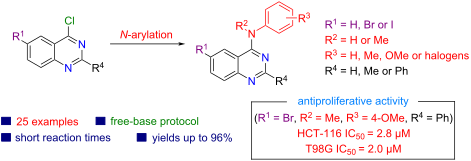
- being a more environmentally friendly methodology. To evaluate the antiproliferative properties of the 4-anilinoquinazolines we obtained in this study, we screened the synthesized compounds against a set of tumor cell lines including HCT-116 (human colorectal carcinoma), MCF-7 (human breast


A two-phase bromination process using tetraalkylammonium hydroxide for the practical synthesis of α-bromolactones from lactones
Beilstein J. Org. Chem. 2021, 17, 2906–2914, doi:10.3762/bjoc.17.198
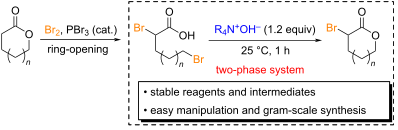
- at the 10 mmol scale using simple operations. α-Bromo-δ-valerolactone, which is extremely reactive and difficult to isolate, could be isolated and stored in a freezer for about one week using the developed method. Optimizing the solvent for environmentally friendly large-scale syntheses revealed that
- (Table 5, entries 1–5). Although the use of other ketones as solvents also afforded 3a in moderate yields, MEK proved to be the most suitable replacement for CHCl3 (Table 5, entries 5–8). This environmentally friendly procedure was used to synthesize other lactones. For instance, this method was used to


Synthetic strategies toward 1,3-oxathiolane nucleoside analogues
Beilstein J. Org. Chem. 2021, 17, 2680–2715, doi:10.3762/bjoc.17.182
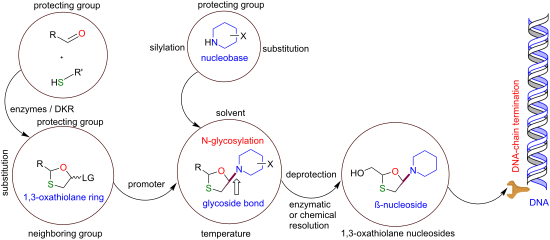
- a single enantiomer via an in situ stereoinversion, and it was implemented in some of the examples described herein. Therefore, for the construction of the 1,3-oxathiolane sugar ring, an extensive number of efficient and environmentally friendly chemical and enzymatic approaches has been established


Transition-metal-free intramolecular Friedel–Crafts reaction by alkene activation: A method for the synthesis of some novel xanthene derivatives
Beilstein J. Org. Chem. 2021, 17, 2203–2208, doi:10.3762/bjoc.17.142
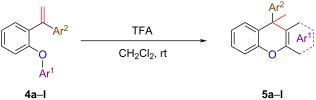
- ]. Therefore, there has been an increase in arylation methods using Friedel–Crafts alkylation (FCA) protocols without transition metals [35][36]. Environmentally friendly methods, in which metal-free catalysts are used, have come to the fore and are gaining importance because there are many disadvantages of





