


Search results
Search for "nucleophilic substitution" in Full Text gives 361 result(s) in Beilstein Journal of Organic Chemistry. Showing first 200.
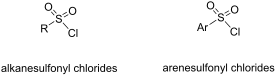
Mechanistic studies of the solvolysis of alkanesulfonyl and arenesulfonyl halides
Beilstein J. Org. Chem. 2022, 18, 120–132, doi:10.3762/bjoc.18.13
- defining mechanisms of nucleophilic substitution at sulphur are known to the writer...”. Examination of this section of the text shows, however, that it is limited to a consideration of substitution at the sulfur of sulfinates and reactions of the general type illustrated in Equation 3 and reactions
- nucleophilic substitution taking place at the sulfur. 4. Consideration of evidence from applications of the extended Grunwald–Winstein equation Consistent with the bimolecular nature of the solvolyses of alkanesulfonyl chlorides and arenesulfonyl chlorides [49][55][56][57][58][59][60][61][62][63][64][65][66


Chemoselective N-acylation of indoles using thioesters as acyl source
Beilstein J. Org. Chem. 2022, 18, 89–94, doi:10.3762/bjoc.18.9
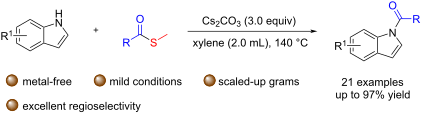
- , heterocycles, such as carbazole, can also be used as nucleophiles in this reaction. Keywords: indole; N-acylation; nucleophilic substitution; thioesters; Introduction Molecules containing N-acylindoles have attracted wide attention in the synthetic polymers and pharmaceutical industry because of their unique
- acid (4) (Scheme 4, reaction 4). A plausible reaction mechanism has been proposed based on the results of the control experiments. As shown in Scheme 5, the reaction starts with a base-promoted deprotonation of indole forming intermediate A. In the next step nucleophilic substitution between


1,2-Naphthoquinone-4-sulfonic acid salts in organic synthesis
Beilstein J. Org. Chem. 2022, 18, 53–69, doi:10.3762/bjoc.18.5
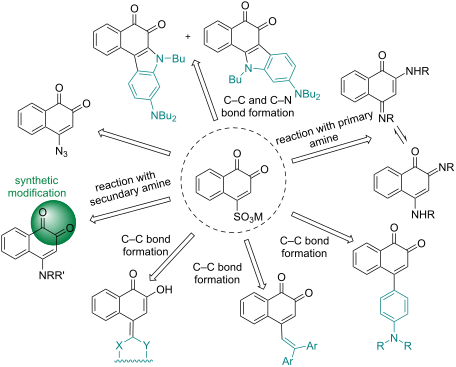
- recognition of cholylglycine, which is a combination of cholic acid and glycine. The β-cyclodextrin/graphene oxide composite forms an inclusion complex with a β-NQS guest. The amino group of cholylglycine can bind to β-NQS by a nucleophilic substitution reaction, resulting in a decrease in the electrochemical


A two-phase bromination process using tetraalkylammonium hydroxide for the practical synthesis of α-bromolactones from lactones
Beilstein J. Org. Chem. 2021, 17, 2906–2914, doi:10.3762/bjoc.17.198
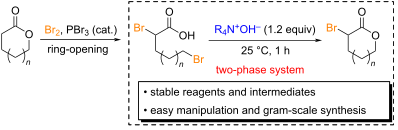
- conditions, and its purity quickly deteriorated even when stored in a freezer with shading (see Supporting Information File 1), resulting in trace amounts of α-functionalized lactones using the above-mentioned two-step method. Hence, we focused on sequential nucleophilic substitution in a two-phase system
- then phase-transferred into the organic phase, with subsequent nucleophilic substitution at the α-position of 3a proceeding directly to produce a variety of α-substituted lactones, along with the regeneration of n-Bu4N+Br− (Scheme 5). To demonstrate the applicability of this protocol, we investigated
- 2a. Synthesis of α-functionalized lactones using the two-phase system. Synthesis of unsymmetrically functionalized sulfide 5 via the two-phase system-promoted intramolecular cyclization of 2b. Sequential nucleophilic substitution in the two-phase system. One-pot synthesis of 2-phenylthio-α


Synthesis of a novel aminobenzene-containing hemicucurbituril and its fluorescence spectral properties with ions
Beilstein J. Org. Chem. 2021, 17, 2840–2847, doi:10.3762/bjoc.17.195
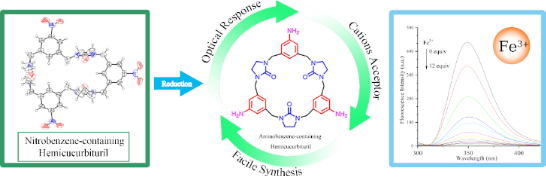
- intensity. Conclusion In summary, we have presented a novel type of hemicucurbituril derivative modified with aminobenzene. Based on the fragment coupling strategy, the nitrobenzene-containing hemicucurbituril 9 was synthesized by nucleophilic substitution reaction with two fragments 7 and 8. The desired


Selective sulfonylation and isonitrilation of para-quinone methides employing TosMIC as a source of sulfonyl group or isonitrile group
Beilstein J. Org. Chem. 2021, 17, 2822–2831, doi:10.3762/bjoc.17.193
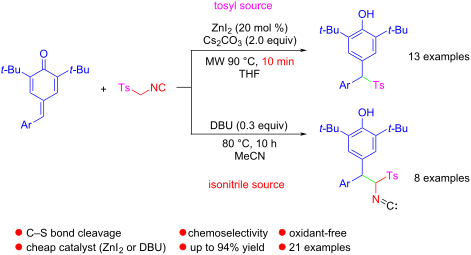
- standard conditions, the desired products 3b or 4b were obtained with yields of 92% and 88%, respectively. Second, the sulfonylated diarylmethane 3b obtained through the C–S bond-cleavage sulfonylation reaction is a versatile building block for preparing diarylmethane derivatives through a nucleophilic
- substitution process. For example, compound 3b reacted with difluoroenolate to form the difluoroalkylated diarylmethane 5 in 83% yield via a Cu(OAc)2-catalyzed hydrodifluoroalkylation reaction [52]. Two other examples were the use of photoredox catalysis to generate acyl anions in situ from aromatic carboxylic


Me3Al-mediated domino nucleophilic addition/intramolecular cyclisation of 2-(2-oxo-2-phenylethyl)benzonitriles with amines; a convenient approach for the synthesis of substituted 1-aminoisoquinolines
Beilstein J. Org. Chem. 2021, 17, 2765–2772, doi:10.3762/bjoc.17.186
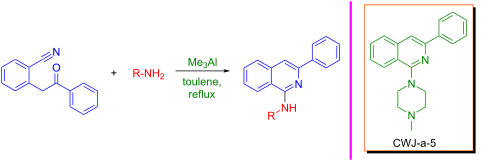
- the development of several approaches for the efficient construction of these heterocyclic frameworks (Scheme 1). Traditional preparations for 1-aminoisoquinolines include nucleophilic substitution of 1-haloisoquinolines with amines either employing a base [31][32][33][34][35] or a transition metal


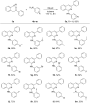


Direct C(sp3)–H allylation of 2-alkylpyridines with Morita–Baylis–Hillman carbonates via a tandem nucleophilic substitution/aza-Cope rearrangement
Beilstein J. Org. Chem. 2021, 17, 2505–2510, doi:10.3762/bjoc.17.167
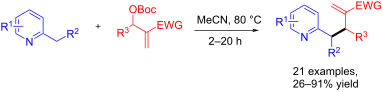
- (sp3)–H allylic alkylation of 2-alkylpyridines with Morita–Baylis–Hillman (MBH) carbonates is described. A plausible mechanism of the reaction might involve a tandem SN2’ type nucleophilic substitution followed by an aza-Cope rearrangement. Various alkyl substituents on 2-alkylpyridines were tolerated
- demonstrated a direct C(sp3)–H allylic alkylation reaction of 2-alkylpyridines with MBH carbonates with mild and simple operation. The process does not need either a base or a transition metal catalyst. The mechanism of this reaction was envisioned involving a tandem SN2’ type nucleophilic substitution


A novel methodology for the efficient synthesis of 3-monohalooxindoles by acidolysis of 3-phosphate-substituted oxindoles with haloid acids
Beilstein J. Org. Chem. 2021, 17, 2321–2328, doi:10.3762/bjoc.17.150
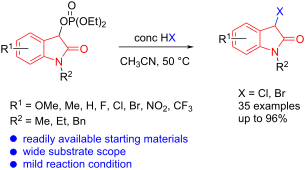
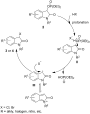
- challenge in chemistry. In order to achieve this goal, and on the basis of our previous experiences in the functionalization of oxindoles [33][34], we herein designed a nucleophilic substitution method of an isatin-derived 3-phosphate-substituted oxindole with haloid acids, leading to 3-monohalooxindoles


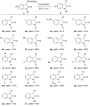


(Phenylamino)pyrimidine-1,2,3-triazole derivatives as analogs of imatinib: searching for novel compounds against chronic myeloid leukemia
Beilstein J. Org. Chem. 2021, 17, 2260–2269, doi:10.3762/bjoc.17.144
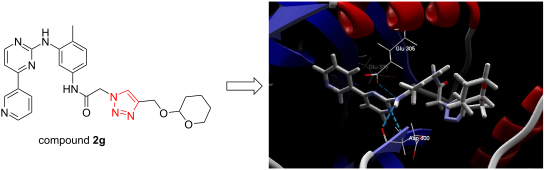
- )pyrimidin-2-amine (5) was obtained from the aromatic nucleophilic substitution reaction of intermediate PAPP via the formation of a diazonium salt with 84% yield, which was characterized, and its data agreed with those in the literature [29]. The carbonyl nucleophilic substitution reaction between
- obtained from the nucleophilic substitution reaction of intermediate 8 in 85% yield. The 1H and 13C NMR spectra of compounds 8 and 9 were similar, but in the IR spectrum of intermediate 9, it was possible to observe the characteristic stretching of the azide group at 2103 cm−1. The 1,3-dipolar


Transition-metal-free intramolecular Friedel–Crafts reaction by alkene activation: A method for the synthesis of some novel xanthene derivatives
Beilstein J. Org. Chem. 2021, 17, 2203–2208, doi:10.3762/bjoc.17.142
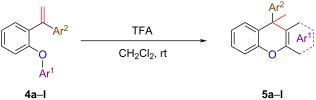
- alcohols with diaryliodonium salts [26], the Sc(OTf)3-catalyzed domino reaction [27], and the iodine-catalyzed nucleophilic substitution reaction of xanthen-9-ol [28]. As an example of an intramolecular hydroarylation of an olefin, 9,10-dihydroacridines, which are N derivatives of xanthenes, were


Preparation of mono-substituted malonic acid half oxyesters (SMAHOs)
Beilstein J. Org. Chem. 2021, 17, 2085–2094, doi:10.3762/bjoc.17.135

- usually achieved by a nucleophilic substitution of an alkyl halide by the deprotonated malonate [12][13][14][15][16][17][18][19], but other strategies could be envisioned: Cu-catalyzed arylation reactions for aryl-substituted MAHOs [20][21][22][23]; Knoevenagel/reduction sequences for benzyl-substituted


Asymmetric organocatalyzed synthesis of coumarin derivatives
Beilstein J. Org. Chem. 2021, 17, 1952–1980, doi:10.3762/bjoc.17.128
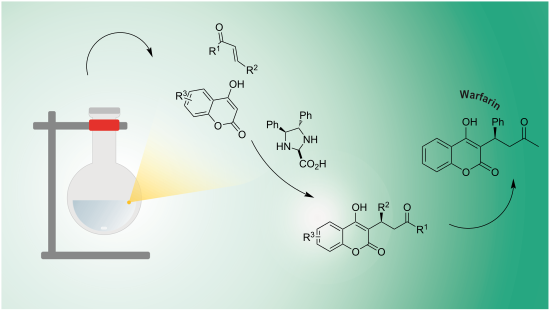
- was described by Sun et al. [46]. In this method, the catalyst (DHQ)2PYR 42 reacts with tert-butyl 2-bromoacetate, and then an ylide is formed by the base Cs2CO3. After a conjugated addition of this intermediate to the coumarin 43 followed by nucleophilic substitution, the corresponding cyclopropa[c
- described an allylic alkylation reaction between 3-cyano-4-methylcoumarins 39 and Morita–Baylis–Hillman (MBH) carbonates 40 [45]. In this case, the catalyst (DHQ)2PYR 42 activates the MBH substrate and generates the dienolate in the vinylogous coumarin moiety, acting as a base. After the nucleophilic
- substitution reaction between the coumarin and the activated MBH substrate, it is possible to obtain functionalized coumarins 41 (Scheme 13). Furthermore, the absolute configuration of the stereogenic center was determined by X-ray crystallography. The enantioselective synthesis of cyclopropa[c]coumarins 45




Regioselective N-alkylation of the 1H-indazole scaffold; ring substituent and N-alkylating reagent effects on regioisomeric distribution
Beilstein J. Org. Chem. 2021, 17, 1939–1951, doi:10.3762/bjoc.17.127
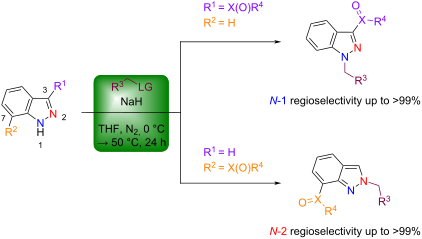
- followed by the nucleophilic substitution of alkylating reagent R2–X to selectively give the desired N-1 regioisomer 68. It is likely that a mixture of the solvent-separated ion pairs 65 and 66 predominate, when using polar solvents such as DMF [24]. Furthermore, precluding tight ion pair formation through


Development of N-F fluorinating agents and their fluorinations: Historical perspective
Beilstein J. Org. Chem. 2021, 17, 1752–1813, doi:10.3762/bjoc.17.123




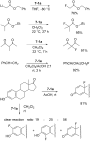


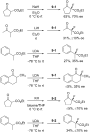


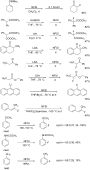


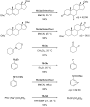















Electron-rich triarylphosphines as nucleophilic catalysts for oxa-Michael reactions
Beilstein J. Org. Chem. 2021, 17, 1689–1697, doi:10.3762/bjoc.17.117
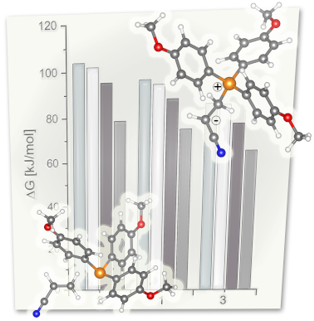
- generating the ion pair iii. In the final step, the α-carbanionic species in iii gets protonated by an alcohol generating the oxa-Michael addition product (iv) and regenerating ii (Scheme 1). Additionally, the ion par ii might directly react via a nucleophilic substitution of the phosphonium group by the


Fritsch–Buttenberg–Wiechell rearrangement of magnesium alkylidene carbenoids leading to the formation of alkynes
Beilstein J. Org. Chem. 2021, 17, 1352–1359, doi:10.3762/bjoc.17.94
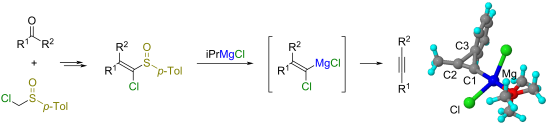
- ethylmagnesium bromide (Scheme 7c) [16]. The nucleophilic substitution of the halide on the magnesium atom with the carbenoid carbon atom having a halogen substituent is a plausible mechanism for the isomerization. The FBW rearrangement of magnesium alkylidene carbenoids was studied by using DFT calculations




Structural effects of meso-halogenation on porphyrins
Beilstein J. Org. Chem. 2021, 17, 1149–1170, doi:10.3762/bjoc.17.88
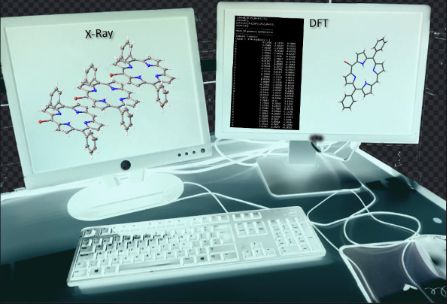
- product has been previously reported [56], this appears to be the first instance of the free base counterpart. One such study, using (5,15-bis(4-methylphenyl)porphyrinato)zinc(II), alludes to nucleophilic substitution by Cl to form the chlorinated product, with the only possible source of the exogenous Cl


N-tert-Butanesulfinyl imines in the asymmetric synthesis of nitrogen-containing heterocycles
Beilstein J. Org. Chem. 2021, 17, 1096–1140, doi:10.3762/bjoc.17.86

- of anti/syn diastereoisomers. Treatment of compounds 24 with potassium hexamethyldisilazide provided vinylaziridines 22 through an intramolecular cyclization step. This intramolecular nucleophilic substitution is a stereospecific process. In the case of aromatic compounds 24, trans-vinylaziridines
- , followed by an intramolecular nucleophilic substitution to form the aziridines ring. On the contrary, aziridines 32 were obtained starting from dichloromethyltrimethylsilane (33, [Si] = TMS), and adding the chiral imine before HMPA to the reaction mixture. The nucleophilic addition of metaloenaime occurred
- an intramolecular nucleophilic substitution of the tosylate of the resulting primary alcohol (Scheme 15). This methodology was applicable to the synthesis of 1-phenyl-2-azaspiro[3.4]octane (45, n = 2, R = Ph) and 1-phenyl-2-azaspiro[3.5]nonane (45, n = 3, R = Ph). The structure and absolute


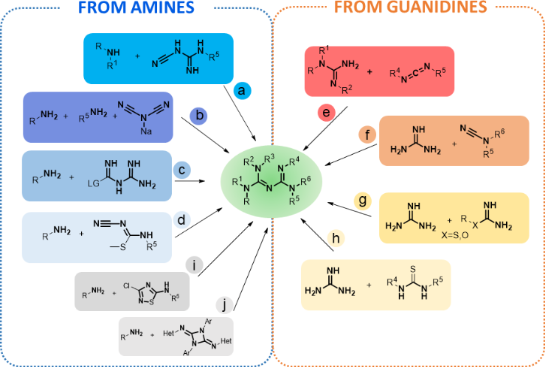
Synthetic accesses to biguanide compounds
Beilstein J. Org. Chem. 2021, 17, 1001–1040, doi:10.3762/bjoc.17.82


Synthesis of 10-O-aryl-substituted berberine derivatives by Chan–Evans–Lam coupling and investigation of their DNA-binding properties
Beilstein J. Org. Chem. 2021, 17, 991–1000, doi:10.3762/bjoc.17.81
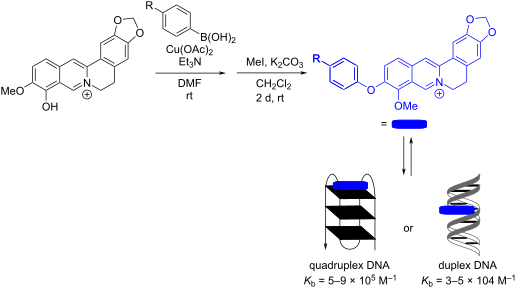
- strands [30]. Due to their straightforward synthetic accessibility by substitution at the 9-hydroxy functionality of berberrubine (1b), 9-O-substituted berberine derivatives are particularly attractive. But so far, only functionalization at this position by alkylation [23][24][25][26] and nucleophilic
- substitution [17][18][19][20][21] of berberrubine (1b) have been performed, whereas the direct O-arylation of berberrubine has not been accomplished, yet, most likely because the substrate is not fully compatible with the usual conditions of the corresponding Ullmann or Buchwald–Hartwig coupling reactions


α,γ-Dioxygenated amides via tandem Brook rearrangement/radical oxygenation reactions and their application to syntheses of γ-lactams
Beilstein J. Org. Chem. 2021, 17, 688–704, doi:10.3762/bjoc.17.58
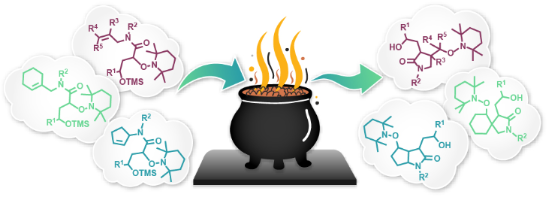
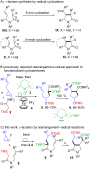
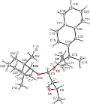
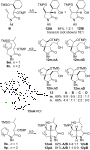
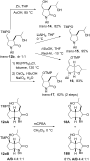
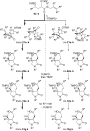
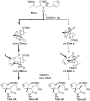
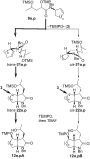
- reported. The sequence starts with a new tandem nucleophilic substitution/Brook rearrangement/single electron transfer-induced radical oxygenation furnishing orthogonally protected α,γ-dioxygenated N-allylamides with wide scope, mostly good yields, and partly good diastereo- and enantioselectivity for
- simplified by further useful reaction steps. Results Tandem nucleophilic substitution/Brook rearrangement/radical α-oxygenation reactions The N-allylic α-(trimethylsilyl)acetamides 8a–m were efficiently prepared by a two-step sequence. First, N-allyl acetamides 11a–m were synthesized by N-acetylation of the







Synthesis of (Z)-3-[amino(phenyl)methylidene]-1,3-dihydro-2H-indol-2-ones using an Eschenmoser coupling reaction
Beilstein J. Org. Chem. 2021, 17, 527–539, doi:10.3762/bjoc.17.47
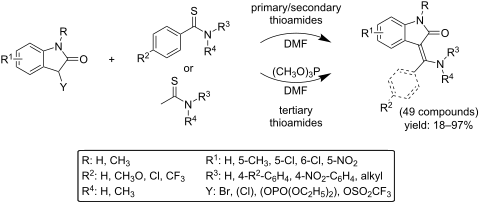
- ). Alternative electrophilic components for the Eschenmoser coupling reaction The Eschenmoser coupling reaction [36][37] usually starts from α-substituted ketones, esters, malonates, or nitriles. The group in the α-position must be a good leaving group enabling a facile nucleophilic substitution giving the α


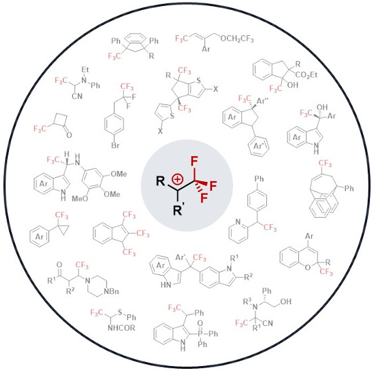
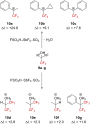
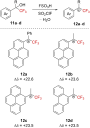
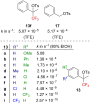
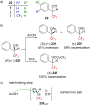
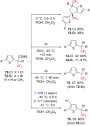
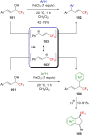
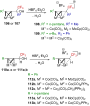
CF3-substituted carbocations: underexploited intermediates with great potential in modern synthetic chemistry
Beilstein J. Org. Chem. 2021, 17, 343–378, doi:10.3762/bjoc.17.32

















Benzothiazolium salts as reagents for the deoxygenative perfluoroalkylthiolation of alcohols
Beilstein J. Org. Chem. 2021, 17, 83–88, doi:10.3762/bjoc.17.8

- synthesized that serve as convenient sources of hitherto underexplored perfluoroalkylthiolate anions. An investigation of their reactivity in a deoxygenative nucleophilic substitution reaction led to the development of an unprecedented process that provides pentafluoroethyl and heptafluoropropyl thioethers
- nucleophilicity of −SRF anions [39]. Herein, we report the successful synthesis of several BT-SRF reagents and provide insights into the reactivity of different perfluoroalkylthiolate anions in nucleophilic substitution reactions. This study led to the development of unprecedented deoxygenative pentafluoroethyl
- affords the key electrophilic 2-alkoxybenzothiazolium species A and the perfluoroalkylthiolate anion. Nucleophilic substitution then affords product 3 and thiocarbamate byproduct B. As a side-reaction, β-fluoride elimination from the perfluoroalkylthiolate anion can occur, leading to a thiocarbonyl





