


Search results
Search for "alkenes" in Full Text gives 570 result(s) in Beilstein Journal of Organic Chemistry. Showing first 200.
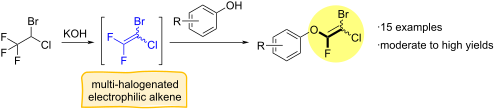
Simple synthesis of multi-halogenated alkenes from 2-bromo-2-chloro-1,1,1-trifluoroethane (halothane)
Beilstein J. Org. Chem. 2022, 18, 1567–1574, doi:10.3762/bjoc.18.167


A facile approach to spiro[dihydrofuran-2,3'-oxindoles] via formal [4 + 1] annulation reaction of fused 1H-pyrrole-2,3-diones with diazooxindoles
Beilstein J. Org. Chem. 2022, 18, 1532–1538, doi:10.3762/bjoc.18.162
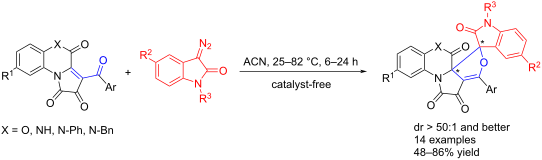
- investigated for FPDs: the [4 + 2] cycloaddition with alkenes resulting in pyran-annulated products [27][28][29][30][31][32][33][34] and the [3 + 2] cycloaddition with nitrones resulting in isoxazole-annulated products [35][36][37] (Scheme 2). However, formal [4 + 1] cycloaddition reactions for FPDs remain to


Dissecting Mechanochemistry III
Beilstein J. Org. Chem. 2022, 18, 1454–1456, doi:10.3762/bjoc.18.150
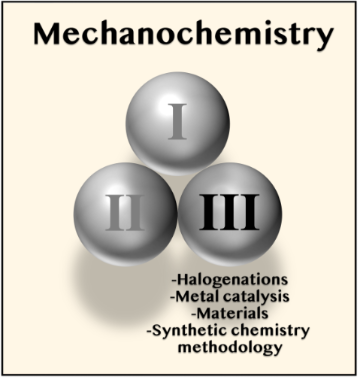
- Margetić used dibrominated polycyclic imides as substrates to generate reactive alkenes, which could be trapped in situ by several dienes through Diels−Alder cycloadditions by ball milling (Scheme 3) [7]. Further, Moores and co-workers synthesized phosphorus-bridged heptazine-based carbon nitrides (g-h-PCN


Reductive opening of a cyclopropane ring in the Ni(II) coordination environment: a route to functionalized dehydroalanine and cysteine derivatives
Beilstein J. Org. Chem. 2022, 18, 1166–1176, doi:10.3762/bjoc.18.121
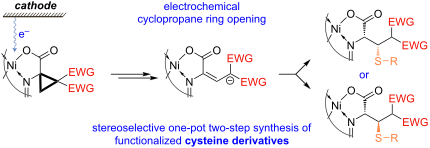
- reactions with electrophiles, intramolecular cyclization and disproportionation process. The synthetic viability of the approach will be considered. A one-pot multistep synthetic protocol is suggested, based on addition of thiols to the mixture of isomeric alkenes formed in an electroreductive opening of a
- analysis of the reaction mixture showed that two isomeric alkenes (containing the α-β or β-γ double bond) are formed. In the isomers, two protons of the amino acid side chain create an AB system; in the α-β isomer, both protons show correlations in the HMBC spectrum with the C atoms of the COOMe groups
- , whereas in the β-γ isomer, only one H correlates with the COOMe and the other H atom correlates with the Schiff and carboxylic carbons (see Figure 3 and Supporting Information File 1). The experimental ratio of the isomeric alkenes (1.5:1) is close to the calculated value predicted from their relative



Electrochemical hydrogenation of enones using a proton-exchange membrane reactor: selectivity and utility
Beilstein J. Org. Chem. 2022, 18, 1055–1061, doi:10.3762/bjoc.18.107
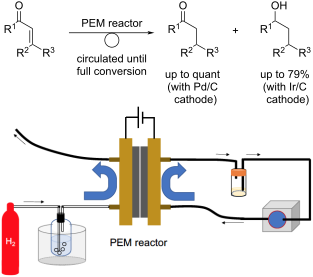
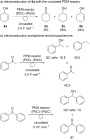
- ]. For instance, they recently reported a stereoselective reduction of alkynes to Z-alkenes using a PEM reactor. The use of a Pd/C cathode catalyst and the appropriate cathode potential realize the selective synthesis of Z-alkenes [22][23][24]. They also reported the stereoselective hydrogenation of α,β





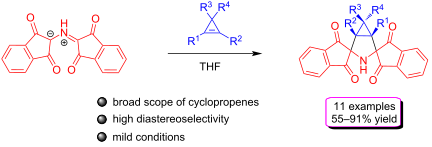
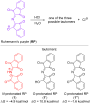
Synthesis of bis-spirocyclic derivatives of 3-azabicyclo[3.1.0]hexane via cyclopropene cycloadditions to the stable azomethine ylide derived from Ruhemann's purple
Beilstein J. Org. Chem. 2022, 18, 769–780, doi:10.3762/bjoc.18.77
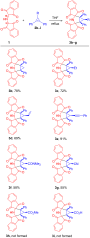
- (Scheme 3). Notably, it took longer reaction times (6 h) for achieving full consumption of 1 while significant amounts of alkenes 2f and 2g remained unreacted. In turn, both the ester 2h and acid 2i [35] proved to be totally unreactive towards PRP (1) under the optimized reaction conditions (THF, reflux






Structural basis for endoperoxide-forming oxygenases
Beilstein J. Org. Chem. 2022, 18, 707–721, doi:10.3762/bjoc.18.71
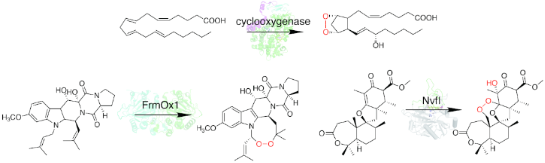
- the synthesis of chemical reagents with an endoperoxide bridge have been reported [77][78]. The classical method for endoperoxide synthesis is through cycloadditions of dienes and alkenes, using singlet oxygen. Furthermore, cyclizations of hydroperoxides with pendant alkenes or alkynes have also been


Tri(n-butyl)phosphine-promoted domino reaction for the efficient construction of spiro[cyclohexane-1,3'-indolines] and spiro[indoline-3,2'-furan-3',3''-indolines]
Beilstein J. Org. Chem. 2022, 18, 669–679, doi:10.3762/bjoc.18.68
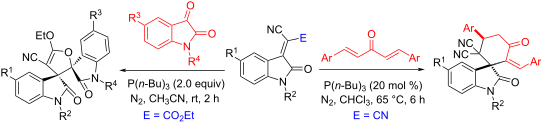
- the construction of diverse carbocyclic systems [17][18][19][20][21][22][23][24]. In these reactions, the tertiary phosphine firstly adds to electron-deficient alkenes, alkynes, and allenes to give active ionic intermediates. Then, the in situ-generated ionic intermediates further react with various


Sesquiterpenes from the soil-derived fungus Trichoderma citrinoviride PSU-SPSF346
Beilstein J. Org. Chem. 2022, 18, 479–485, doi:10.3762/bjoc.18.50
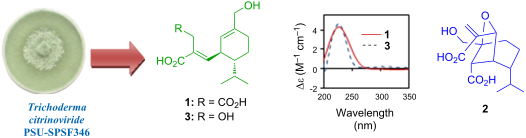
- functional groups, respectively [10]. The 1H NMR spectrum (Table 1) displayed characteristic signals for two olefinic protons of two trisubstituted alkenes (δH 6.64, d, J = 10.5 Hz, and 5.31, s, each 1H), two methine protons (δH 3.06 and 1.35, each m, 1H), one set of equivalent oxymethylene protons (δH 3.92


Synthesis of 3,4,5-trisubstituted isoxazoles in water via a [3 + 2]-cycloaddition of nitrile oxides and 1,3-diketones, β-ketoesters, or β-ketoamides
Beilstein J. Org. Chem. 2022, 18, 446–458, doi:10.3762/bjoc.18.47

- organocatalysts (Figure 1) [26][27]. This enolate-mediated cycloaddition, however, requires long reaction time in organic solvents at high temperatures. Our current work was inspired by a recent report by Kesornpun et al., in which a cycloaddition of nitrile oxides and alkenes or alkynes was carried out in 0.1 M
- oxide and strained alkenes has been used to achieve the high-density functionalization of oligodeoxyribonucleotides [29]. However, the alkenes need to be highly strained in order for this reaction to occur without the need for an additional metal catalyst. As an alternative to the mild acidic conditions



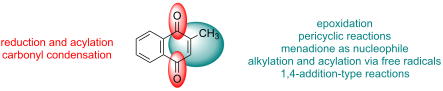
Menadione: a platform and a target to valuable compounds synthesis
Beilstein J. Org. Chem. 2022, 18, 381–419, doi:10.3762/bjoc.18.43


Synthesis of piperidine and pyrrolidine derivatives by electroreductive cyclization of imine with terminal dihaloalkanes in a flow microreactor
Beilstein J. Org. Chem. 2022, 18, 350–359, doi:10.3762/bjoc.18.39
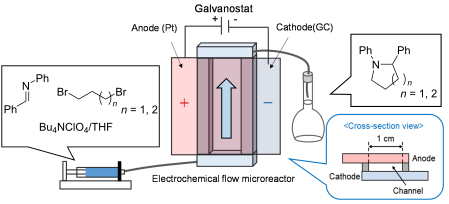
- ]. Conventional synthetic methods for piperidine derivatives include nucleophilic substitution (route (1) in Scheme 1), reductive amination (route (2)), intramolecular cyclization of amines and alkenes (route (3)), the Diels–Alder reaction and subsequent reduction (route (4)), and the radical cyclization reaction


Site-selective reactions mediated by molecular containers
Beilstein J. Org. Chem. 2022, 18, 309–324, doi:10.3762/bjoc.18.35
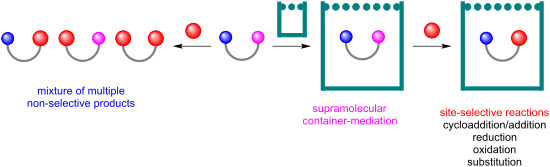
- , azides, halides and alkenes, oxidation of remote C–H bonds and alkenes, and substitution reactions involving ring-opening cyclization of epoxides, nucleophilic substitution of allylic chlorides, and hydrolysis reactions. The product selectivity is interpreted as the consequence of the space shape and


Iridium-catalyzed hydroacylation reactions of C1-substituted oxabenzonorbornadienes with salicylaldehyde: an experimental and computational study
Beilstein J. Org. Chem. 2022, 18, 251–261, doi:10.3762/bjoc.18.30
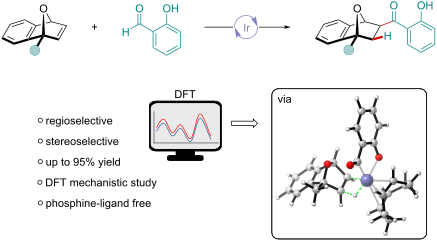
- -opening reactions of heterobicyclic alkenes are of particular interest [39][40][41][42][43][44][45][46][47][48][49][50][51][52][53], as they provide access to a broad family of synthetic building blocks bearing multiple stereocenters in a single step 2 [54]. Application of these functionalized
- catalyzed by rhodium/diene to afford the 1,2,4-trisubstituted naphthalene framework 8 with complete regio- and stereocontrol (Scheme 1) [62][63]. In 2015, the Nishimura group reported the first iridium-catalyzed addition of salicylaldehydes 14 to bicyclic alkenes 11 (Scheme 1) [64]. Although a variety of
- carbo- and heterobicyclic alkenes was investigated, the study was limited by the number of unsymmetrical coupling partners. In their seminal report, the authors were able to produce hydroacylated adducts 15a and 15b in good yield. On the basis of the aforementioned literature, several different products


Synthesis of novel [1,2,4]triazolo[1,5-b][1,2,4,5]tetrazines and investigation of their fungistatic activity
Beilstein J. Org. Chem. 2022, 18, 243–250, doi:10.3762/bjoc.18.29
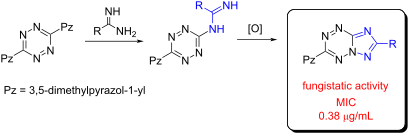
- labeling proteins and visualizing cancer due to the ability of s-tetrazine to fast and biocompatible ligation with alkenes via the inverse electron demand Diels–Alder reactions [29][30][31]. At the same time, azolo-annulated 1,2,4,5-tetrazines remain to be a scarcely studied class of compounds, mainly due


Trichloroacetic acid fueled practical amine purifications
Beilstein J. Org. Chem. 2022, 18, 225–231, doi:10.3762/bjoc.18.26
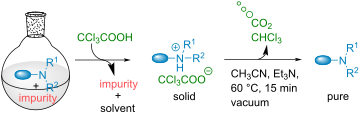
- isolated in its pure form starting from model mixtures containing various aromatics, phenols, alkanes or alkenes in overall purification yields ranging from 53 to 98%. The lower yields are observed for coordinating phenol and catechol (Table 2, entries 3 and 4), probably impacting the crystallization


Regioselective synthesis of methyl 5-(N-Boc-cycloaminyl)-1,2-oxazole-4-carboxylates as new amino acid-like building blocks
Beilstein J. Org. Chem. 2022, 18, 102–109, doi:10.3762/bjoc.18.11
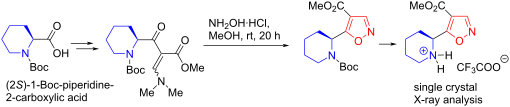
- -oxazoles are: the 1,3-dipolar cycloaddition of alkenes and alkynes with nitrile oxides, and the reaction of a three-carbon atom component, such as a α,β-unsaturated ketone or a 1,3-diketone with hydroxylamine hydrochloride [33]. Recently, Rosa et al. reported a useful procedure for the synthesis of various


Efficient synthesis of ethyl 2-(oxazolin-2-yl)alkanoates via ethoxycarbonylketene-induced electrophilic ring expansion of aziridines
Beilstein J. Org. Chem. 2022, 18, 70–76, doi:10.3762/bjoc.18.6
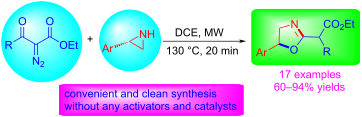
- alcohols [13][14][15] (Scheme 1a); (3) oxidative condensation of aldehydes with vicinal amino alcohols [16] (Scheme 1b); (4) cyclization of N-allylamides in the presence of electrophilic reagents or radical initiators or catalysts [17] (Scheme 1c); (5) direct synthesis from alkenes and amides or nitriles




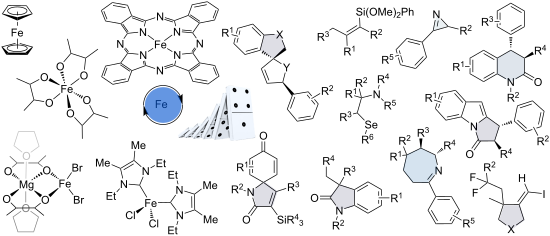
Iron-catalyzed domino coupling reactions of π-systems
Beilstein J. Org. Chem. 2021, 17, 2848–2893, doi:10.3762/bjoc.17.196
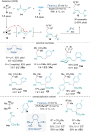
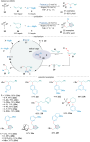
- initiated, the reaction will propagate, which typically involves the insertion of a π-system (carbometallation of alkenes/alkynes) in the case of organoiron species (Scheme 2). Alternatively, the generated radical species may undergo radical addition to alkenes, alkynes, or aromatic arenes. The final step
- reaction. In the same year, the Gutierrez Lab reported the first three-component 1,2-dicarbofunctionalzation of alkenes 21 (Scheme 5) [66]. The authors noted π-systems bearing O- and S-heteroatoms had little to no compatibility with the transformation as well as sterically hindered Grignard reagents 2
- addition is paramount, this method is currently limited to the use of a large excess of olefins; however, activated alkenes could circumvent this requirement. In 2016, the Deng group studied a novel double carbomagnesiation of unsymmetrical internal alkynes 31 with alkyl Grignard reagents 32 producing 1,3













Selective sulfonylation and isonitrilation of para-quinone methides employing TosMIC as a source of sulfonyl group or isonitrile group
Beilstein J. Org. Chem. 2021, 17, 2822–2831, doi:10.3762/bjoc.17.193
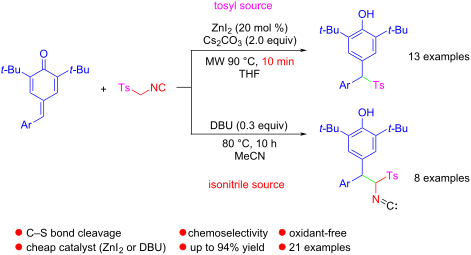
- combination of acidic α-carbon atoms, isocyano groups, and sulfonyl moieties [18]. In general, TosMIC undergoes base-mediated 1,3-dipolar cycloadditions with activated alkenes to provide pyrroles as products [18] (Scheme 1A). Recently, alternative functionalizations using TosMIC as a tosyl source of


The PIFA-initiated oxidative cyclization of 2-(3-butenyl)quinazolin-4(3H)-ones – an efficient approach to 1-(hydroxymethyl)-2,3-dihydropyrrolo[1,2-a]quinazolin-5(1H)-ones
Beilstein J. Org. Chem. 2021, 17, 2787–2794, doi:10.3762/bjoc.17.189
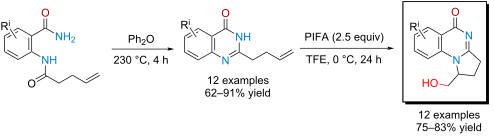
- ][40] including from properly functionalized arenes and alkenes [41][42][43][44][45][46][47][48][49][50][51][52][53]. In the case of such substrates having oxygen-containing functional groups, PIFA attacked the double bond first [41][42][43]. With unsaturated amides or hydroxamates, oxidation of the


Highly stereocontrolled total synthesis of racemic codonopsinol B through isoxazolidine-4,5-diol vinylation
Beilstein J. Org. Chem. 2021, 17, 2781–2786, doi:10.3762/bjoc.17.188
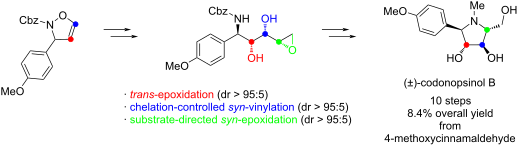
- terminal alkenes bearing both an allylic and homoallylic-type hydroxy group, yielding a sole threo isomer, are rare [36]. The cyclization of 5 through an epoxide ring-opening reaction with boron trifluoride etherate in dichloromethane at 0 °C yielded pyrrolidine derivative 12 in 69% isolated yield [37


Recent advances in the asymmetric phosphoric acid-catalyzed synthesis of axially chiral compounds
Beilstein J. Org. Chem. 2021, 17, 2729–2764, doi:10.3762/bjoc.17.185
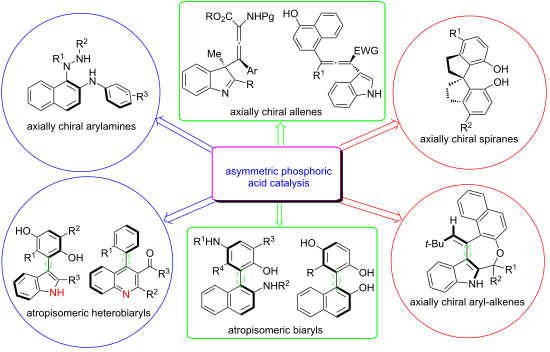
- elimination as opposed to styrenyl selectivity. In addition, the methacrylates were used as allyl surrogates to overcome the reactivity problem caused by steric hindrance of 1,1,-disubstituted alkenes, and the electron-withdrawing esters enhance the migratory insertion to form palladacycle I-2. The CPA
- generates the chiral environment and played a crucial role in favoring of atropisomerism. A series of axially chiral biaryl-2-amines with 1,1-disubstituted alkenes 17 was efficiently synthesized in moderate to excellent yields (42–96%) with excellent enantioselectivities (up to >99% ee). 2. Enantioselective
- chiral phosphoric acids in the preparation of centrally chiral compounds, their application in the synthesis of axially chiral biaryls and heterobiaryls, axially chiral allene, atropisomeric aryl alkenes, and spirane moieties is still quite limited. Given the increasing importance of axially chiral










Visible-light-mediated copper photocatalysis for organic syntheses
Beilstein J. Org. Chem. 2021, 17, 2520–2542, doi:10.3762/bjoc.17.169
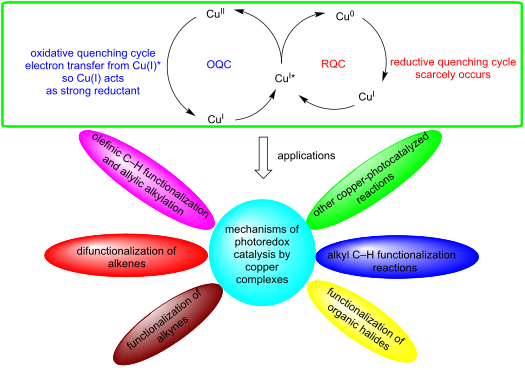
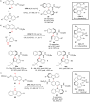
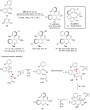
- thiocyanate to generate 4-alkyl/aryl-2-aminothiazoles. Mechanistic experiments demonstrated that the photocatalyst formed in situ from Cu(OAc)2 and ammonium thiocyanate promoted the intermolecular cyclization (Scheme 7). 3.2 Difunctionalization of alkenes The 1,2-difunctionalization of alkenes is a versatile
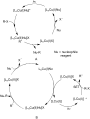
- strategy for the construction of complex molecules. The primary process involved in the 1,2-difunctionalization of alkenes catalyzed by copper complexes is an atom-transfer radical addition (ATRA). Copper complexes or copper-based photoredox-active complexes formed in situ serve as photocatalysts to
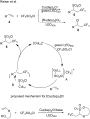
- -catalyzed trifluoromethylchlorosulfonylation of unactivated alkenes 4 under photochemical conditions. When used in place of [Cu(dap)2]Cl, ruthenium-based, iridium-based, and eosin Y catalysts promoted the trifluoromethylchlorination of alkenes with the extrusion of SO2 (e.g., product 6). Studies were






Allylic alcohols and amines by carbenoid eliminative cross-coupling using epoxides or aziridines
Beilstein J. Org. Chem. 2021, 17, 2385–2389, doi:10.3762/bjoc.17.155

- alkoxide. Keywords: alkenes; aziridines; epoxides; lithiation; synthetic methods; Introduction Methods for the convergent generation of alkenes can be of significant utility in organic synthesis [1]. A relatively under-examined approach is through the interaction of two carbenoids [2]. Dimerisation of
- (Scheme 1). The eliminative cross-coupling of carbenoids can provide a way to unsymmetrical alkenes, provided the differential reactivity of the two carbenoids is suitably matched [2]. In the current letter, we report preliminary results on the latter strategy to form alkenes which possess an allylic
- -carbon homologation of an epoxide to an allylic alcohol (cf Scheme 3) can also be achieved using excess dimethylsulfonium methylide [12][13], although non-terminal alkenes have not been shown to be directly accessible by higher homologation. To examine the latter in the context of the current chemistry





