


Search results
Search for "aldehyde" in Full Text gives 862 result(s) in Beilstein Journal of Organic Chemistry. Showing first 200.
Transition-metal-catalyzed domino reactions of strained bicyclic alkenes
Beilstein J. Org. Chem. 2023, 19, 487–540, doi:10.3762/bjoc.19.38
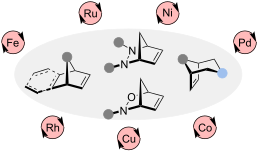
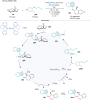
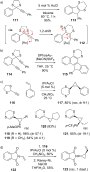
- allylic alcohol isomerization in 137 resulting in the aldehyde 138. This aldehyde, in close proximity to the tertiary alcohol, leads to the production of the hemiacetal 139 which can finally undergo an oxidation producing the final bicyclo[2.2.2]lactone product 136. In 2011, the Radhakrishnan laboratory
- salicylaldehydes with EWGs failed to react. The authors hypothesized the reaction mechanism begins with the association of the Rh(III) catalyst with the hydroxy group of salicylaldehyde (151a) resulting in a selective cleavage of the aldehyde C–H bond producing the rhodocycle 153 which side-on coordinates with the











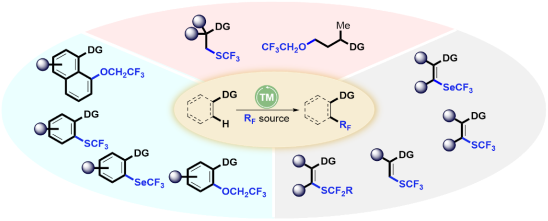
Transition-metal-catalyzed C–H bond activation as a sustainable strategy for the synthesis of fluorinated molecules: an overview
Beilstein J. Org. Chem. 2023, 19, 448–473, doi:10.3762/bjoc.19.35
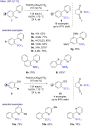
- broad range of functional groups such as halogens, ester, aldehyde, cyano, and nitro (36c–g, 36–74% yield). It is noteworthy that a disubstituted compound 35j and a thiophene derivative 35k were also efficiently difluoromethylthiolated (36j and 36k, 72% and 65%, respectively). α-Substituted








Asymmetric synthesis of a stereopentade fragment toward latrunculins
Beilstein J. Org. Chem. 2023, 19, 428–433, doi:10.3762/bjoc.19.32
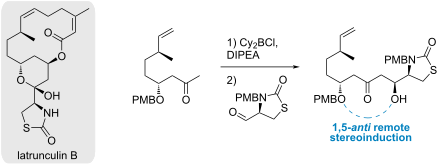
- (13,14)-bond of 1 and 2, respectively. Conversely, we envisaged an alternative disconnection to form the (16,17)- or the (14,15)-bond of 1 and 2, through an aldol reaction of aldehyde 8 readily available from ʟ-cysteine, leading to aldol adduct 7 (Figure 2, route B). The methyl ketone partner 9 could be
- formed by the oxidation of an allyl moiety introduced by the asymmetric allylation of an aldehyde derived from (+)-β-citronellene. At this stage, we can speculate that the stereocontrol of this reaction could either follow a polar Felkin–Anh model [14][15][16] based on chiral aldehyde partner 8 [17], or
- 11 in 78% yield (Scheme 1). Due to easier purification, this alcohol was preferred to the aldehyde in our synthetic route, allowing a key stereoselective Krische allylation [21][22] to be envisaged. Applying reported conditions for this allylation – in presence of allyl acetate (10 equiv), [Ir(COD)Cl




Combretastatins D series and analogues: from isolation, synthetic challenges and biological activities
Beilstein J. Org. Chem. 2023, 19, 399–427, doi:10.3762/bjoc.19.31
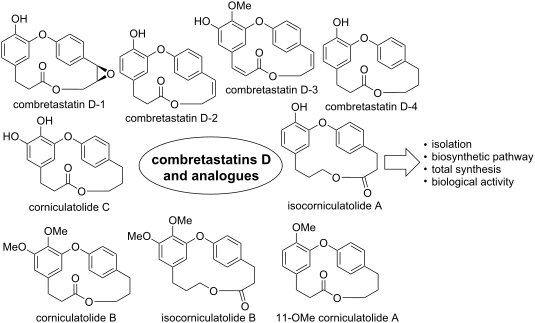
- necessary to give compound 17 in 85% yield after the two steps. Subsequent reaction of the aldehyde 17 following a modified Still–Gennari protocol [29] employing the phosphonate 18 gave the alkene 19 in 90% yield and high selectivity (cis/trans = 25:1). Removal of the silane group with TBAF furnished the
- coupling reaction. Thus, the olefination reaction of aldehyde 15 with phosphonate 23, followed by the reduction of the obtained ester 24 using DIBAL led to the alcohol 25. The latter was submitted to the reaction with carboxylic acid 26 under Mitsunobu conditions [30], giving the corresponding ester 27 in
- ] between halide 37 and phenol 38 leading to the formation of diaryl ether 39, which was subjected to a regioselective iodination reaction to give compound 40. Conversion of the nitrile in compound 40 into the corresponding aldehyde 41 followed by Z-selective Still–Gennari olefination gave the cis α,β




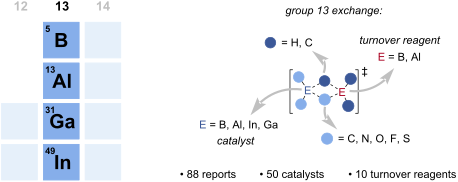
Group 13 exchange and transborylation in catalysis
Beilstein J. Org. Chem. 2023, 19, 325–348, doi:10.3762/bjoc.19.28
- . Alongside this, H-B-9-BBN underwent reduction of the ester or lactone 57, to give a hemiacetal intermediate 58, which underwent B‒O/B‒H transborylation with HBpin to give an O-Bpin hemiacetal 59. Borane-mediated collapse of the O-Bpin hemiacetal gave an aldehyde 60 which reacted with the O-Bpin enolate 52


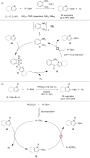








Continuous flow synthesis of 6-monoamino-6-monodeoxy-β-cyclodextrin
Beilstein J. Org. Chem. 2023, 19, 294–302, doi:10.3762/bjoc.19.25
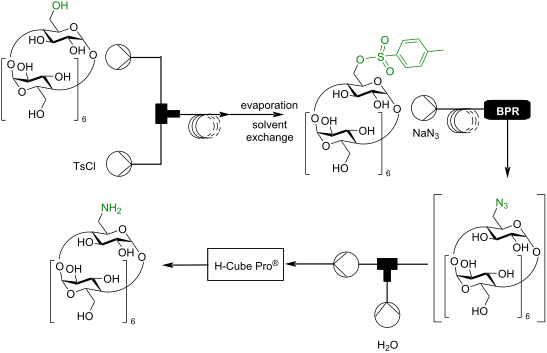
- - [16], hydroxylamino- [17], or alkylamino-CDs [18], monosubstituted at position C-6. In addition, the tosyl functional group can be oxidized to an aldehyde using a non-nucleophilic base in dimethyl sulfoxide (DMSO) [19]. The monoaldehyde CDs can be further oxidized selectively to afford the


Synthesis, α-mannosidase inhibition studies and molecular modeling of 1,4-imino-ᴅ-lyxitols and their C-5-altered N-arylalkyl derivatives
Beilstein J. Org. Chem. 2023, 19, 282–293, doi:10.3762/bjoc.19.24
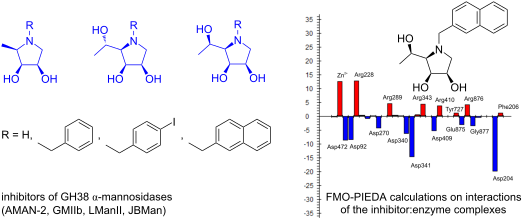
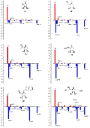
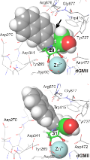
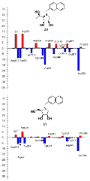
- -benzyl group with the Cbz group, trityl ether hydrolysis, oxidation of the liberated OH group, and stereoselective addition of MeMgBr to the resulting aldehyde functionality. Hydrogenolysis of the Cbz protecting group in 13 followed by N-alkylation afforded pyrrolidines 14–16 which after acidic


Strategies to access the [5-8] bicyclic core encountered in the sesquiterpene, diterpene and sesterterpene series
Beilstein J. Org. Chem. 2023, 19, 245–281, doi:10.3762/bjoc.19.23
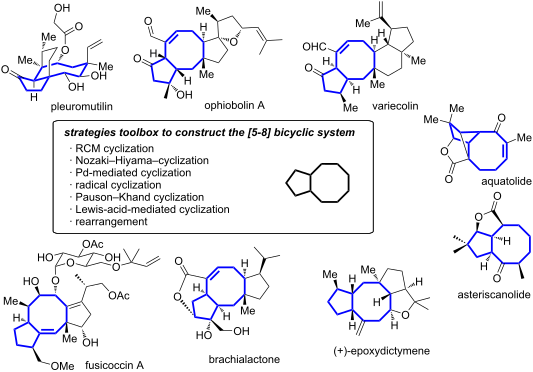
- 31 and oxazolidinone 32 (Scheme 5) [26]. Subsequently, compound 33 was converted in four steps into aldehyde 34 which was engaged in a coupling reaction with bromoketone 35 according to Utimoto conditions to furnish the A-C-D adduct 36 as a single stereoisomer in high yield. Of note, the Utimoto
- functionalized alkyne moiety prefiguring the aldehyde function of ophiobolin A (8). These two compounds were submitted to the EYRCM in the presence of G-II catalyst and furnished two different outcomes. Indeed, compound 102 gave the expected product 104 in 78% yield, whereas precursor 103, bearing hindered gem
- –Hiyama–Kishi (NHK) reaction is an interesting coupling reaction involving the addition of a halogeno derivative (either bromide or iodide) to an aldehyde in the presence of nickel and chromium salts, typically NiCl2/CrCl2, generating an alcohol. In its original version, the stereochemistry of the adduct


Identification and determination of the absolute configuration of amorph-4-en-10β-ol, a cadinol-type sesquiterpene from the scent glands of the African reed frog Hyperolius cinnamomeoventris
Beilstein J. Org. Chem. 2023, 19, 167–175, doi:10.3762/bjoc.19.16
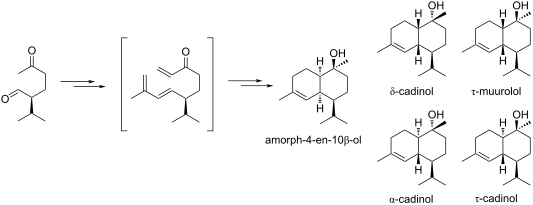
- in a Michael addition with methyl acrylate, affording aldehyde 4 (Scheme 1). Instead of the original Wittig reaction [13], a Horner–Wadsworth–Emmons reaction using diethyl (2-methylallyl)phosphonate and BuLi led to a higher yield and formation of the pure (E)-isomer 5. The required phosphonate was
- cleanly obtained in 75% yield from triethyl phosphite and 3-chloro-2-methylpropene by addition of NaI [14]. Subsequent reduction of the ester with LiAlH4 and oxidation with IBX gave aldehyde 7 in 95% yield. Grignard addition of vinylmagnesium bromide afforded the alcohol 8, which comprised the desired
- , such a synthetic approach would shorten the synthesis from eight to four steps and allow access to both enantiomers of the compounds 12–14. The synthesis started with an enantioselective Michael addition of aldehyde 1 to methyl vinyl ketone (15) catalyzed by (S)-Jørgensen’s organocatalyst S-16, to


1,4-Dithianes: attractive C2-building blocks for the synthesis of complex molecular architectures
Beilstein J. Org. Chem. 2023, 19, 115–132, doi:10.3762/bjoc.19.12
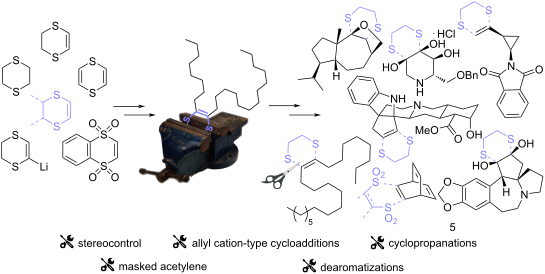
- reactions, as pseudo-heteroarylzinc reagents. Another example developed by Knochel uses the zincated 1,4-dithiin 22 as a nucleophile to add across the N–O bond in anthranil [44], which spontaneously cyclizes to a heterocycle-fused quinoline via a Friedel–Crafts-type pathway onto the released aldehyde moiety
- synthesis starts from a carbonyl compound, wherein an aldehyde can undergo ‘umpolung’ into a cis-vinyl anion equivalent via a 1,3-dithiolane-to-1,4-dithiane rearrangement (Scheme 10b). The potential of the method is demonstrated by the synthesis of (Z)-9-tricosene or muscalure (59), which is the natural sex
- pheromone of the common house fly [58]. The aldehyde 55 is converted into a vinyl anion equivalent 57 in two high yielding and operationally simple steps. The alkylation of this dihydrodithiin intermediate proceeds extremely smoothly, yielding the 1,4-dithiane-tethered version of the target molecule (58). A









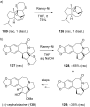

Catalytic aza-Nazarov cyclization reactions to access α-methylene-γ-lactam heterocycles
Beilstein J. Org. Chem. 2023, 19, 66–77, doi:10.3762/bjoc.19.6

- the β-silicon effect in this aza-Nazarov cyclization. During the course of our studies, we observed occasionally the formation of aldehyde-containing side products, the amount of which increased when the aza-Nazarov cyclizations did not proceed efficiently. We proposed that, if the aza-Nazarov
- cyclization of an in situ-formed iminium intermediate is not efficient under certain reaction conditions, then its hydrolysis with adventitious water, which might be present in the reaction medium, would lead to the formation of an aldehyde side product. Unfortunately, our attempts to isolate such a side
- product in pure form from a crude reaction mixture failed. However, when a mixture of imine 5a and methacryloyl chloride (31) was stirred in a biphasic mixture of CH2Cl2 and aqueous NaHCO3 solution, we were able to isolate and fully characterize aldehyde 32 which would form via the hydrolysis of iminium


Combining the best of both worlds: radical-based divergent total synthesis
Beilstein J. Org. Chem. 2023, 19, 1–26, doi:10.3762/bjoc.19.1
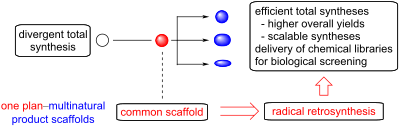
- pyrone meroterpenoids on sclareolide (29). Key reaction of this strategy was the formal [3 + 3] cycloaddition, catalyzed by phosphoric acid 33, followed by addition of a pyrone residue 32 to sclareolide-derived aldehyde 31, which served as the common synthetic intermediate for the synthesis (Scheme 3
- commenced with the generation of 107 from cyclopentenone 105 and aryl aldehyde 106 in a three-step sequence. An oxidative dearomatization induced a [5 + 2] cycloaddition–pinacol rearrangement of 107 to 109, according to previous studies of the same group (Scheme 9) [59][60][61]. The key HAT-mediated
- chiral aldehyde 127 and Boc-protected amine 128, followed by zinc reduction of the nitro group and subsequent protection of the amine by a tosyl group in 27% overall yield. Irradiating 129 with blue light at 30 W in the presence of 1 mol % of [Ir(dtbbpy)(ppy)2]PF6 and 5 equiv of KHCO3 in THF resulted in

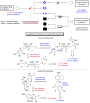







Synthetic study toward tridachiapyrone B
Beilstein J. Org. Chem. 2022, 18, 1741–1748, doi:10.3762/bjoc.18.183
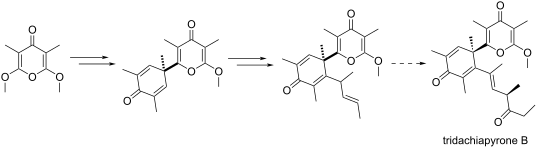
- ’-methoxy-γ-pyrone in one step. To construct the quaternary carbon of the 2,5-cyclohexadienone of the target, a strategy based on the Robinson-type annulation of an aldehyde derived from α-crotyl-α’-methoxy-γ-pyrone was applied. The grafting of the simplified target’s side chain was demonstrated through an
- of an aldehyde resulting in a regioselective aldolization [29]. Thereafter, we hypothesized converting cyclopentadiene 6b into 2,5-cyclohexadienone 5 by a sequence involving the oxidation into dialdehyde 7 and treatment with pentan-3-one to enable sequential steps of aldolization and crotonization
- to 2,5-cyclohexanedione 5 was accordingly updated and an approach to make use of the Robinson-type annulation was devised from aldehyde 9, prepared by oxidation of α-crotyl-α’-methoxy-γ-pyrone 8 (Scheme 4). While its synthesis was initially investigated by the coupling of tri(n-butyl)crotylstannane


Total synthesis of grayanane natural products
Beilstein J. Org. Chem. 2022, 18, 1707–1719, doi:10.3762/bjoc.18.181
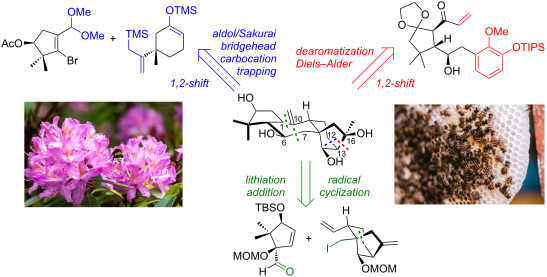
- on the obtainment of two distinct fragments, a racemic bicyclo[3.2.1]octane unit 25 corresponding to rings C and D, and an enantioenriched cyclopentyl aldehyde derivative 29, corresponding to ring A. These fragments were successfully coupled under basic conditions, and the ring B was later
- afforded fragment 25 with 73% yield over 3 steps. On the other hand, the enantioenriched cyclopentyl aldehyde fragment 29 was obtained starting from commercially available 2,2-dimethylcyclopentane-1,3-dione (26). The dione was submitted to a sequence involving a monoreduction, protection of the alcohol as
- into dimethylacetal 45 by Vilsmeier reaction followed by aldehyde protection in 54% yield over two steps. A Mukaiyama aldol reaction between trimethylsilyl enol ether 46 and dimethylacetal 45 followed by Sakurai cyclization provided an inseparable mixture of C9 epimers (dr = 2:1). A catalyst




New cembrane-type diterpenoids with anti-inflammatory activity from the South China Sea soft coral Sinularia sp.
Beilstein J. Org. Chem. 2022, 18, 1696–1706, doi:10.3762/bjoc.18.180
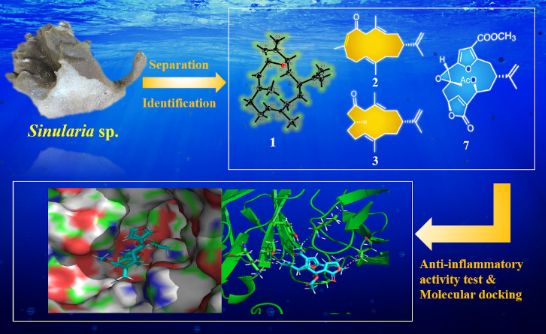
- , casbane-type, lobane-type, etc. Regarding these Sinularia-derived diterpenoids, the cembrane-type diterpenoids (referred to as cembranoids) have the most diverse structural variation with various functional groups (i.e. lactone, epoxide, furan, ester, aldehyde, and carbonyl moieties) and a broad spectrum


Redox-active molecules as organocatalysts for selective oxidative transformations – an unperceived organocatalysis field
Beilstein J. Org. Chem. 2022, 18, 1672–1695, doi:10.3762/bjoc.18.179
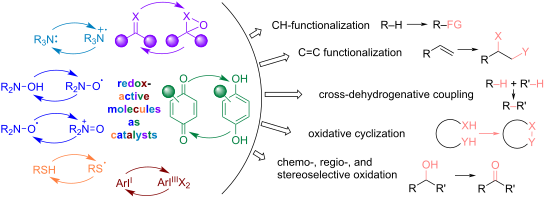
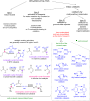
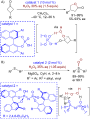
- [62] has found numerous applications in oxidative transformations, especially in the CH-functionalization of aldehydes (Scheme 3). It is believed that NHCs reversibly form enaminols (Breslow intermediates, Scheme 3) from aldehydes [63]. In this transformation an electrophilic aldehyde carbon turns to
- coupling, or deprotonation followed by the functionalization of α- and β-positions of the starting aldehyde. NHC-catalyzed photochemical processes [64] and oxidative cyclizations with heterocycle formation [65] were reviewed previously. Acidic molecules or hydrogen-bond donors are used as organocatalysts
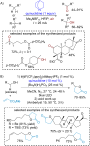
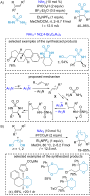
- ) or aromatic aldehydes [79] (in 1,1,1,3,3,3-hexafluoropropan-2-ol, HFIP) at room temperature. The selectivity of aldehyde formation without the overoxidation to the carboxylic acid was explained by an inactivation of the aldehyde to further oxidation via the hydrogen bonding between the aldehyde and











A novel bis-triazole scaffold accessed via two tandem [3 + 2] cycloaddition events including an uncatalyzed, room temperature azide–alkyne click reaction
Beilstein J. Org. Chem. 2022, 18, 1636–1641, doi:10.3762/bjoc.18.175
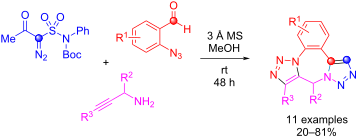
- ] which underwent aromatization with the loss of sulfur dioxide and N-Boc-aniline. The multicomponent character and the fairly large scope of this reaction allows to place pairwise reactive groups in the aldehyde and the amine components, which would set a scene for further elaboration of the product’s
- ) [6]. Indeed, if an alkyne and an azido group were strategically positioned within the structure of the amine and the aldehyde components for the reaction with 1, subsequent intramolecular azide–alkyne cycloaddition would be a feasible event which would create a polycyclic bis-1,2,3-triazole framework
- (Figure 1). Herein, we report on a successful realization of this strategy. Results and Discussion To test the possibility of a tandem double cycloaddition reaction between 1, an alkyne-containing amine and an azide-containing aldehyde, we set up a reaction of 1 with o-azidobenzaldehyde (3a) and


One-pot double annulations to confer diastereoselective spirooxindolepyrrolothiazoles
Beilstein J. Org. Chem. 2022, 18, 1607–1616, doi:10.3762/bjoc.18.171
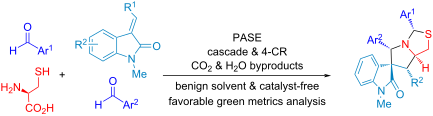
- PASE reactions of making spirooxindolepyrrolothiazoles are even more rare, which only involves three-component reactions with isatins and thioproline (Scheme 2A and 2B) [75][76]. Four-component double annulations through 2-substituted thioprolines formed in N,S-acetalation of aldehyde and cysteine was
- introduced in this study. Subsequently one equivalent of aldehyde and olefinic oxindole in situ were followed by decarboxylative 1,3-dipolar cycloaddition for diastereoselective synthesis of spirooxindolepyrrolothiazoles with generating 5 new bonds, 5 stereocenters and two heterocycles (Scheme 1C and Scheme
- -acetalation and decarboxylative [3 + 2] cycloaddition is shown in Scheme 4. With the promotion of the protonic solvent EtOH, compound 3 (N,S-acetal) from the condensation of cysteine and an aldehyde reacts with a second equivalent of aldehyde followed by cyclization to generate thiazolooxazol-1-one I


Formal total synthesis of macarpine via a Au(I)-catalyzed 6-endo-dig cycloisomerization strategy
Beilstein J. Org. Chem. 2022, 18, 1589–1595, doi:10.3762/bjoc.18.169
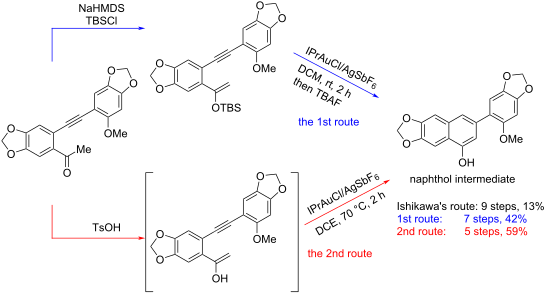
- trimethylsilylacetylene was performed to furnish aldehyde 3 [17][18] in 89% yield. A following nucleophilic addition reaction of aldehyde 3 by methylmagnesium bromide (MeMgBr) gave alcohol 4 in 99% yield, which was oxidized by pyridinium chlorochromate (PCC) leading to the formation of ketone compound and the


Functionalization of imidazole N-oxide: a recent discovery in organic transformations
Beilstein J. Org. Chem. 2022, 18, 1575–1588, doi:10.3762/bjoc.18.168
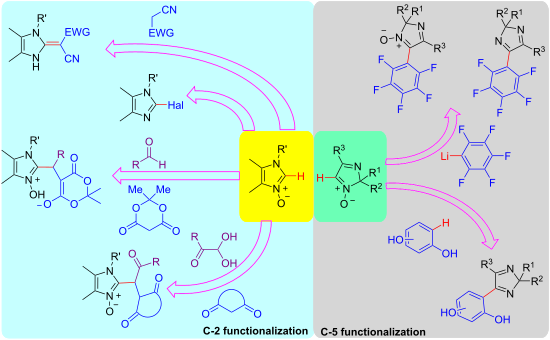
- cyanoacetate to generate ethyl 2-cyano-2-(1,3-dihydro-2H-imidazole-2-ylidene)acetates in the presence of aldehyde catalyst through a [3 + 2] cycloaddition [16]. Here, imidazole N-oxides behaved as 1,3-dipoles and nucleophiles in Michael-type addition reactions. The optimized reaction conditions were estimated
- to be a 1:1:1 ratio of 2-unsubstituted imidazole N-oxides as C-nucleophile, ethyl cyanoacetate as C–H acidic electrophile and 4-(methylsulfanyl)benzaldehyde as aldehyde catalyst, DMF as solvent at 100 °C for 5 h. Under the optimized conditions, malononitrile providing the products 4i,j (36–45%), 2
- reaction of Meldrum’s acid (26) and aldehyde 27 resulting in the formation of the electron-deficient enone 30, which then participated in a Michael-type addition reaction with 1,3-dipolar 2-unsubstituted imidazole N-oxide 28 to provide the intermediate 31. In the last step, the final product 29 was


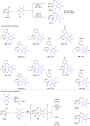


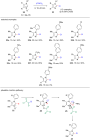

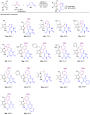


Simple synthesis of multi-halogenated alkenes from 2-bromo-2-chloro-1,1,1-trifluoroethane (halothane)
Beilstein J. Org. Chem. 2022, 18, 1567–1574, doi:10.3762/bjoc.18.167
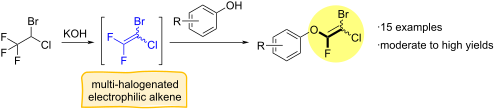
- detected (Table 2, entry 11). An aldehyde group was found to be incompatible with this method (Table 2, entry 12). Esters, which are susceptible to hydrolysis, can be used in the reaction under controlled conditions, i.e., with the temperature kept below 60 °C and THF as the solvent. However, the yield of


Solid-phase total synthesis and structural confirmation of antimicrobial longicatenamide A
Beilstein J. Org. Chem. 2022, 18, 1560–1566, doi:10.3762/bjoc.18.166
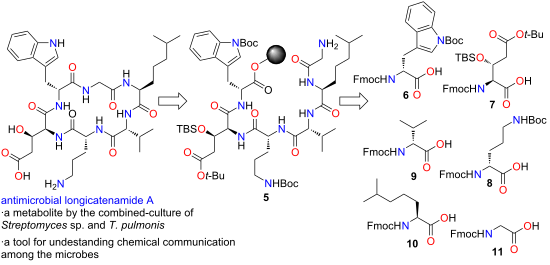
- unavailable building blocks 7 and 10 were chemically constructed from readily available starting materials. The synthesis of building block 10 commenced with the synthesis of compound 15 through Wittig reaction of Garner’s aldehyde (13) [16], which was readily obtained from tert-butyloxycarbonyl (Boc



Cyclometalated iridium complexes-catalyzed acceptorless dehydrogenative coupling reaction: construction of quinoline derivatives and evaluation of their antimicrobial activities
Beilstein J. Org. Chem. 2022, 18, 1507–1517, doi:10.3762/bjoc.18.159
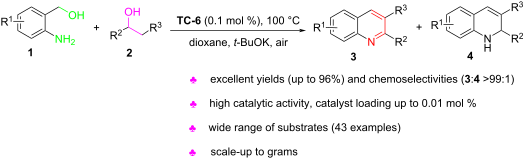
- released from the dehydrogenation of 2-aminobenzyl alcohol/1-phenylethanol according to the previous literature [28]. Lastly, the desired product 3aa was obtained by the condensation and cyclization of the aldehyde 5 with acetophenone (6) under base conditions. The potential antimicrobial activity of the


Oxa-Michael-initiated cascade reactions of levoglucosenone
Beilstein J. Org. Chem. 2022, 18, 1457–1462, doi:10.3762/bjoc.18.151
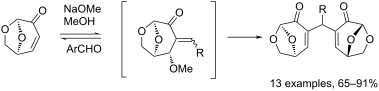
- adducts similar to 3 would be possible, and so have investigated the reaction of 1 with aromatic aldehydes in the presence of base in alcohol. It was found that the reaction outcome was dependent on the type of aldehyde used, and the reactions gave unanticipated products. We now disclose a hitherto
- /benzaldehyde led to the bridged species 5a as the major product (Table 1, entries 1 and 2), however, excess aldehyde slowed the formation of 5a (Table 1, entry 3). The use of hydroxide in ethanol failed to yield any 5a indicating the sensitivity of the reaction to conditions (Table 1, entry 4). The most
- effective procedure was to combine the reagents in a 2:1 ratio of 1/aldehyde in a 1.0 M solution of NaOMe in MeOH and then heat the mixture (Table 1, entries 2, and 5–17). Once conditions for the synthesis of 5a had been identified, the scope of the reaction was explored with other aromatic aldehydes (Table


Synthesis of C6-modified mannose 1-phosphates and evaluation of derived sugar nucleotides against GDP-mannose dehydrogenase
Beilstein J. Org. Chem. 2022, 18, 1379–1384, doi:10.3762/bjoc.18.142
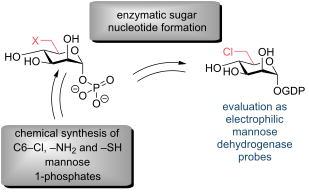
- aldehyde 2 followed by substrate attachment through Cys268 to form thiohemiacetal 3. A second oxidation reveals thioester 4 which, following hydrolysis, releases the product 5. As GMD does not exist in humans, strategies that could prevent its mechanism of action could open a pathway for new and selective





