Search results
Search for "metal-free" in Full Text gives 303 result(s) in Beilstein Journal of Organic Chemistry. Showing first 200.
Microfluidic light-driven synthesis of tetracyclic molecular architectures
Beilstein J. Org. Chem. 2018, 14, 2418–2424, doi:10.3762/bjoc.14.219
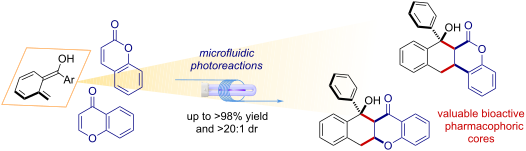
- functionalize organic molecules is receiving considerable interest from the scientific community [2]. Thus, innovative light-driven metal-free synthetic methods have been successfully developed [3]. More recently, the microfluidic photoreactor (MFP) technology has revealed to be a key technology applicable for


Catalyst-free synthesis of 4-acyl-NH-1,2,3-triazoles by water-mediated cycloaddition reactions of enaminones and tosyl azide
Beilstein J. Org. Chem. 2018, 14, 2348–2353, doi:10.3762/bjoc.14.210
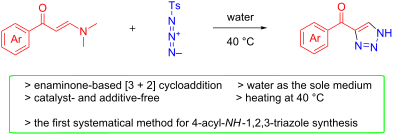
- development of these metal-catalyzed cycloaddition strategies [33][34][35]. Alongside the vast progress happened in MAAC-based 1,2,3-triazole synthesis, the past decade has witnessed the emergence of another powerful cycloaddition tool for the 1,2,3-triazole synthesis: the metal-free cycloaddition of azides
- construction, enamines with good stability and easy availability such as enaminones have exhibited also conspicuously versatile application in the metal-free synthesis of divergent 1,2,3-triazoles by directly acting as starting materials [51][52][53][54]. In 2016, Dehaen and co-workers [55] reported the
- and tosyl azide employing water the sole reaction medium, a series of 4-acyl-NH-1,2,3-triazoles has been efficiently synthesized under catalyst-free and very mild heating conditions, thus providing the first water-mediated metal-free method toward the synthesis of 4-acyl-NH-1,2,3-triazoles. The


Applications of organocatalysed visible-light photoredox reactions for medicinal chemistry
Beilstein J. Org. Chem. 2018, 14, 2035–2064, doi:10.3762/bjoc.14.179
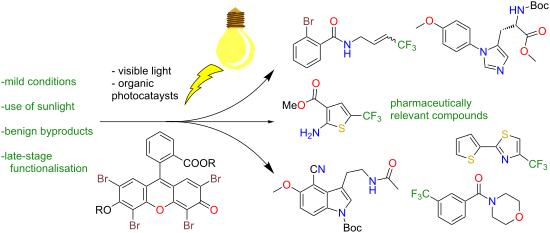
- related transition metal-catalysed C–C bond forming reactions are in the top 5 most used reactions in medicinal chemistry [45]. Therefore, the development of metal-free variants of these types of reactions is a very attractive goal. An interesting approach was taken by König et al., who report the


Recent advances in hypervalent iodine(III)-catalyzed functionalization of alkenes
Beilstein J. Org. Chem. 2018, 14, 1813–1825, doi:10.3762/bjoc.14.154
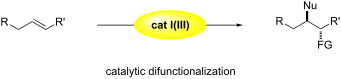
- ) reagents were applied to oxidize transition metals [21][22][23][24][25]. In an alternative way, the electrophilic hypervalent iodine(III) reagents can activate alkenes directly in a metal-free manner. Based on this strategy, dichlorination [26], 1,2-difluorination [27], gem-difluorination [28


Synthesis of spirocyclic scaffolds using hypervalent iodine reagents
Beilstein J. Org. Chem. 2018, 14, 1778–1805, doi:10.3762/bjoc.14.152
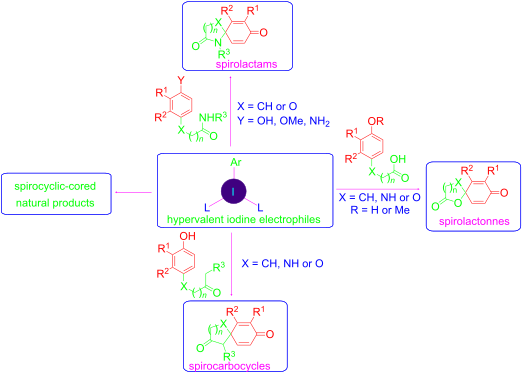
- Sreenithya [92] developed a metal-free approach for the synthesis of 1,1'-dimethyl-3,3'-spirobi[indoline]-2,2'-dione (61) from N1,N3-dimethyl-N1,N3-diphenylmalonamide (60) using PIFA (31) in trifluoroethanol at room temperature. The spirolactam 61 was isolated in 75% yield (Scheme 21). According to the


β-Hydroxy sulfides and their syntheses
Beilstein J. Org. Chem. 2018, 14, 1668–1692, doi:10.3762/bjoc.14.143
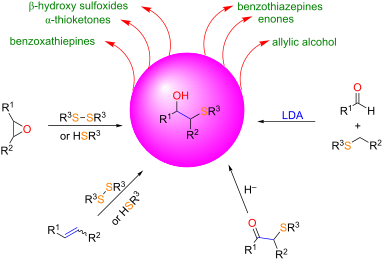
- electron-donating groups. Whilst this method offers a one-pot, transition metal-free and odorless approach to β-hydroxy sulfides utilizing atmospheric oxygen, an environmentally benign and cheap oxidant, its chief drawback is the incompatibility with aliphatic alkenes and dialkyl disulfides to provide the


Mild and selective reduction of aldehydes utilising sodium dithionite under flow conditions
Beilstein J. Org. Chem. 2018, 14, 1529–1536, doi:10.3762/bjoc.14.129
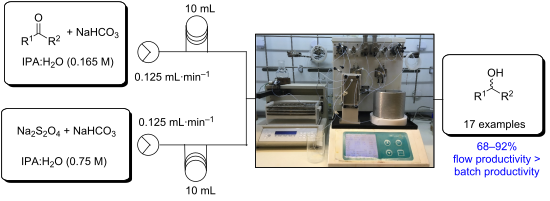
- developed a simple transition-metal-free continuous flow method for the reduction of aldehydes in aqueous media utilising sodium dithionite which does not generate or use molecular hydrogen. The process affords comparable yields to those obtained under batch conditions but in reduced reaction residence time


Hypervalent organoiodine compounds: from reagents to valuable building blocks in synthesis
Beilstein J. Org. Chem. 2018, 14, 1508–1528, doi:10.3762/bjoc.14.128
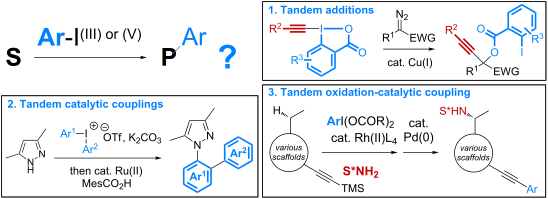
- metal-free alternative to the previous methods of formation of sulfur heterocycles 70 has been reported by using elemental sulfur in the presence of cesium carbonate (Scheme 32) [72]. The strategy can be extended to the synthesis of the cyclic selenium analogs 71 by utilizing elemental selenium and
- been further extended to the synthesis of a new series of molecules 77, where the central thiophene moiety is replaced by a 6-membered heterocycle, which is substituted by a gem-dimethyl or a cyclopropyl group. In this case, the reaction can be performed under metal-free conditions in the presence of a
- Namitharan has very recently demonstrated that a one-pot palladium-catalyzed Heck coupling allows for transferring the aryl group of (diacetoxyiodo)arenes released after a metal-free methylenation reaction (Scheme 45) [110]. The latter that is performed by reacting PhI(OAc)2 with DMSO, applies to amidines 97




Metal-free formal synthesis of phenoxazine
Beilstein J. Org. Chem. 2018, 14, 1491–1497, doi:10.3762/bjoc.14.126
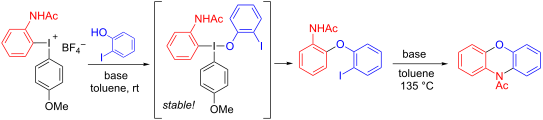
- Gabriella Kervefors Antonia Becker Chandan Dey Berit Olofsson Department of Organic Chemistry, Arrhenius Laboratory, Stockholm University, SE-106-91 Stockholm, Sweden 10.3762/bjoc.14.126 Abstract A transition metal-free formal synthesis of phenoxazine is presented. The key step of the sequence is
- ][8], are present in a variety of dyes [9], and can be applied in chemosensors and dye-sensitized solar cells (Figure 1) [10][11][12]. N-Arylphenoxazines were recently employed as photoredox catalysts in metal-free polymerizations [13]. The first synthesis of phenoxazine dates back more than 100 years
- [14], and a range of synthetic routes to this target has since been developed [1]. Transition metal-free routes include the synthesis from 2-aminophenols and 3,4-dihaloarenes decorated with electron-withdrawing substituents, which proceed through a Smiles rearrangement (Scheme 1a) [15][16][17]. More


Synthesis of trifluoromethylated 2H-azirines through Togni reagent-mediated trifluoromethylation followed by PhIO-mediated azirination
Beilstein J. Org. Chem. 2018, 14, 1452–1458, doi:10.3762/bjoc.14.123

- trifluoromethylated 2H-azirine compounds. This method features mild reaction conditions, a simple operation, and metal-free characteristics. The presence of both, the biologically interesting CF3 group and the 2H-azirine skeleton in the products obtained might making them interesting for further applications in


Atom-economical group-transfer reactions with hypervalent iodine compounds
Beilstein J. Org. Chem. 2018, 14, 1263–1280, doi:10.3762/bjoc.14.108
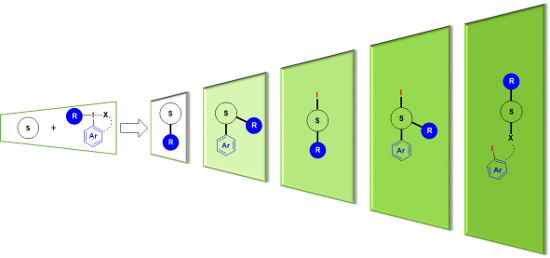
- partner) are taken into account. Other additives, such as additional bases, acids or catalysts were neglected. Review 1. Diaryliodonium salts 1.1. Acyclic diaryliodonium salts Acyclic diaryliodonium salts 1 find widespread application in numerous metal-free and transition metal-mediated electrophilic
- waste. Examples for their atom-economical utilization, in which at least both aryl ligands are transferred, are still rare. A general approach would involve at first a metal-catalysed or metal-free arylation step of a suitable substrate A with the diaryliodonium salt 1 to give monoarylated intermediate
- –boron bond formation gives one equivalent of arylboronic ester 4 and an iodoarene 2 through a metal-free boron arylation. Subsequent cross coupling under Suzuki conditions affords symmetrical biphenyls 3’ in good yields. Due to the temporary introduction and cleavage of the boron moiety the formal atom






A survey of chiral hypervalent iodine reagents in asymmetric synthesis
Beilstein J. Org. Chem. 2018, 14, 1244–1262, doi:10.3762/bjoc.14.107
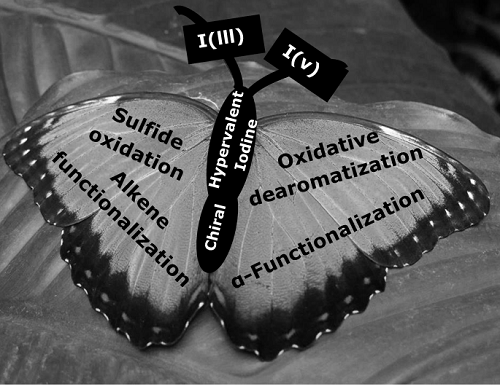
- application due to their reduced toxicity, ready availability and lower costs as replacement for transition metals leading to several “metal-free” like chemical transformations. The ongoing demand of modern synthetic chemistry for the development of catalytic enantioselective C–C bond formation reactions
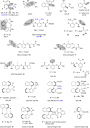
- different stereoelectronic properties by using aliphatic alcohols as a sole source of chirality [64]. Olofsson and Wirth et al. also jointly reported the synthesis of new structurally distinct chiral reagents 20 considering their interest towards asymmetric metal-free arylation [65]. In 1997, Wirth et al



Selective carboxylation of reactive benzylic C–H bonds by a hypervalent iodine(III)/inorganic bromide oxidation system
Beilstein J. Org. Chem. 2018, 14, 1087–1094, doi:10.3762/bjoc.14.94
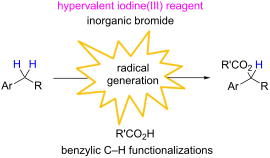
- , reports aimed at realizing efficient and selective metal-free C(sp3)–H transformations are rather limited; however, investigations by several research groups are still ongoing [15][16][17][18][19][20][21][22][23][24][25][26][27][28][29][30]. Hypervalent iodine reagents are now widely accepted as a safe
- synthesis of lactones via the intramolecular oxidative cyclization of aryl carboxylic acids at the benzyl carbon under transition-metal-free conditions [52]. Based on our previous research and general interest in the unique reactivity of hypervalent iodine(III)–Br bonds [53][54][55][56], we report the
- facilitate the activation of the benzylic C(sp3)–H bond are rare [21][57][58][59][60][61][62]. Furthermore, only a limited number of transition-metal-free methods have been reported; successful examples include the Wohl–Ziegler-type conditions [21], the sodium bromate system [57] for the conversion of


Hypervalent iodine(III)-mediated decarboxylative acetoxylation at tertiary and benzylic carbon centers
Beilstein J. Org. Chem. 2018, 14, 1046–1050, doi:10.3762/bjoc.14.92
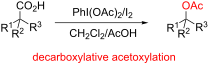
- operationally simple method under metal-free and mild reaction conditions can be used to produce a variety of acetates, which can be efficiently transformed into tertiary and benzylic alcohols. Decarboxylative functionalization using PhI(OAc)2/I2 system. Substrate scope. Reactions were conducted on a 0.5 mmol


Imide arylation with aryl(TMP)iodonium tosylates
Beilstein J. Org. Chem. 2018, 14, 1034–1038, doi:10.3762/bjoc.14.90
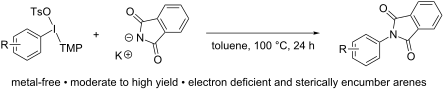
- Souradeep Basu Alexander H. Sandtorv David R. Stuart Department of Chemistry, Portland State University, Portland OR 97201, United States 10.3762/bjoc.14.90 Abstract Herein, we describe the synthesis of N-aryl phthalimides by metal-free coupling of potassium phthalimide with unsymmetrical aryl
- -deficient and sterically encumbered aryl groups. Keywords: arylation; C–N coupling; diaryliodonium; hypercoordinate iodine; metal-free; Introduction Imides are important structural units in a range of approved pharmaceuticals and agrochemicals (Scheme 1a) [1]. Despite the general prevalence of imides, N
- , transition metals feature prominently in such methods, but even recent examples employ stoichiometric metal mediators [4]. Metal-free methods by classic SNAr are also attractive, but only possible on very electron-deficient arene substrates [5]. Diaryliodonium salts are useful reagents for metal-free aryl


Hypervalent iodine-mediated Ritter-type amidation of terminal alkenes: The synthesis of isoxazoline and pyrazoline cores
Beilstein J. Org. Chem. 2018, 14, 1028–1033, doi:10.3762/bjoc.14.89
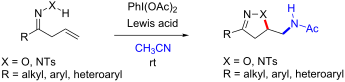
- accessing both isoxazoline and pyrazoline cores. Additionally, acetonitrile serves as both the solvent and an amine source in the presence of this PIDA/Lewis acid combination. This operationally straightforward and metal-free protocol provides an easy access to isoxazoline and pyrazoline derivatives
- . Keywords: amido-amidation; hypervalent iodine; isoxazoline; metal-free; oxyamidation; pyrazoline; Introduction Isoxazoline and pyrazoline-containing heterocycles are abundant in natural products and biologically active molecules [1][2][3][4][5]. Thus, these scaffolds are also important from the standpoint


Fluorocyclisation via I(I)/I(III) catalysis: a concise route to fluorinated oxazolines
Beilstein J. Org. Chem. 2018, 14, 1021–1027, doi:10.3762/bjoc.14.88
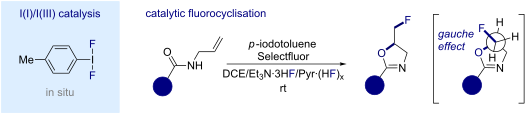
- . Conclusion An operationally simple route to 5-fluoromethyl-2-oxazolines from readily accessible N-allylcarboxamides is disclosed based on an I(I)/I(III) catalysis manifold. This metal-free fluorocyclisation employs p-iodotoluene (10 mol %) as an inexpensive organocatalyst and Selectfluor® as oxidant. The


Electrochemically modified Corey–Fuchs reaction for the synthesis of arylalkynes. The case of 2-(2,2-dibromovinyl)naphthalene
Beilstein J. Org. Chem. 2018, 14, 891–899, doi:10.3762/bjoc.14.76
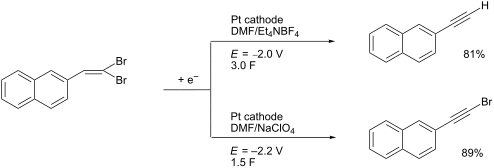
- ; Introduction Terminal alkynes, due to the considerable triple-bond strength (839 kJ mol−1), are characterized by a moderate thermodynamic reactivity [1]. Nevertheless, both the C–C triple bond and the terminal C–H bond can be efficiently and selectively activated by metal or metal-free catalysts. Therefore


One-pot synthesis of diaryliodonium salts from arenes and aryl iodides with Oxone–sulfuric acid
Beilstein J. Org. Chem. 2018, 14, 849–855, doi:10.3762/bjoc.14.70

- nucleophiles including electron-rich carbon-centered species [5][6][7]. The unique arylating reactivity of diaryliodonium salts has been demonstrated in many metal-catalyzed and also metal-free transformations [8][9][10][11][12][13][14][15]. The development of novel synthetic approaches to diaryliodonium salts

D–A–D-type orange-light emitting thermally activated delayed fluorescence (TADF) materials based on a fluorenone unit: simulation, photoluminescence and electroluminescence studies
Beilstein J. Org. Chem. 2018, 14, 672–681, doi:10.3762/bjoc.14.55
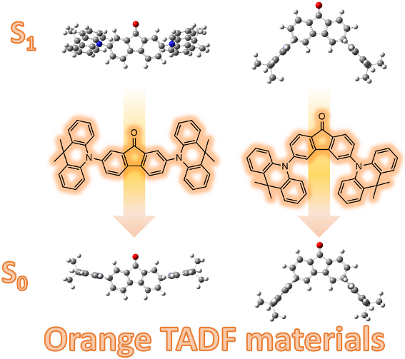
- increase the cost of the final OLEDs. Alternatively, a thermally activated delayed fluorescence (TADF) material is a kind of noble-metal-free fluorescent material able to transform triplet excitons into singlet excitons through reverse intersystem crossing (RISC) to achieve 100% IQEmax in theory [4]. On the


Enantioselective dioxytosylation of styrenes using lactate-based chiral hypervalent iodine(III)
Beilstein J. Org. Chem. 2018, 14, 659–663, doi:10.3762/bjoc.14.53
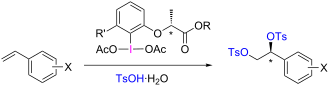
- )-isomer. Keywords: 1,2-difunctionalization of alkenes; enantioselective synthesis; hypervalent iodine; oxidation; Findings Hypervalent aryl-λ3-iodanes have been widely used for metal-free oxidation with high selectivity in organic synthesis [1][2][3]. The reactivity of an aryl-λ3-iodane is controlled by


Sequential Ugi reaction/base-induced ring closing/IAAC protocol toward triazolobenzodiazepine-fused diketopiperazines and hydantoins
Beilstein J. Org. Chem. 2018, 14, 626–633, doi:10.3762/bjoc.14.49
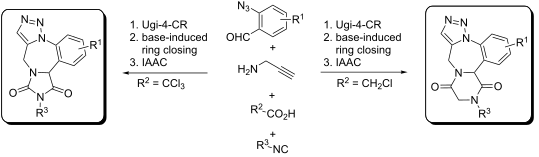
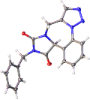
- heterocycle formation and the other an IAAC. Unlike some of the reported strategies using Cu-catalyzed IAAC [13][15], we postulated that the intramolecular dipolar cycloaddition would proceed under thermal conditions (metal-free) due to the close proximity of the azide and similar functionalities in the





Addition of dithi(ol)anylium tetrafluoroborates to α,β-unsaturated ketones
Beilstein J. Org. Chem. 2018, 14, 515–522, doi:10.3762/bjoc.14.37
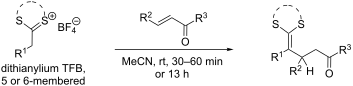
- examples for additions of activated (EWG-substituted) ketene 1,3-dithioacetals to α,β-unsaturated carbonyl compounds are literature known [31][32] but concepts for a versatile (metal-free) application of this reaction to starting materials lacking the EWG in α-position are still missing. Results and


Functionalization of N-arylglycine esters: electrocatalytic access to C–C bonds mediated by n-Bu4NI
Beilstein J. Org. Chem. 2018, 14, 499–505, doi:10.3762/bjoc.14.35

- the presence of excess amounts of oxidant. On the other hand, the toxicity of residual traces of transition metal (photo)catalyst in products is also highly concerned. Consequently, metal-free and environmentally friendly oxidative C–C bond formation is highly desired. Electrochemistry has proved to


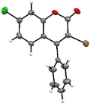
One-pot preparation of 4-aryl-3-bromocoumarins from 4-aryl-2-propynoic acids with diaryliodonium salts, TBAB, and Na2S2O8
Beilstein J. Org. Chem. 2018, 14, 345–353, doi:10.3762/bjoc.14.22
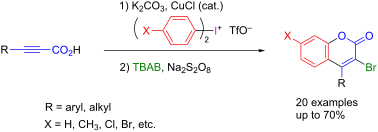
- -vinylphenols at 110 °C [19], the FeCl3-catalyzed areneselenyl-cyclization of aryl 2-alkynoates with ArSeSeAr at rt [20], and the Rh-catalyzed annulation of arylthiocarbamates with alkynes/AgOTf/Cu(OAc)2 at 120 °C [21]. As examples of the transition-metal-free construction of the coumarin skeleton, the Brønsted
- N-arylation of NH groups under metal-free conditions [35][36][37][38][39]. For example, treatment of arenecarboxylic acids and alkanecarboxylic acids with diaryliodonium salts and t-BuOK under toluene refluxing conditions provides the corresponding aryl carboxylates in good yields [40][41]. However