


Search results
Search for "X-ray analysis" in Full Text gives 350 result(s) in Beilstein Journal of Organic Chemistry. Showing first 200.
Self-assembled coordination thioether silver(I) macrocyclic complexes for homogeneous catalysis
Beilstein J. Org. Chem. 2019, 15, 2465–2472, doi:10.3762/bjoc.15.239
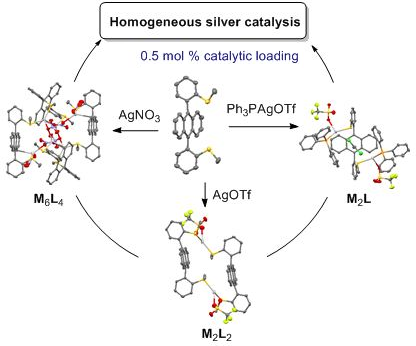
- reactions of alkynes. Results and Discussion Synthesis of silver(I) complexes Ligand 1 was synthesized in one step, from commercially available 9,10-dibromoanthracene and 2-(methylthio)phenylboronic acid, using a Suzuki–Miyaura cross-coupling reaction. Notably, the yield was low (26%) [55], and the X-ray
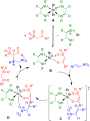
- analysis of monocrystals revealed the syn-conformation of 1 (Scheme 1). A variable temperature 1H NMR (VT-NMR, Figures S10–12 in Supporting Information File 1) experiment conducted on syn-1 in the range of –30 to 110 °C in C2D2Cl4 showed the broadening of proton signals, due to the restricted rotation of


Indium-mediated C-allylation of melibiose
Beilstein J. Org. Chem. 2019, 15, 2458–2464, doi:10.3762/bjoc.15.238
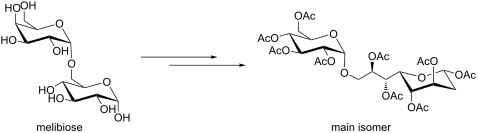
- elongation methodology allows for a short, efficient and diastereoselective approach towards complex glycosylated carbohydrate structures. The stereochemical outcome of the key intermediates, allylated disaccharides, has been determined by X-ray analysis. Ozonolysis of the introduced double bond yielded the
- main product was crystallized and the configuration was determined by X-ray analysis proving the expected syn-configuration (compound 2-syn) [CCDC 1922520] (Figure 1). Epimer 2-syn was applied to Zemplén conditions prior to the ozonolysis. Conventional work-up, neutralization with acidic ion exchange
- , 20.71, 20.69, 20.66, 20.64, 20.58 (9 × O(C=O)CH3) ppm; HRMS (ESI+) m/z: [M + NH4]+ calcd for C32H48NO21+, 782.2713; found, 782.2720. X-ray analysis of the main C-allylation product 2-syn [CCDC 1922520]. Structures of the main products 5-syn-β and 5-anti-β. Indium-mediated allylation of melibiose (1


In water multicomponent synthesis of low-molecular-mass 4,7-dihydrotetrazolo[1,5-a]pyrimidines
Beilstein J. Org. Chem. 2019, 15, 2390–2397, doi:10.3762/bjoc.15.231
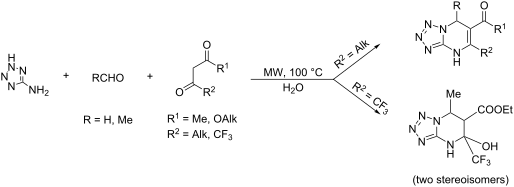
- the NMR data corresponded quite well to the proposed structure 9, they did not allow the complete rejection of the isomeric structure 9' for the reaction product. The final confirmation of structures 9a–g was achieved by X-ray analysis of 9a (Figure 1). A specific behavior of acetylacetone (10) as the


Aggregation-induced emission effect on turn-off fluorescent switching of a photochromic diarylethene
Beilstein J. Org. Chem. 2019, 15, 2204–2212, doi:10.3762/bjoc.15.217
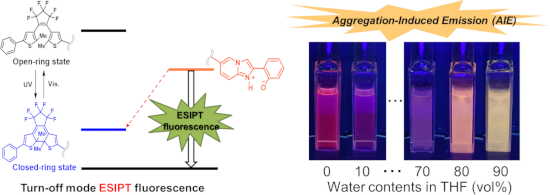
- substrate [19]. The X-ray analysis data of a single crystal of 1o is shown in Figure S1 and Table S1 in Supporting Information File 1. The distance between two reactive carbon atoms in the thiophene rings was obtained to be 3.534 Å, which is less than 4.2 Å. It indicates the molecule is photoreactive in the
- 214: X-ray analysis data of a single crystal of 1o. Supporting Information File 215: Movie 1, quenching rate dependence on the environmental conditions. Supporting Information File 216: Movie 2, fluorescent color change of 1o. Acknowledgements This work was supported by JSPS KAKENHI Grant Number


Characterization of two new degradation products of atorvastatin calcium formed upon treatment with strong acids
Beilstein J. Org. Chem. 2019, 15, 2085–2091, doi:10.3762/bjoc.15.206
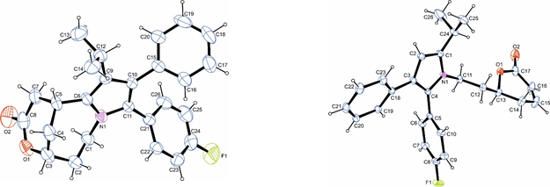
- investigated here, even direct protonation at C-3 of the pyrrole by strong acid is most likely, due to the significant basicity of pyrroles. Delocalization of the positive charge (A ↔ A’) as shown in Scheme 2 will support the initial ring protonation step. The X-ray analysis of compound 7 revealed that the




Regioselective Pd-catalyzed direct C1- and C2-arylations of lilolidine for the access to 5,6-dihydropyrrolo[3,2,1-ij]quinoline derivatives
Beilstein J. Org. Chem. 2019, 15, 2069–2075, doi:10.3762/bjoc.15.204
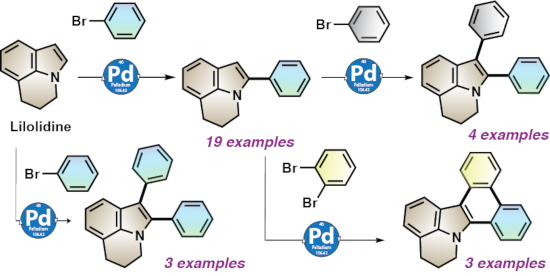
- structure of 2 was confirmed by X-ray analysis. A lower yield of 7 was obtained for the reaction of 4-bromobenzaldehyde with lilolidine due to the formation of degradation products. Good yields in 8 and 9 were obtained from 4-chloro- and 4-carbonitrile-substituted aryl bromides. In all cases, with these


Synthesis of benzo[d]imidazo[2,1-b]benzoselenoazoles: Cs2CO3-mediated cyclization of 1-(2-bromoaryl)benzimidazoles with selenium
Beilstein J. Org. Chem. 2019, 15, 2029–2035, doi:10.3762/bjoc.15.199
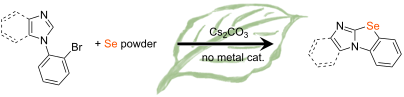
- tetracyclic heterocycles are all novel compounds. Single-crystal X-ray analysis of the parent benzimidazo[2,1-b]benzoselenoazole revealed that the tetracyclic ring is almost planar. Absorption spectroscopy data of the benzimidazo[2,1-b]benzoselenoazoles showed the λmax was dependent on the number of rings


Fluorinated azobenzenes as supramolecular halogen-bonding building blocks
Beilstein J. Org. Chem. 2019, 15, 2013–2019, doi:10.3762/bjoc.15.197
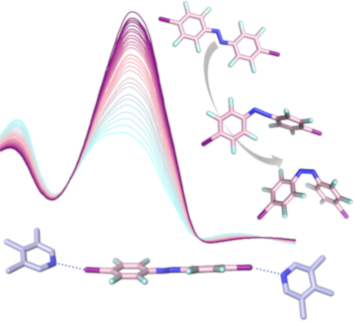
- the Supporting Information File 1, Figures S6–S8). In addition to that, slow evaporation of an equimolar solution of U1 and A2 in benzene furnished red-orange single crystals suitable for X-ray analysis of a [2 + 2] halogen-bonded box, U1···A2, over the course of a few days in quantitative yield


Halide metathesis in overdrive: mechanochemical synthesis of a heterometallic group 1 allyl complex
Beilstein J. Org. Chem. 2019, 15, 1856–1863, doi:10.3762/bjoc.15.181
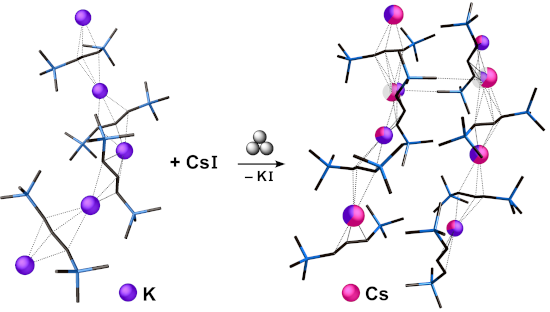
- produced crystals that were yellow-orange; they were highly soluble in C6D6, giving a bright red solution. Single crystal X-ray analysis identified the crystals as the heterometallic complex [KCsA'2] (see below). The 1H NMR spectrum of the products from the 1:1 and 3:1 grinds were identical. It should be
- analogous solvate is obtained, and the resulting crystals are of higher quality than those from toluene. Single crystal X-ray analysis reveals that it has a structure that is qualitatively the same as the toluene solvate, and only the benzene solvate is discussed here. Like the unsolvated complex [KA']∞ [17


Different reactivity of phosphorylallenes under the action of Brønsted or Lewis acids: a crucial role of involvement of the P=O group in intra- or intermolecular interactions at the formation of cationic intermediates
Beilstein J. Org. Chem. 2019, 15, 1491–1504, doi:10.3762/bjoc.15.151
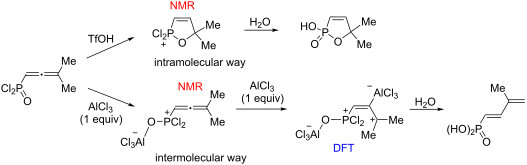
- hydrolysis strongly depend on the substituent X on the phosphorus atom. Ions containing a labile P–X bond (X = Cl, O, S), namely A, B, and F–H, gave unstable adducts 2 (registered by GC–MS), which are further transformed into acids 3. The structure of compound 3a was confirmed by X-ray analysis (see




Synthesis of pyrrolo[1,2-a]quinolines by formal 1,3-dipolar cycloaddition reactions of quinolinium salts
Beilstein J. Org. Chem. 2019, 15, 1480–1484, doi:10.3762/bjoc.15.149
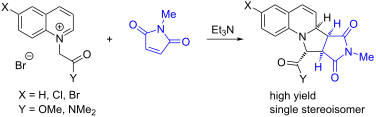
- triethylamine and were pleased to obtain good yields of the adducts 7a–c and 8a,b (Scheme 2). In each case, the products 7a–c and 8a,b were formed as a single regioisomer and stereoisomer. The selectivity in favour of the isomer drawn in Scheme 2 was verified by single crystal X-ray analysis of the adduct 7c
- to undergo reaction with the ylides derived from the salts 4 and 5. In both cases, very good yields of the tetracyclic adducts 9 and 10 were obtained after heating for only 1 h (Scheme 3). The relative stereochemistry of the adduct 9 was determined by single crystal X-ray analysis (Figure 2). To
- with N-methylmaleimide in the presence of triethylamine in methanol to give the desired adducts 15a and 15b as single stereoisomers (Scheme 5). The stereochemistry of product 15a was confirmed by single crystal X-ray analysis (see Supporting Information File 1) and matches the relative configuration of


Introduction of an isoxazoline unit to the β-position of porphyrin via regioselective 1,3-dipolar cycloaddition reaction
Beilstein J. Org. Chem. 2019, 15, 1434–1440, doi:10.3762/bjoc.15.143
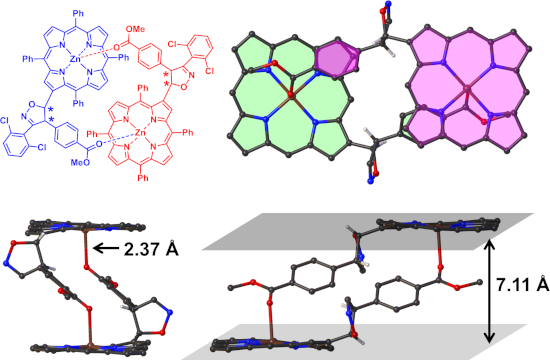
- the double bond after the cycloaddition reaction, the absorption spectrum shifted to shorter wavelengths. The isoxazoline-modified porphyrins have been identified by absorption, emission, 1H NMR and mass spectrometry, and 3a was further characterized by X-ray analysis. In the crystal, a pair of


Selenophene-containing heterotriacenes by a C–Se coupling/cyclization reaction
Beilstein J. Org. Chem. 2019, 15, 1379–1393, doi:10.3762/bjoc.15.138

- crucial cyclization steps to the stable and soluble fused systems were achieved by copper-catalyzed C–S and C–Se coupling/cyclization reactions. Structures and packing motifs in the solid state were elucidated by single crystal X-ray analysis and XRD powder measurements. Comparison of the optoelectronic


Synthesis of non-racemic 4-nitro-2-sulfonylbutan-1-ones via Ni(II)-catalyzed asymmetric Michael reaction of β-ketosulfones
Beilstein J. Org. Chem. 2019, 15, 1289–1297, doi:10.3762/bjoc.15.127
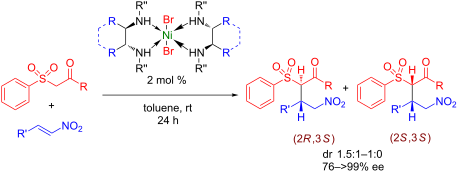
- suitable for X-ray analysis were obtained for compound 8d (which is formed as an individual diastereomer). This made it possible to determine its absolute (2R,3S)-configuration, as well as to assign the absolute configuration for the other compounds obtained. The molecular structure of compound 8d is shown




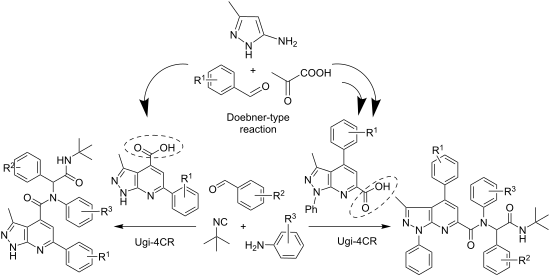
Doebner-type pyrazolopyridine carboxylic acids in an Ugi four-component reaction
Beilstein J. Org. Chem. 2019, 15, 1281–1288, doi:10.3762/bjoc.15.126
- adding compounds 12a–f. The purity and structures of the obtained heterocyclic products were established by means of NMR spectroscopy, mass spectrometry, and elemental analysis. The final assignment of the structures 11 and 12 was made by X-ray analysis for the structure 11n (Figure 1). Antibacterial


Bambusuril analogs based on alternating glycoluril and xylylene units
Beilstein J. Org. Chem. 2019, 15, 1268–1274, doi:10.3762/bjoc.15.124
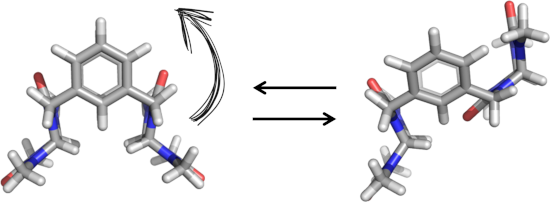
- of one glycoluril unit and methine protons of the second glycoluril unit. The monocrystals of 1b suitable for X-ray analysis were obtained upon slow diffusion of diisopropyl ether into the solution of 1b in dichloromethane and benzene. The X-ray structure features Cs symmetry (Figure 5), which is in


Insertion of [1.1.1]propellane into aromatic disulfides
Beilstein J. Org. Chem. 2019, 15, 1172–1180, doi:10.3762/bjoc.15.114
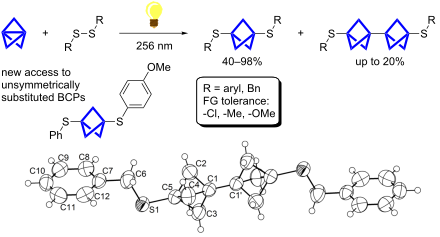
- , 13C NMR, X-ray analysis) are provided in the following files. Supporting Information File 514: Description and analyses. Supporting Information File 515: Spectra. Supporting Information File 516: RInChIs. Supporting Information File 517: DOIs data repository. Supporting Information File 518: Reference


Mechanochemistry of supramolecules
Beilstein J. Org. Chem. 2019, 15, 881–900, doi:10.3762/bjoc.15.86
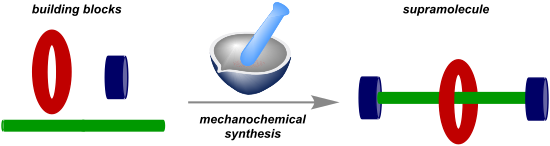
- to be 100% stereospecific under dry mortar and pestle grinding [110]. The hydrogen-bond donor 4,6-dichlororesorcinol was used as the supramolecular catalyst for the transformation in the solid-state. From single crystal X-ray analysis the authors have proved the formation of the 2:2 complex 42 from


Hoveyda–Grubbs catalysts with an N→Ru coordinate bond in a six-membered ring. Synthesis of stable, industrially scalable, highly efficient ruthenium metathesis catalysts and 2-vinylbenzylamine ligands as their precursors
Beilstein J. Org. Chem. 2019, 15, 769–779, doi:10.3762/bjoc.15.73
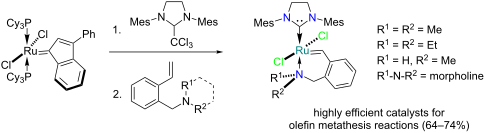
- catalysts 11a–c (Figure 3). In spite of the fact that we do not have the X-ray analysis for catalyst 11d, it is possible to assume that this complex should exhibit the longest coordination N→Ru bond (at least more than 2.30 Å). Interestingly, lower yields of stilbene from styrene in CH2Cl2 were obtained in


Synthesis of 2H-furo[2,3-c]pyrazole ring systems through silver(I) ion-mediated ring-closure reaction
Beilstein J. Org. Chem. 2019, 15, 679–684, doi:10.3762/bjoc.15.62

- −127.5 to −128.0 ppm for N-1. The structure of 4d was investigated additionally by single crystal X-ray analysis (Figure 1) [39]. The asymmetric unit of the crystal consists of two molecules 4d(A) and 4d(B) held together by the weak CH···N type hydrogen bonds C19–H···N51 (C···N = 3.470(11) Å, H···N


Catalyst-free assembly of giant tris(heteroaryl)methanes: synthesis of novel pharmacophoric triads and model sterically crowded tris(heteroaryl/aryl)methyl cation salts
Beilstein J. Org. Chem. 2019, 15, 642–654, doi:10.3762/bjoc.15.60
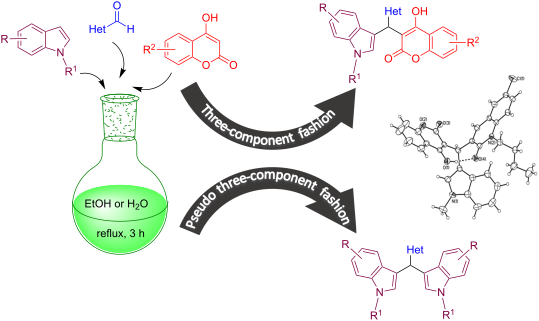
- reactions could also be carried out in water (at circa 80 °C) but with chemoselectivity favoring (Ar1Ar1Ar2)CH over (Ar1Ar2Ar3)CH. The molecular structure of a representative (Ar1Ar2Ar3)CH triad was confirmed by X-ray analysis. Model tris(heteroaryl/aryl)methylium salts were generated by reaction with DDQ
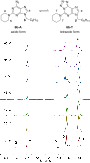
- 1D and 2D NMR spectroscopy and by EIMS, elemental analysis, and HRMS (see experimental section and Supporting Information File 1). Additionally, single crystals of compound 9{4,7,1} suitable for X-ray analysis were grown from ACN at room temperature. Compound 9{4,7,1} crystallizes in the triclinic








Synthesis and fluorescent properties of N(9)-alkylated 2-amino-6-triazolylpurines and 7-deazapurines
Beilstein J. Org. Chem. 2019, 15, 474–489, doi:10.3762/bjoc.15.41
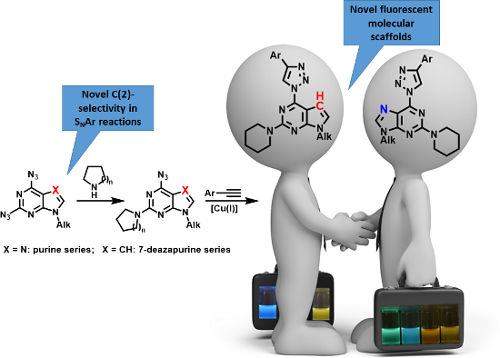
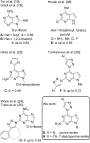
- increases with the increase of solvent polarity. Additionally, X-ray analysis of 2,6-diazidopurine 2'-deoxyribonucleoside revealed the exclusive existence of the azido tautomer in the solid state [41]. The discovered ability of the azido group to be substituted with amines at C(2) position was used for the




Annulation of 1H-pyrrole-2,3-diones by thioacetamide: an approach to 5-azaisatins
Beilstein J. Org. Chem. 2019, 15, 364–370, doi:10.3762/bjoc.15.32
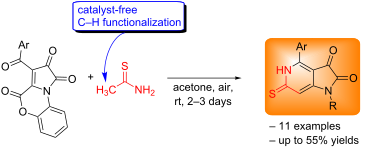
- precipitates. The precipitates were isolated and analyzed. We established that they were formed by pyrrolo[3,2-c]pyridine-2,3-diones 4 (Scheme 3). The structure of compounds 4 was unequivocally confirmed by a single crystal X-ray analysis (CCDC 1877232). We assume that the formation of compounds 4 occurred
- compound 5 (Scheme 7). The structure of compound 5 was proved by X-ray analysis (CCDC 1879686). Obviously, compound 5 corresponds to an intermediate proposed in pathway b (Scheme 4) which is one more evidence to support this pathway. Unfortunately, we did not succeed to transform compound 5 in the


Reusable and highly enantioselective water-soluble Ru(II)-Amm-Pheox catalyst for intramolecular cyclopropanation of diazo compounds
Beilstein J. Org. Chem. 2019, 15, 357–363, doi:10.3762/bjoc.15.31
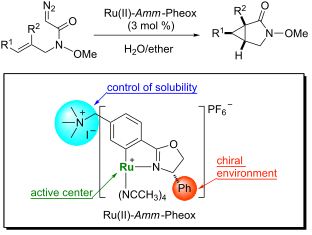
- Information Supporting Information File 66: Full experimental details and analytical data (reaction method, 1H NMR, 13C NMR, HPLC, X-ray analysis). Acknowledgements This work was supported by a Grant-in-Aid for Scientific Research (B) (No. 26288087) from Japan Society for the Promotion of Science. The data


Systematic synthetic study of four diastereomerically distinct limonene-1,2-diols and their corresponding cyclic carbonates
Beilstein J. Org. Chem. 2019, 15, 130–136, doi:10.3762/bjoc.15.13
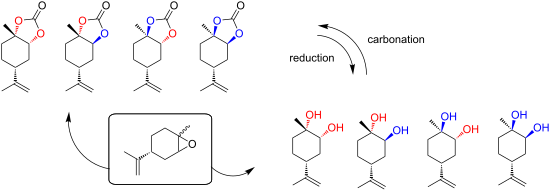
- reported in our previous study [27]. Of these, 1a has already been synthesised by other groups [10][11] as well as our group. Particularly, Kleij et al. revealed the solid-state structure of 1a via X-ray analysis [11], but the isolation and characterisation of 1d has only been reported by our group. Herein
- corresponding LMdiol 2d [27]. Notably, the structure of 2d was confirmed by X-ray analysis. It has been reported that reduction of the 5CC moiety with LAH gives the corresponding diol with the same stereochemical configuration at the carbon atoms as of the original 5CC moiety [28][29]. Such a reduction with LAH





