


Search results
Search for "addition reaction" in Full Text gives 192 result(s) in Beilstein Journal of Organic Chemistry.
Synthesis of aryl 2-bromo-2-chloro-1,1-difluoroethyl ethers through the base-mediated reaction between phenols and halothane
Beilstein J. Org. Chem. 2021, 17, 89–96, doi:10.3762/bjoc.17.9

- the further application of compound 2o in a cyclization reaction. Upon the treatment of 2o with zinc and chlorotrimethylsilane (TMSCl), the intramolecular 1,4-addition reaction of 2o proceeded to give the 2,2-gem-difluorochromane 3 in low yield (Scheme 3). Next, we moved on consideration of the


An atom-economical addition of methyl azaarenes with aromatic aldehydes via benzylic C(sp3)–H bond functionalization under solvent- and catalyst-free conditions
Beilstein J. Org. Chem. 2020, 16, 3093–3103, doi:10.3762/bjoc.16.259
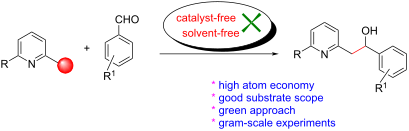
- moderate to excellent yields. This draws the conclusion that the benzylic C–H unit of 2-alkylpyridine/quinolines actively participates in this addition reaction. However, in some cases, 2-alkenyl compounds were formed. Nevertheless, these are of equivalent significance. Moreover, this method has a high


Using multiple self-sorting for switching functions in discrete multicomponent systems
Beilstein J. Org. Chem. 2020, 16, 2831–2853, doi:10.3762/bjoc.16.233
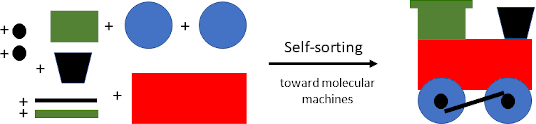
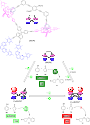
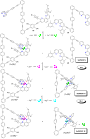
- activity in a Knoevenagel addition reaction. At the same time, the click reaction remained shut down (ON-1, OFF-2). In sum, the three interdependent states SelfSORT-I to III regulated two different reaction outcomes and an OFF state. In biology, motor proteins carry out essential tasks by walking along







Asymmetric Mannich reactions of (S)-N-tert-butylsulfinyl-3,3,3-trifluoroacetaldimines with yne nucleophiles
Beilstein J. Org. Chem. 2020, 16, 2671–2678, doi:10.3762/bjoc.16.217
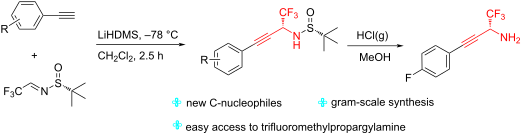
- yields and high enantioselectivities by the groups of Zhou and Peng, respectively (Scheme 1a). It should be mentioned that the Qing group also reported a method for the synthesis of α-trifluoromethylated α-propargylamines via a Ti-promoted addition reaction between acetylide and chiral CF3-ketimines




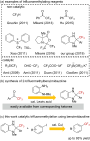
Catalytic trifluoromethylation of iodoarenes by use of 2-trifluoromethylated benzimidazoline as trifluoromethylating reagent
Beilstein J. Org. Chem. 2020, 16, 2442–2447, doi:10.3762/bjoc.16.198
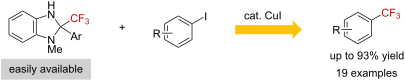
- (I)–CF3 species, generated through the reaction of benzimidazoline 2 with CuI under basic conditions, underwent an oxidative addition reaction with the aryl iodide to generate a Cu(III) complex. A subsequent reductive elimination furnished the trifluoromethylarene and Cu(I). Because an electron



Recent developments in enantioselective photocatalysis
Beilstein J. Org. Chem. 2020, 16, 2363–2441, doi:10.3762/bjoc.16.197
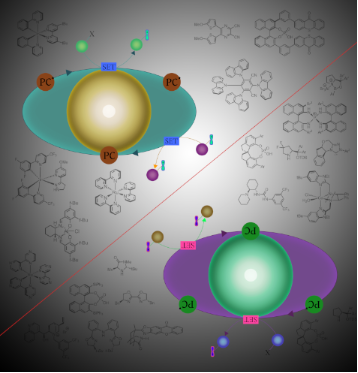
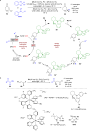
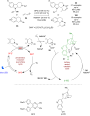
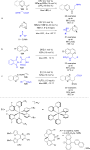
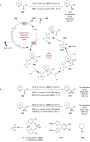
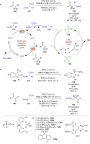
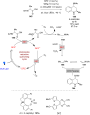
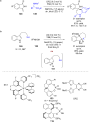
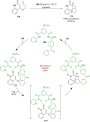
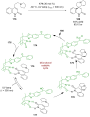
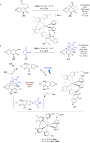
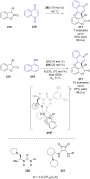
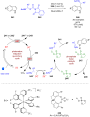
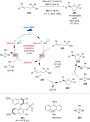
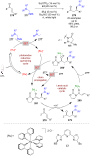
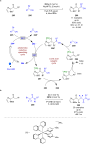
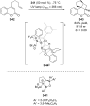
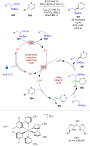
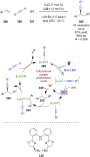
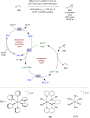
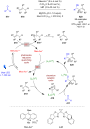
- synthesise the corresponding RCA products 283 in excellent yields and enantioselectivities (22 examples, up to >99:1 er) (Scheme 45) [111]. Huang et al. applied a similar catalytic system to that reported by Yoon et al. to a different radical addition reaction between nitrones 284 and aldehydes 285 (Scheme


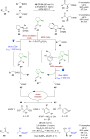























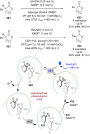


A complementary approach to conjugated N-acyliminium formation through photoredox-catalyzed intermolecular radical addition to allenamides and allencarbamates
Beilstein J. Org. Chem. 2020, 16, 1983–1990, doi:10.3762/bjoc.16.165
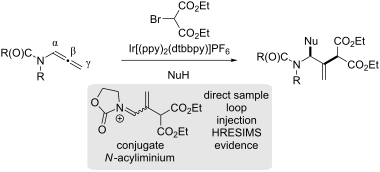
- undergoes an addition reaction with a suitable nucleophile (Scheme 1). Importantly, the electrophilic mediated formation of this key intermediate 2 have been the cornerstone for allenamide chemistry over the past 15 years. Therefore, given the importance of the allenamide building block we sought a new


Pauson–Khand reaction of fluorinated compounds
Beilstein J. Org. Chem. 2020, 16, 1662–1682, doi:10.3762/bjoc.16.138
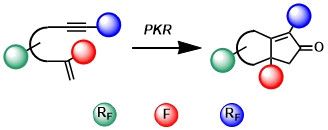
- this sense, while the addition of hard organometallic nucleophiles, such as lithium dialkylcuprates or Grignard reagents, failed, softer nucleophiles such as nitroalkanes cleanly added to the β-position, providing the Michael adduct 61. Unexpectedly, the conjugate addition reaction resulted in




The McKenna reaction – avoiding side reactions in phosphonate deprotection
Beilstein J. Org. Chem. 2020, 16, 1436–1446, doi:10.3762/bjoc.16.119
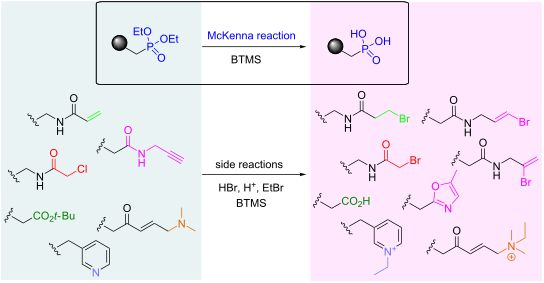
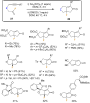
- storage and/or use of BTMS, which exposes it to traces of water. As mentioned in the previous section, compounds having multiple bonds could undergo an addition reaction upon exposure to HBr [42]. We studied this problem using 1H NMR spectroscopy with the model acrylamide 11 (Scheme 3), representing a


An overview on disulfide-catalyzed and -cocatalyzed photoreactions
Beilstein J. Org. Chem. 2020, 16, 1418–1435, doi:10.3762/bjoc.16.118
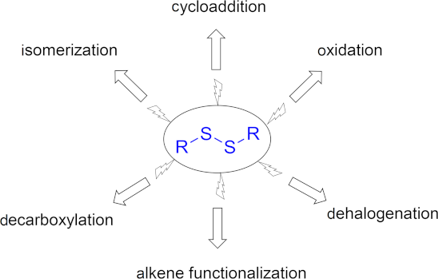
- fluorine-containing groups can effectively change the physical and chemical properties and biological activities of organic molecules [21][22]. The addition reaction using disulfide as the visible-light catalyst is an effective and atom-economic method for introducing fluorine-containing groups. In 2016






Disposable cartridge concept for the on-demand synthesis of turbo Grignards, Knochel–Hauser amides, and magnesium alkoxides
Beilstein J. Org. Chem. 2020, 16, 1343–1356, doi:10.3762/bjoc.16.115
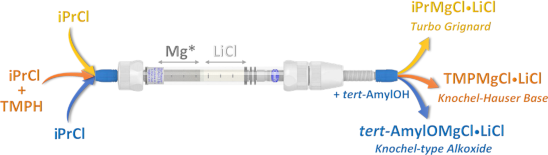
- possible to directly use the hygroscopic LiCl in a solid form. The back-pressure control allows a high-temperature oxidative addition reaction and enables the quantitative conversion of less reactive but more cost-effective alkyl chlorides. Furthermore, a low-cost pod-style synthesizer prototype has been


A simple and easy to perform synthetic route to functionalized thienyl bicyclo[3.2.1]octadienes
Beilstein J. Org. Chem. 2020, 16, 1092–1099, doi:10.3762/bjoc.16.96
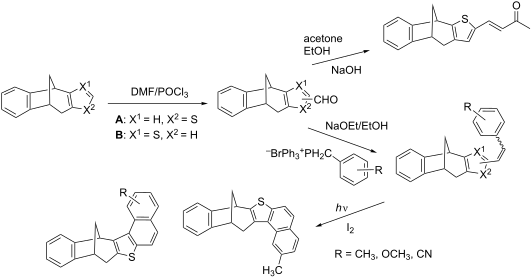
- functionalization. These functionalizations, beside the addition reaction, could involve photooxygenation reactions (Scheme 5) [1][22][23][24][25], previously studied in our laboratory. These reactions could result in a completely new spectrum of products, with preserved bicyclo[3.2.1.]octadiene skeleton, crucial


Aldehydes as powerful initiators for photochemical transformations
Beilstein J. Org. Chem. 2020, 16, 833–857, doi:10.3762/bjoc.16.76
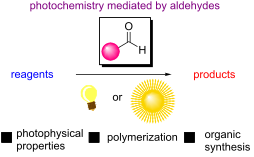
- of the benzophenone 172 to the triplet state 173 by UV irradiation, followed by HAT from the aldehyde 170 to 173 and the formation of the acyl radical 175. At the same time, the nickel(0) complex 176 performs an oxidative addition reaction to the aryl bromide 171, and the nickel(II) complex 177






Synthesis of C70-fragment buckybowls bearing alkoxy substituents
Beilstein J. Org. Chem. 2020, 16, 681–690, doi:10.3762/bjoc.16.66
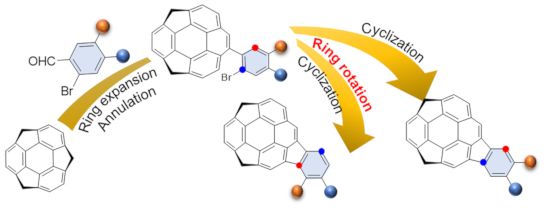
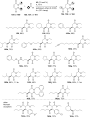
- the preparative TLC (PTLC) purification was conducted using Wakogel B-5F PTLC plates. Elemental analyses were measured on a J-Science Micro corder JM10 at the Analysis Center at Osaka University. General experimental procedure for the addition reaction In a similar manner as described in [18], to a


Regio- and stereoselective synthesis of new ensembles of diversely functionalized 1,3-thiaselenol-2-ylmethyl selenides by a double rearrangement reaction
Beilstein J. Org. Chem. 2020, 16, 515–523, doi:10.3762/bjoc.16.47
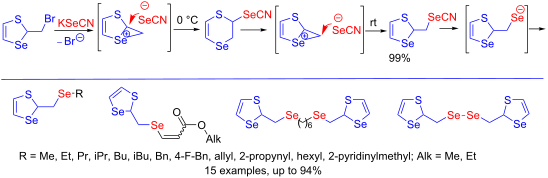
- -ylmethylselanyl heterocycles connected by a carbon bridge was demonstrated (e.g., compound 6k containing two 1,3-thiaselenol-2-ylmethylselanyl heterocycles connected by a six-carbon bridge). The 1,3-thiaselenol-2-ylmethylselenolate anion generated from selenocyanate 4 was also subjected to a nucleophilic addition
- reaction with activated acetylenes (Scheme 9). The reaction of the 1,3-thiaselenol-2-ylmethylselenolate anion with alkyl propiolates proceeded in a regio- and stereoselective manner affording alkyl 3-[(1,3-thiaselenol-2-ylmethyl)selanyl]-2-propenoates 7a (Z/E = 94:6) and 7b (Z/E = 93:7) in 94% and 90


Controlling alkyne reactivity by means of a copper-catalyzed radical reaction system for the synthesis of functionalized quaternary carbons
Beilstein J. Org. Chem. 2020, 16, 502–508, doi:10.3762/bjoc.16.45
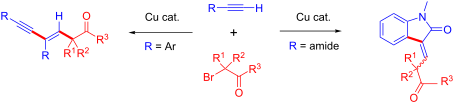
- alkene derivatives. Because an alkyne undergoes addition reaction at a C–C triple bond or cross-coupling at a terminal C–H bond. Combining those reaction patterns could realize a new reaction methodology to synthesize complex molecules including C–C multiple bonds. In this report, we found that the


Fluorinated maleimide-substituted porphyrins and chlorins: synthesis and characterization
Beilstein J. Org. Chem. 2019, 15, 2704–2709, doi:10.3762/bjoc.15.263
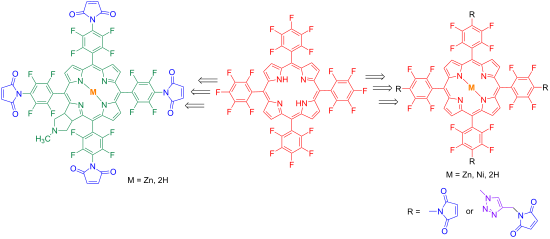
- conjugated to a cystein residue of serum albumin via a Michael addition reaction. At the same time, it is well known that 5,10,15,20-tetrakis(pentafluorophenyl)porphyrin and its chlorin derivatives generate singlet oxygen by the light irradiation under atmospheric oxygen [31]. These tetrapyrrole macrocycles


Synthesis and biological evaluation of truncated derivatives of abyssomicin C as antibacterial agents
Beilstein J. Org. Chem. 2019, 15, 1468–1474, doi:10.3762/bjoc.15.147
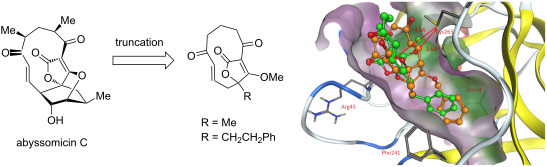
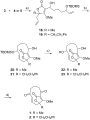
- carbonyl addition reaction between aldehyde 3 and the tetronate derivatives 4 and 5, followed by a ring-closing metathesis (Scheme 1). Since both enantiomers of AbC have similar activity [25], we pursued racemic synthesis of the targeted compounds. We synthesized the common building block 3 in six steps


Ugi reaction-derived prolyl peptide catalysts grafted on the renewable polymer polyfurfuryl alcohol for applications in heterogeneous enamine catalysis
Beilstein J. Org. Chem. 2019, 15, 1210–1216, doi:10.3762/bjoc.15.118
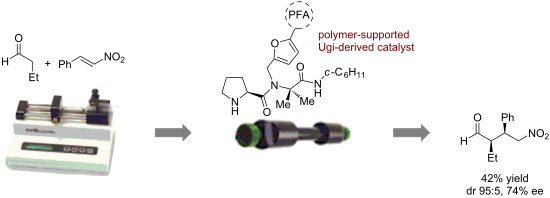
- employ a three-component, diastereoselective variant of the Ugi reaction for the synthesis of a prolyl pseudo-peptide catalyst, which proved effective in an organocatalytic conjugate addition reaction [6]. Later, our groups developed an Ugi reaction-based multicomponent approach enabling the structure


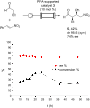
Electrophilic oligodeoxynucleotide synthesis using dM-Dmoc for amino protection
Beilstein J. Org. Chem. 2019, 15, 1116–1128, doi:10.3762/bjoc.15.108
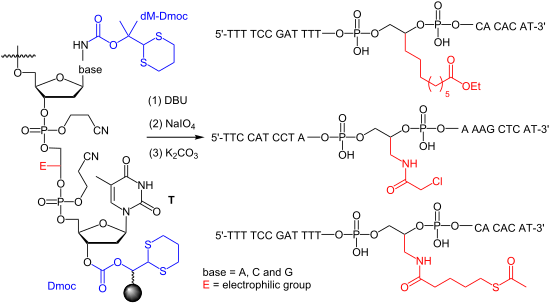
- the nucleophiles on ODNs including hydroxy and amino groups. Even the reaction took place, a hindered four-substituted carbon center would be formed. Because the Michael addition reaction is reversible, the adducts would easily fall apart to give back un-modified ODNs. Indeed, due to the use of dM





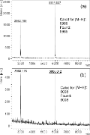

An anomalous addition of chlorosulfonyl isocyanate to a carbonyl group: the synthesis of ((3aS,7aR,E)-2-ethyl-3-oxo-2,3,3a,4,7,7a-hexahydro-1H-isoindol-1-ylidene)sulfamoyl chloride
Beilstein J. Org. Chem. 2019, 15, 931–936, doi:10.3762/bjoc.15.89
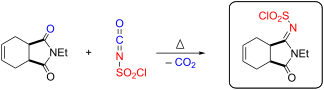
- study, we developed a new addition reaction of chlorosulfonyl isocyanate (CSI), starting from 2-ethyl-3a,4,7,7a-tetrahydro-1H-isoindole-1,3(2H)-dione. The addition reaction of CSI with 2-ethyl-3a,4,7,7a-tetrahydro-1H-isoindole-1,3(2H)-dione resulted in the formation of ylidenesulfamoyl chloride, whose
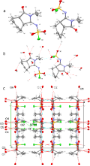
- exact configuration was determined by X-ray crystal analysis. We explain the mechanism of product formation supported by theoretical calculations. Keywords: addition reaction; chlorosulfonyl isocyanate; sulfamoyl chloride; theoretical calculations; Introduction Since its identification in 1959 [1
- mechanism of the addition product. Such an addition reaction is one of the unique examples that define the addition of CSI. Furthermore, the chemical transformation of chlorosulfonyl isocyanate to the related compounds is currently under investigation. Experimental General All reagents and substrates were




Diastereo- and enantioselective preparation of cyclopropanol derivatives
Beilstein J. Org. Chem. 2019, 15, 752–760, doi:10.3762/bjoc.15.71
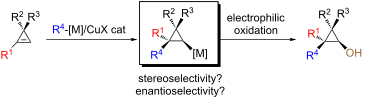
- ). First, we checked that the carbometalation reaction was regio- and diastereoselective by addition of lower order cyanocuprate, easily obtained from the corresponding organolithium and a stoichiometric amount of CuCN (Scheme 4) [68][69][70]. The addition reaction proceeds similarly for the addition of


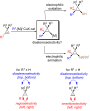


The LANCA three-component reaction to highly substituted β-ketoenamides – versatile intermediates for the synthesis of functionalized pyridine, pyrimidine, oxazole and quinoxaline derivatives
Beilstein J. Org. Chem. 2019, 15, 655–678, doi:10.3762/bjoc.15.61
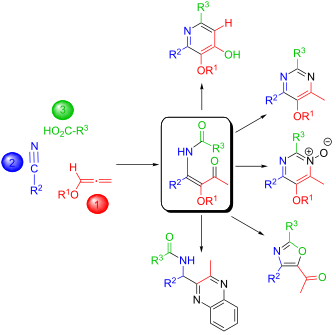
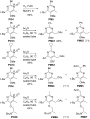
- the solvent methanol to the double bond provided compound PO27 as major product (Scheme 17) [32]. It was not studied whether the use of other solvents can suppress this addition reaction. The allyl-substituted β-ketoenamide KE7 was converted under the standard conditions into condensation product PO28




Nucleofugal behavior of a β-shielded α-cyanovinyl carbanion
Beilstein J. Org. Chem. 2018, 14, 3018–3024, doi:10.3762/bjoc.14.281
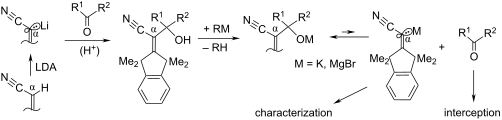
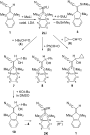
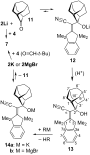
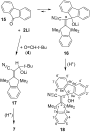
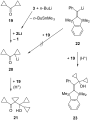
- and a carbonyl compound (R1)2C=O. Such a C–C fission (retro-addition reaction) can occur already near room temperature (rt) if the nucleofugal carbanion proves to be an electronically stabilized N≡C–CH2– [1] or allylic [2] species or a short-lived equilibrium component [3]. A cleavable alkoxide A1M1
- “normal” C=O addition reaction was obviously faster than the deprotonation of 19 and also apparently irreversible under the reaction conditions, whereas the unobserved C=O addition of 19 to 2Li might be possible yet quickly reversible with a terminating proton transfer from 19 to 2Li as shown in Scheme 5
- blocked by FSiMe3 and hence unsuitable for an analysis of the retro-addition reaction (see Supporting Information File 1). Conclusion (i) The nucleofugal carbanion (α-deprotonated 1) can escape with surprising ease from alkoxides, perhaps with some assistance by a metal cation if present. Conversely



Molecular iodine-catalyzed one-pot multicomponent synthesis of 5-amino-4-(arylselanyl)-1H-pyrazoles
Beilstein J. Org. Chem. 2018, 14, 2789–2798, doi:10.3762/bjoc.14.256
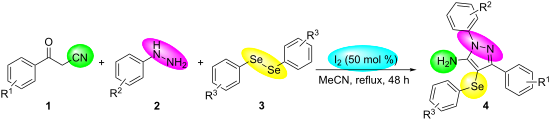
- could be obtained in 90% yield as depicted in Scheme 3. On the basis of previous reports [21][25] a mechanism can be proposed for this reaction as depicted in Scheme 4. Initially, we believe that arylhydrazine 2 reacts with benzoylacetonitrile 1 by a 1,2-addition reaction in the presence of iodine as





