


Sustainable electrochemical synthesis of aliphatic nitro-NNO-azoxy compounds employing ammonium dinitramide and their in vitro evaluation as potential nitric oxide donors and fungicides
- Alexander S. Budnikov,
- Nikita E. Leonov,
- Michael S. Klenov,
- Andrey A. Kulikov,
- Igor B. Krylov,
- Timofey A. Kudryashev,
- Aleksandr M. Churakov,
- Alexander O. Terent’ev and
- Vladimir A. Tartakovsky
Beilstein J. Org. Chem. 2025, 21, 2739–2754, doi:10.3762/bjoc.21.211
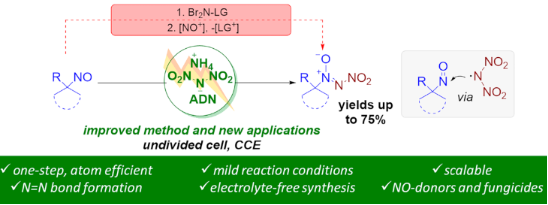

Graphical Abstract
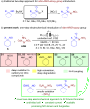
Scheme 1: Current synthetic approaches to aliphatic nitro-NNO-azoxy compounds and the summary of the present ...

Scheme 2: Scope of the discovered electrochemical nitro-NNO-azoxylation of nitrosoalkanes containing electron...

Scheme 3: Synthetic utility and derivatization of synthesized coupling product 2f.

Figure 1: CV-curves of 0.01 M solutions of a) 1a (blue), b) 1f (azure), c) 1c (pink), d) 1i (yellow), e) S4 (...

Figure 2: CV-curves of 0.01 M solutions of a) 1a (blue), b) ADN (red), c) the mixture of 1a and ADN (green), ...

Scheme 4: Control experiments.
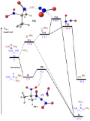
Figure 3: Free energy diagram of possible interaction pathways between 1a and dinitramide-derived radical A a...

Scheme 5: Proposed mechanism for electrochemical nitro-NNO-azoxylation of 1-nitro-1-nitroso compounds 1. Free...

Figure 4: Assessment of the NO release from compounds 2a–i, 3f, and 4f.
Competitive cyclization of ethyl trifluoroacetoacetate and methyl ketones with 1,3-diamino-2-propanol into hydrogenated oxazolo- and pyrimido-condensed pyridones
- Svetlana O. Kushch,
- Marina V. Goryaeva,
- Yanina V. Burgart,
- Marina A. Ezhikova,
- Mikhail I. Kodess,
- Pavel A. Slepukhin,
- Alexandrina S. Volobueva,
- Vladimir V. Zarubaev and
- Victor I. Saloutin
Beilstein J. Org. Chem. 2025, 21, 2716–2729, doi:10.3762/bjoc.21.209
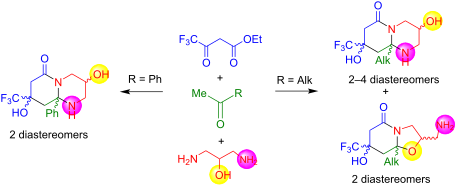

Graphical Abstract

Figure 1: Structures of bioactive molecules with trifluoromethylpyridine and piperidine frameworks.

Scheme 1: The reaction of ethyl trifluoroacetoacetate (1), acetone (2a) and 1,3- diaminopropan-2-ol (3).

Scheme 2: Three-component reaction of ethyl trifluoroacetoacetate (1), alkyl methyl ketones 2b,c and 1,3-diam...

Scheme 3: Three-component reaction of ethyl trifluoroacetoacetate (1), acetophenone (2d) and 1,3-diaminopropa...

Scheme 4: The proposed mechanism of three-component cyclization of 3-oxo ester 1, methyl ketones 2a–d and 1,3...

Figure 2: ORTEP view of compounds 4асc (a, CCDC: 2479553), 4аct (b, CCDC: 2479554), 4аtt (c, CCDC: 2479555), ...

Figure 3: ORTEP view of compound 5ctc (a, CCDC: 2479558), 5ctt (b, CCDC: 2479559) showing with the thermal el...

Figure 4: The fragments of the 1H NMR spectra (400 MHz, DMSO-d6) of diastereomers 4acc (a), 4аct (b), 4аtt (c...

Figure 5: Fragments of 1H NMR spectra (400 MHz, DMSO-d6) of hexahydrooxazolo[3,2-a]pyridin-5-ones 5ctc (a) an...
An Fe(II)-catalyzed synthesis of spiro[indoline-3,2'-pyrrolidine] derivatives
- Elizaveta V. Gradova,
- Nikita A. Ozhegov,
- Roman O. Shcherbakov,
- Alexander G. Tkachenko,
- Larisa Y. Nesterova,
- Elena Y. Mendogralo and
- Maxim G. Uchuskin
Beilstein J. Org. Chem. 2025, 21, 2383–2388, doi:10.3762/bjoc.21.183
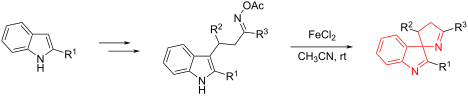

Graphical Abstract

Figure 1: Natural and synthetic bioactive spiro[indoline-3,2'-pyrrolidine] derivatives.
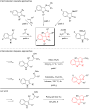
Scheme 1: Previous approaches and our work.

Scheme 2: The reaction of 2-arylindoles 1 with α,β-unsaturated ketones 2. aIsolated yield of the 5 mmol scale...

Scheme 3: The scope of the Fe-catalyzed spirocyclization. aIsolated yield of the 4.2 mmol scale experiment.

Scheme 4: The proposed mechanism of product 4 formation.
α-Ketoglutaric acid in Ugi reactions and Ugi/aza-Wittig tandem reactions
- Vladyslav O. Honcharov,
- Yana I. Sakhno,
- Olena H. Shvets,
- Vyacheslav E. Saraev,
- Svitlana V. Shishkina,
- Tetyana V. Shcherbakova and
- Valentyn A. Chebanov
Beilstein J. Org. Chem. 2025, 21, 2021–2029, doi:10.3762/bjoc.21.157
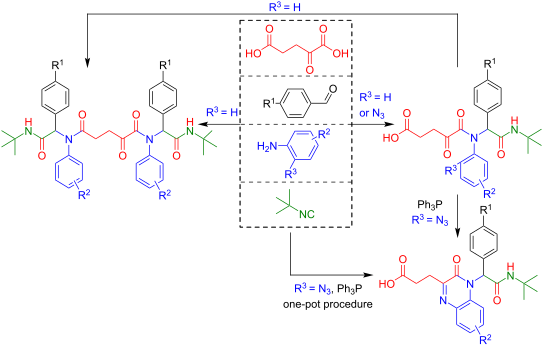

Graphical Abstract

Figure 1: Some biologically active quinoxalinone derivatives.

Scheme 1: Known multicomponent reactions of KGA.

Scheme 2: Ugi reaction involving KGA.

Scheme 3: Tandem Ugi/aza-Wittig combination involving KGA.
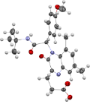
Figure 2: Molecular structure of 3-(4-(2-(tert-butylamino)-1-(4-methoxyphenyl)-2-oxoethyl)-5,7-dimethyl-3-oxo...
Reactions of acryl thioamides with iminoiodinanes as a one-step synthesis of N-sulfonyl-2,3-dihydro-1,2-thiazoles
- Vladimir G. Ilkin,
- Pavel S. Silaichev,
- Valeriy O. Filimonov,
- Tetyana V. Beryozkina,
- Margarita D. Likhacheva,
- Pavel A. Slepukhin,
- Wim Dehaen and
- Vasiliy A. Bakulev
Beilstein J. Org. Chem. 2025, 21, 1397–1403, doi:10.3762/bjoc.21.104
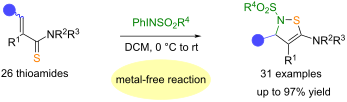

Graphical Abstract

Figure 1: Representatives of biologically active 1,2-thiazoles.
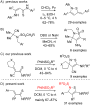
Scheme 1: Synthesis of 2,5-dihydro-1,2-thiazoles.
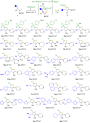
Scheme 2: Synthesis of 2,3-dihydro-N-sulfonyl-1,2-thiazoles 3. Conditions: aMethod A: thioamide 1 (1.0 equiv)...

Figure 2: Compound 3aa in thermal ellipsoids 50% probability.
N-Salicyl-amino acid derivatives with antiparasitic activity from Pseudomonas sp. UIAU-6B
- Joy E. Rajakulendran,
- Emmanuel Tope Oluwabusola,
- Michela Cerone,
- Terry K. Smith,
- Olusoji O. Adebisi,
- Adefolalu Adedotun,
- Gagan Preet,
- Sylvia Soldatou,
- Hai Deng,
- Rainer Ebel and
- Marcel Jaspars
Beilstein J. Org. Chem. 2025, 21, 1388–1396, doi:10.3762/bjoc.21.103
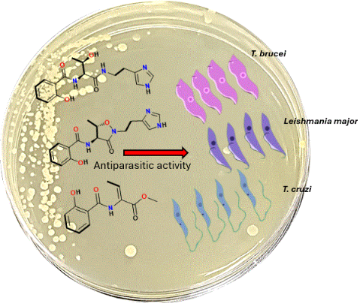

Graphical Abstract

Figure 1: Structures of the pseudomonins D–G (1–4), pseudomonine (5), pseudomonin B (6) and salicylic acid (7...

Figure 2: Key HMBC, 1H-1H COSY and NOE correlations.

Figure 3: Extracted ion chromatogram and corresponding mass spectrum of compound 4 in the crude extract.

Figure 4: Proposed biosynthetic scheme for the formation of compounds (1–4).
Synthesis of β-ketophosphonates through aerobic copper(II)-mediated phosphorylation of enol acetates
- Alexander S. Budnikov,
- Igor B. Krylov,
- Fedor K. Monin,
- Valentina M. Merkulova,
- Alexey I. Ilovaisky,
- Liu Yan,
- Bing Yu and
- Alexander O. Terent’ev
Beilstein J. Org. Chem. 2025, 21, 1192–1200, doi:10.3762/bjoc.21.96
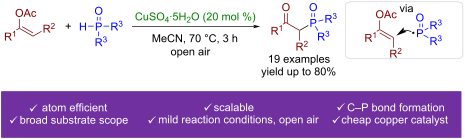

Graphical Abstract

Scheme 1: Recent approaches for the synthesis of β-ketophosphonates by the oxyphosphorylation of unsaturated ...

Scheme 2: The scope of the discovered copper(II)-mediated phosphorylation of enol acetates.

Scheme 3: Gram-scale synthesis of 3a.

Scheme 4: Control experiments.

Scheme 5: Proposed mechanism for copper(II) mediated phosphorylation of enol acetates.
Unprecedented visible light-initiated topochemical [2 + 2] cycloaddition in a functionalized bimane dye
- Metodej Dvoracek,
- Brendan Twamley,
- Mathias O. Senge and
- Mikhail A. Filatov
Beilstein J. Org. Chem. 2025, 21, 500–509, doi:10.3762/bjoc.21.37
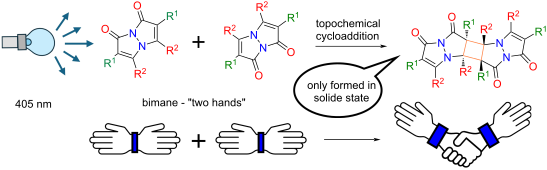

Graphical Abstract

Figure 1: Structures of a) the unfunctionalized bimane scaffold and b) the two isomers of bimanes with their ...

Figure 2: a) Structures of the bimanes studied and b) the reaction scheme of the [2 + 2] photocycloaddition o...

Figure 3: Synthetic approach to bimanes.

Figure 4: View of the molecular structures in the crystal of the functionalized bimanes studied: a) Cl2B (B),...

Figure 5: View of the molecular structure in the crystal of a) symmetry generated by inversion bimanes Cl2B (...

Figure 6: View of the packing of the unit cells of a) Me2B viewed normal to the c-axis and b) Me4B viewed nor...

Figure 7: UV–vis spectrum of Cl2B after irradiation in DCM.

Figure 8: Proposed mechanism for the topochemical [2 + 2] photocycloaddition of Cl2B.
Synthesis, structure, ionochromic and cytotoxic properties of new 2-(indolin-2-yl)-1,3-tropolones
- Yurii A. Sayapin,
- Eugeny A. Gusakov,
- Inna O. Tupaeva,
- Alexander D. Dubonosov,
- Igor V. Dorogan,
- Valery V. Tkachev,
- Anna S. Goncharova,
- Gennady V. Shilov,
- Natalia S. Kuznetsova,
- Svetlana Y. Filippova,
- Tatyana A. Krasnikova,
- Yanis A. Boumber,
- Alexey Y. Maksimov,
- Sergey M. Aldoshin and
- Vladimir I. Minkin
Beilstein J. Org. Chem. 2025, 21, 358–368, doi:10.3762/bjoc.21.26
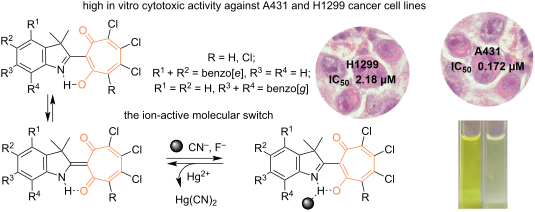

Graphical Abstract

Scheme 1: Synthesis of 2-hetaryl-substituted 1,3-tropolones 1.

Scheme 2: Synthesis of 1,3-tropolones 7a,b and 8a,b. Reagents and conditions: method A: dioxane, reflux; meth...
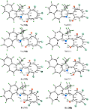
Figure 1: Structural characteristics of (NH) and (OH) tautomeric forms of compounds 7 and 8 in the gas phase ...

Figure 2: Scheme of HMBC correlations of compound 7a in DMSO-d6.

Figure 3: Molecular structure of 2-(3,3-dimethyl-3H-benzo[g]indolin-2-yl)-5,6,7-trichloro-1,3-tropolone (7b).

Figure 4: Result of matching structures of 7b (solid lines) and 2-(3,3-dimethylindolin-2-yl)-5,6,7-trichloro-...

Figure 5: Absorption and emission spectra of compound 8b in acetonitrile before (1,1’) (c 2.5 × 10⁻⁵ mol L–1)...

Scheme 3: Possible binding mode of 7 and 8 with CN− and F−.

Figure 6: Dose–response curves for H1299 and A431 cells treated with compound 7a for 24 h. *Significant diffe...
Advances in radical peroxidation with hydroperoxides
- Oleg V. Bityukov,
- Pavel Yu. Serdyuchenko,
- Andrey S. Kirillov,
- Gennady I. Nikishin,
- Vera A. Vil’ and
- Alexander O. Terent’ev
Beilstein J. Org. Chem. 2024, 20, 2959–3006, doi:10.3762/bjoc.20.249
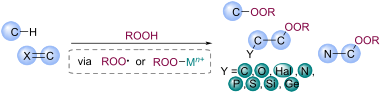

Graphical Abstract

Scheme 1: Organic peroxide initiators in polymer chemistry.

Scheme 2: Synthesis of organic peroxides.

Scheme 3: Richness of radical cascades with species formed from hydroperoxides in redox conditions.
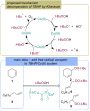
Scheme 4: Co-catalyzed allylic peroxidation of alkenes 1 and 3 by TBHP.

Scheme 5: Allylic peroxidation of alkenes 6 by Pd(II)TBHP.
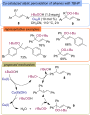
Scheme 6: Cu(I)-catalyzed allylic peroxidation.

Scheme 7: Enantioselective peroxidation of alkenes 10 with TBHP in the presence of copper(I) compounds.

Scheme 8: Oxidation of α-pinene (12) by the Cu(I)/TBHP system.

Scheme 9: Introduction of the tert-butylperoxy fragment into the α-position of cyclic ketones 15 and 17.
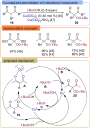
Scheme 10: α-Peroxidation of β-dicarbonyl compounds 19 using the Cu(II)/TBHP system.
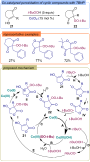
Scheme 11: Co-catalyzed peroxidation of cyclic compounds 21 with TBHP.

Scheme 12: Co-, Mn- and Fe-catalyzed peroxidation of 2-oxoindoles 23, barbituric acids 25, and 4-hydroxycoumar...

Scheme 13: Cu-catalyzed and metal-free peroxidation of barbituric acid derivatives 31 and 3,4-dihydro-1,4-benz...

Scheme 14: Electrochemical peroxidation of 1,3-dicarbonyl compounds 35.

Scheme 15: Peroxidation of β-dicarbonyl compounds, cyanoacetic esters and malonic esters 37 by the TBAI/TBHP s...
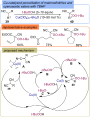
Scheme 16: Cu-catalyzed peroxidation of malonodinitriles and cyanoacetic esters 39 with TBHP.

Scheme 17: Mn-catalyzed remote peroxidation via trifluromethylation of double bond.

Scheme 18: Cu-catalyzed remote peroxidation via trifluromethylthiolation of double bond.

Scheme 19: Fe-, Mn-, and Ru-catalyzed peroxidation of alkylaromatics 45, 47, 49, and 51 with TBHP.

Scheme 20: Cu-catalyzed peroxidation of diphenylacetonitrile (53) with TBHP.
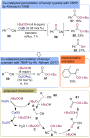
Scheme 21: Cu-catalyzed peroxidation of benzyl cyanides 60 with TBHP.
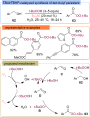
Scheme 22: Synthesis of tert-butylperoxy esters 63 from benzyl alcohols 62 using the TBAI/TBHP system.

Scheme 23: Enantioselective peroxidation of 2-phenylbutane (64) with TBHP and chiral Cu(I) complex.
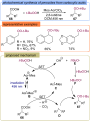
Scheme 24: Photochemical synthesis of peroxides 67 from carboxylic acids 66.
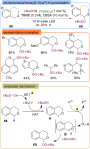
Scheme 25: Photochemical peroxidation of benzylic C(sp3)–H.

Scheme 26: Cu- and Ru-catalyzed peroxidation of alkylamines with TBHP.

Scheme 27: Peroxidation of amides 76 with the TBAI/TBHP system.
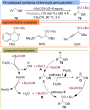
Scheme 28: Fe-catalyzed functionalization of ethers 78 with TBHP.

Scheme 29: Synthesis of 4-(tert-butylperoxy)-5-phenyloxazol-2(3H)-ones 82 from benzyl alcohols 80 and isocyana...

Scheme 30: Fe- and Co-catalyzed peroxidation of alkanes with TBHP.
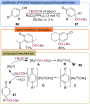
Scheme 31: Rh-catalyzed tert-butylperoxy dienone synthesis with TBHP.

Scheme 32: Rh- and Cu-catalyzed phenolic oxidation with TBHP.

Scheme 33: Metal-free peroxidation of phenols 94.

Scheme 34: Cu-catalyzed alkylation–peroxidation of acrylonitrile.

Scheme 35: Cu-catalyzed cycloalkylation–peroxidation of coumarins 99.

Scheme 36: Metal-free cycloalkylation–peroxidation of coumarins 102.

Scheme 37: Difunctionalization of indene 104 with tert-butylperoxy and alkyl groups.

Scheme 38: Acid-catalyzed radical addition of ketones (108, 111) and TBHP to alkenes 107 and acrylates 110.

Scheme 39: Cu-catalyzed alkylation–peroxidation of alkenes 113 with TBHP and diazo compounds 114.

Scheme 40: Cobalt(II)-catalyzed addition of TBHP and 1,3-dicarbonyl compound 116 to alkenes 117.

Scheme 41: Cu(0)- or Co(II)-catalyzed addition of TBHP and alcohols 120 to alkenes 119.

Scheme 42: Fe-catalyzed functionalization of allenes 122 with TBHP.

Scheme 43: Fe-catalyzed alkylation–peroxidation of alkenes 125 and 127.

Scheme 44: Fe- and Co-catalyzed alkylation–peroxidation of alkenes 130, 133 and 134 with TBHP and aldehydes as...
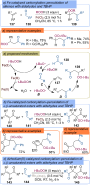
Scheme 45: Carbonylation–peroxidation of alkenes 137, 140, 143 with hydroperoxides and aldehydes.

Scheme 46: Carbamoylation–peroxidation of alkenes 146 with formamides and TBHP.

Scheme 47: TBAB-catalyzed carbonylation–peroxidation of alkenes.

Scheme 48: VOCl2-catalyzed carbonylation–peroxidation of alkenes 152.
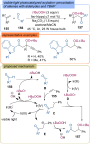
Scheme 49: Acylation–peroxidation of alkenes 155 with aldehydes 156 and TBHP using photocatalysis.
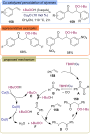
Scheme 50: Cu-catalyzed peroxidation of styrenes 158.

Scheme 51: Fe-catalyzed acylation-peroxidation of alkenes 161 with carbazates 160 and TBHP.

Scheme 52: Difunctionalization of alkenes 163, 166 with TBHP and (per)fluoroalkyl halides.

Scheme 53: Difunctionalization of alkenes 169 and 172 with hydroperoxides and sodium (per)fluoromethyl sulfina...
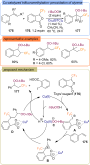
Scheme 54: Trifluoromethylation–peroxidation of styrenes 175 using MOF Cu3(BTC)2 as a catalyst.
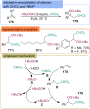
Scheme 55: Difunctionalization of alkenes 178 with tert-butylperoxy and dihalomethyl fragments.

Scheme 56: Difunctionalization of alkenes 180 with the tert-butylperoxy and dihalomethyl moieties.
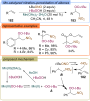
Scheme 57: The nitration–peroxidation of alkenes 182 with t-BuONO and TBHP.
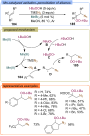
Scheme 58: Azidation–peroxidation of alkenes 184 with TMSN3 and TBHP.

Scheme 59: Co-catalyzed bisperoxidation of butadiene 186.

Scheme 60: Bisperoxidation of styrene (189) and acrylonitrile (192) with TBHP by Minisci.

Scheme 61: Mn-catalyzed synthesis of bis(tert-butyl)peroxides 195 from styrenes 194.

Scheme 62: Bisperoxidation of arylidene-9H-fluorenes 196 and 3-arylidene-2-oxoindoles 198 with TBHP under Mn-c...

Scheme 63: Synthesis of bisperoxides from styrenes 200 and 203 using the Ru and Rh catalysis.
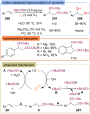
Scheme 64: Iodine-catalyzed bisperoxidation of styrenes 206.
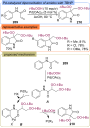
Scheme 65: Synthesis of di-tert-butylperoxyoxoindoles 210 from acrylic acid anilides 209 using a Pd(II)/TBHP o...

Scheme 66: Pinolation/peroxidation of styrenes 211 catalyzed by Cu(I).
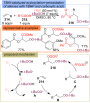
Scheme 67: TBAI-catalyzed acyloxylation–peroxidation of alkenes 214 with carboxylic acids and TBHP.

Scheme 68: Difunctionalization of alkenes 217 with TBHP and water or alcohols.

Scheme 69: TBAI-catalyzed hydroxyperoxidation of 1,3-dienes 220.

Scheme 70: Hydroxyperoxidation of 1,3-dienes 220.

Scheme 71: Iodination/peroxidation of alkenes 223 with I2 and hydroperoxides.

Scheme 72: The reactions of cyclic enol ethers 226 and 228 with I2/ROOH system.

Scheme 73: Synthesis of 1-(tert-butylperoxy)-2-iodoethanes 231.

Scheme 74: Synthesis of 1-iodo-2-(tert-butylperoxy)ethanes 233.
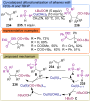
Scheme 75: Cu-catalyzed phosphorylation–peroxidation of alkenes 234.
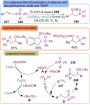
Scheme 76: Co-catalyzed phosphorylation–peroxidation of alkenes 237.
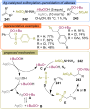
Scheme 77: Ag-catalyzed sulfonylation–peroxidation of alkenes 241.

Scheme 78: Co-catalyzed sulfonylation–peroxidation of alkenes 244.

Scheme 79: Synthesis of α/β-peroxysulfides 248 and 249 from styrenes 247.

Scheme 80: Cu-catalyzed trifluoromethylthiolation–peroxidation of alkenes 250 and allenes 252.

Scheme 81: Photocatalytic sulfonyl peroxidation of alkenes 254 via deamination of N-sulfonyl ketimines 255.

Scheme 82: Photoredox-catalyzed 1,4-peroxidation–sulfonylation of enynones 257.

Scheme 83: Cu-catalyzed silylperoxidation of α,β-unsaturated compounds 260 and enynes 261.

Scheme 84: Fe-catalyzed silyl peroxidation of alkenes.

Scheme 85: Cu-catalyzed germyl peroxidation of alkenes 267.
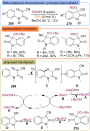
Scheme 86: TBAI-catalyzed intramolecular cyclization of diazo compounds 269 with further peroxidation.

Scheme 87: Co-catalyzed three-component coupling of benzamides 271, diazo compounds 272 and TBHP.

Scheme 88: Co-catalyzed esterification-peroxidation of diazo compounds 274 with TBHP and carboxylic acids 275.

Scheme 89: Cu-catalyzed alkylation–peroxidation of α-carbonylimines 277 or ketones 280.

Scheme 90: Mn-catalyzed ring-opening peroxidation of cyclobutanols 282 with TBHP.

Scheme 91: Peroxycyclization of tryptamines 284 with TBHP.

Scheme 92: Radical cyclization–peroxidation of homotryptamines 287.
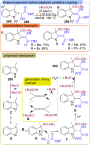
Scheme 93: Iodine-catalyzed oxidative coupling of indoles 288, cyanoacetic esters and TBHP.

Scheme 94: Summary of metal-catalyzed peroxidation processes.
C–C Coupling in sterically demanding porphyrin environments
- Liam Cribbin,
- Brendan Twamley,
- Nicolae Buga,
- John E. O’ Brien,
- Raphael Bühler,
- Roland A. Fischer and
- Mathias O. Senge
Beilstein J. Org. Chem. 2024, 20, 2784–2798, doi:10.3762/bjoc.20.234

Graphical Abstract

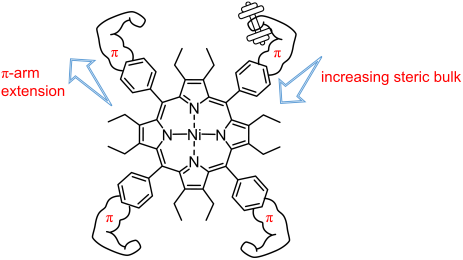
Figure 1: (A) Structures of tetrasubstituted 5,10,15,20-tetraphenylporphyrin (TPP, 1), dodecasubstituted 2,3,...

Scheme 1: Reaction scheme for the synthesis of OET-xBrPPs and subsequent Ni(II) metalation.

Figure 2: Substrates used for the investigations for the Suzuki–Miyaura coupling reactions.

Scheme 2: Scope of arm-extended dodecasubstituted porphyrins synthesized via modification of the meso-para-ph...

Scheme 3: Scope of arm-extended dodecasubstituted porphyrins synthesized via reaction at the meso-meta-phenyl...

Scheme 4: Attempts of arm-extension of dodecasubstituted porphyrins at the meso-ortho-phenyl position.

Scheme 5: Borylation and subsequent Suzuki–Miyaura coupling of porphyrin 13.

Figure 3: View of the molecular structure of compounds 26 (top left) and 27 (top right) with atomic displacem...

Figure 4: Left: packing diagram of 27 viewed normal to the c-axis showing the channels in the lattice with th...

Figure 5: Left: view of part 0 2 in the molecular structure of the α2β2-atropisomer, 11 in the crystal, hydro...

Figure 6: Schematic representation of porphyrin 37 showing a doubly intercalated structure.
Ugi bisamides based on pyrrolyl-β-chlorovinylaldehyde and their unusual transformations
- Alexander V. Tsygankov,
- Vladyslav O. Vereshchak,
- Tetiana O. Savluk,
- Serhiy M. Desenko,
- Valeriia V. Ananieva,
- Oleksandr V. Buravov,
- Yana I. Sakhno,
- Svitlana V. Shishkina and
- Valentyn A. Chebanov
Beilstein J. Org. Chem. 2024, 20, 1773–1784, doi:10.3762/bjoc.20.156
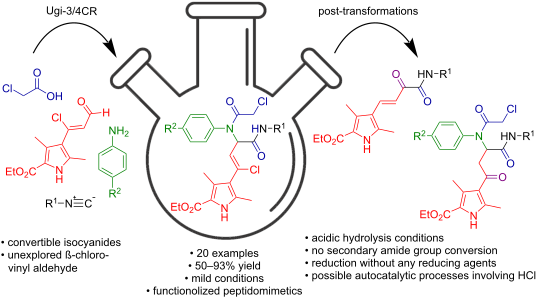

Graphical Abstract

Scheme 1: The use of α,β-unsaturated aldehydes in the Ugi reaction.

Scheme 2: Comparison of isocyanide conversion conditions.

Figure 1: Azomethines based on ethyl 4-acetyl-3,5-dimethyl-1H-pyrrole-2-carboxylate and 4-[(E)-1-chloro-3-oxo...
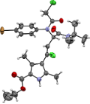
Figure 2: Molecular structure of ethyl (Z)-4-(3-(N-(4-bromophenyl)-2-chloroacetamido)-4-(tert-butylamino)-1-c...

Scheme 3: Hydrolysis of Ugi bisamide 5d in the presence of HCl. Conditions: (A) 5 equiv HCl, MeOH, 80 °C, 3 h...

Figure 3: Molecular structure of ethyl (E)-4-(4-(tert-butylamino)-3,4-dioxobut-1-en-1-yl)-3,5-dimethyl-1H-pyr...

Figure 4: Molecular structure of ethyl 4-(3-(N-(4-bromophenyl)-2-chloroacetamido)-4-(tert-butylamino)-4-oxobu...

Scheme 4: The Ugi-4CR with the participation of p-anisidine and benzyl isocyanide.

Scheme 5: Successful attempt at tandem one-pot coupling of the Ugi-4CR reaction and post-transformation of th...

Scheme 6: Plausible transformation sequence of the formation of amides 10 and ketobisamides 12.
Generation of multimillion chemical space based on the parallel Groebke–Blackburn–Bienaymé reaction
- Evgen V. Govor,
- Vasyl Naumchyk,
- Ihor Nestorak,
- Dmytro S. Radchenko,
- Dmytro Dudenko,
- Yurii S. Moroz,
- Olexiy D. Kachkovsky and
- Oleksandr O. Grygorenko
Beilstein J. Org. Chem. 2024, 20, 1604–1613, doi:10.3762/bjoc.20.143


Graphical Abstract

Scheme 1: Groebke–Blackburn–Bienaymé (GBB) reaction.

Figure 1: Marketed drugs comprising imidazo[1,2-a]azine scaffolds.

Figure 2: Yields of library members 4 synthesized using both Sc(OTf)3 and TsOH as the catalysts.

Figure 3: Amino heterocycles 1{1–27} demonstrating poor performance in the parallel GBB reaction.

Figure 4: (Hetero)aromatic aldehydes 2{1–6} illustrating electronic and steric effects on the parallel GBB re...

Scheme 2: A) Parallel GBB reaction and B) examples of library members 4 obtained (relative configurations are...

Figure 5: Physicochemical properties of the chemical space of 271 Mln. members obtained by virtual GBB reacti...

Figure 6: Distribution of maximal values among pairwise-calculated Tanimoto similarities T (MFP2 fingerprints ...

Figure 7: t-Distributed stochastic neighbor embedding (t-SNE) comparative analysis of 50,000 randomly selecte...

Figure 8: Some biologically active representatives of the generated GBB chemical space found in the ChEMBL da...
A myo-inositol dehydrogenase involved in aminocyclitol biosynthesis of hygromycin A
- Michael O. Akintubosun and
- Melanie A. Higgins
Beilstein J. Org. Chem. 2024, 20, 589–596, doi:10.3762/bjoc.20.51
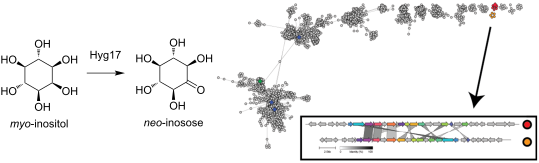

Graphical Abstract

Figure 1: Proposed biosynthetic pathway for the aminocyclitol from hygromycin A.

Figure 2: Hyg17 activity. Reactions with Hyg17 and (a) various inositols with NAD+, (b) myo-inositol with NAD+...

Figure 3: SSN for PF01408. Clusters with characterized enzymes are shown in different colors and labeled with...

Figure 4: (a) SSN for inositol dehydrogenases. (b) Comparison of the hygromycin A (red) and hygromycin A-like...
Comparison of glycosyl donors: a supramer approach
- Anna V. Orlova,
- Nelly N. Malysheva,
- Maria V. Panova,
- Nikita M. Podvalnyy,
- Michael G. Medvedev and
- Leonid O. Kononov
Beilstein J. Org. Chem. 2024, 20, 181–192, doi:10.3762/bjoc.20.18
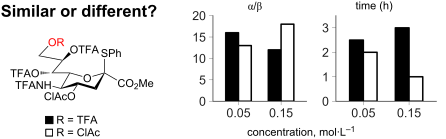

Graphical Abstract

Scheme 1: Model sialylation reaction. TFA = CF3CO; ClAc = ClCH2CO.

Scheme 2: Synthesis of sialyl donor 2.
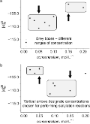
Figure 1: Concentration dependence of the specific optical rotation ([α]D28 / deg·dm−1·cm3·g−1) of solutions ...

Figure 2: Comparison of the outcome of the sialylation of glycosyl acceptor 3 with sialyl donors 1 or 2 perfo...
Cycloaddition reactions of heterocyclic azides with 2-cyanoacetamidines as a new route to C,N-diheteroarylcarbamidines
- Pavel S. Silaichev,
- Tetyana V. Beryozkina,
- Vsevolod V. Melekhin,
- Valeriy O. Filimonov,
- Andrey N. Maslivets,
- Vladimir G. Ilkin,
- Wim Dehaen and
- Vasiliy A. Bakulev
Beilstein J. Org. Chem. 2024, 20, 17–24, doi:10.3762/bjoc.20.3
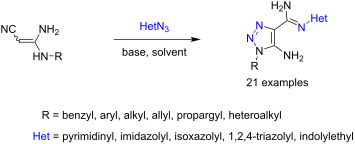

Graphical Abstract

Scheme 1: Synthesis of heteroaryl amidines.

Figure 1: Structures of starting compounds.
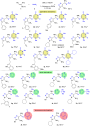
Scheme 2: Scope of 3,3-diaminoacrylonitriles 1 and heterocyclic azides 2. Reaction conditions: 1 (0.5 mmol), 2...

Scheme 3: Proposed mechanism for the formation of triazoles 3.
Cyanothioacetamides as a synthetic platform for the synthesis of aminopyrazole derivatives
- Valeriy O. Filimonov,
- Alexandra I. Topchiy,
- Vladimir G. Ilkin,
- Tetyana V. Beryozkina and
- Vasiliy A. Bakulev
Beilstein J. Org. Chem. 2023, 19, 1191–1197, doi:10.3762/bjoc.19.87
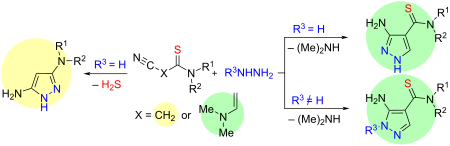

Graphical Abstract

Figure 1: Examples of bioactive pyrazoles for the protection of cultivated plants and drugs containing a thio...
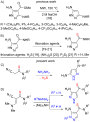
Scheme 1: Syntheses of 4,5-diamino- and 4-thiocarbamoyl-5-aminopyrazoles.

Figure 2: Structures of starting materials.

Scheme 2: Synthesis of 3,5-diaminopyrazoles 4а–с and thiocarbamoyl-NH-pyrazoles 5a–e. Reaction conditions: 1a–...

Scheme 3: Synthesis of 1-aryl-5-amino-4-thiocarbamoylpyrazoles 6a–f. Reaction conditions: 2a–d (1 mmol), 3b,c...
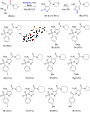
Scheme 4: Synthesis of 1-sulfonylpyrazoles 7a–j and 1-benzoylpyrazole 7k. Conditions for 7a–j: 2b,d,e (1 mmol...
Redox-active molecules as organocatalysts for selective oxidative transformations – an unperceived organocatalysis field
- Elena R. Lopat’eva,
- Igor B. Krylov,
- Dmitry A. Lapshin and
- Alexander O. Terent’ev
Beilstein J. Org. Chem. 2022, 18, 1672–1695, doi:10.3762/bjoc.18.179
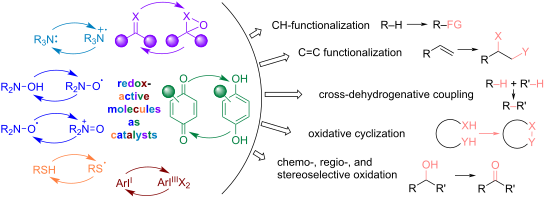

Graphical Abstract
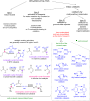
Scheme 1: Organocatalysis classification used in the present perspective.

Scheme 2: Oxidative processes catalyzed by amines.

Scheme 3: N-Heterocyclic carbene (NHC) catalysis in oxidative functionalization of aldehydes.
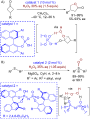
Scheme 4: Examples of asymmetric oxidative processes catalyzed by chiral Brønsted acids.

Scheme 5: Asymmetric aerobic α-hydroxylation of lactams under phase-transfer organocatalysis conditions emplo...

Scheme 6: Selective CH-oxidation of methylarenes to aldehydes or carboxylic acids.

Scheme 7: An example of the regioselective CH-amination by a sterically hindered imide-N-oxyl radical precurs...

Scheme 8: CH-amination of ethylbenzene and CH-fluorination of aldehydes catalyzed by N-hydroxybenzimidazoles,...

Scheme 9: Mixed hetero-/homogeneous TiO2/N-hydroxyimide photocatalysis in the selective benzylic oxidation.

Scheme 10: Electrochemical benzylic iodination and benzylation of pyridine by benzyl iodides generated in situ...

Scheme 11: Electrochemical oxidative C–O/C–N coupling of alkylarenes with NHPI. Electrolysis conditions: Const...

Scheme 12: Chemoselective alcohol oxidation catalyzed by TEMPO.

Scheme 13: ABNO-catalyzed oxidative C–N coupling of primary alcohols with primary amines.

Scheme 14: ACT-catalyzed electrochemical oxidation of primary alcohols and aldehydes to carboxylic acids.

Scheme 15: Electrocatalytic oxidation of benzylic alcohols by a TEMPO derivative immobilized on a graphite ano...

Scheme 16: Electrochemical oxidation of carbamates of cyclic amines to lactams and oxidative cyanation of amin...

Scheme 17: Hydrogen atom transfer (HAT) and single-electron transfer (SET) as basic principles of amine cation...
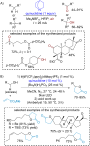
Scheme 18: Electrochemical quinuclidine-catalyzed oxidation involving unactivated C–H bonds.

Scheme 19: DABCO-mediated photocatalytic C–C cross-coupling involving aldehyde C–H bond cleavage.

Scheme 20: DABCO-derived cationic catalysts in inactivated C–H bond cleavage for alkyl radical addition to ele...
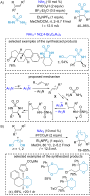
Scheme 21: Electrochemical diamination and dioxygenation of vinylarenes catalyzed by triarylamines.

Scheme 22: Electrochemical benzylic oxidation mediated by triarylimidazoles.

Scheme 23: Thiyl radical-catalyzed CH-arylation of allylic substrates by aryl cyanides.

Scheme 24: Synthesis of redox-active alkyl tetrafluoropyridinyl sulfides by unactivated C–H bond cleavage by t...

Scheme 25: Main intermediates in quinone oxidative organocatalysis.

Scheme 26: Electrochemical DDQ-catalyzed intramolecular dehydrogenative aryl–aryl coupling.

Scheme 27: DDQ-mediated cross-dehydrogenative C–N coupling of benzylic substrates with azoles.
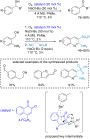
Scheme 28: Biomimetic o-quinone-catalyzed benzylic alcohol oxidation.

Scheme 29: Electrochemical synthesis of secondary amines by oxidative coupling of primary amines and benzylic ...

Scheme 30: General scheme of dioxirane and oxaziridine oxidative organocatalysis.

Scheme 31: Dioxirane organocatalyzed CH-hydroxylation involving aliphatic C(sp3)–H bonds.

Scheme 32: Enantioselective hydroxylation of CH-acids catalyzed by chiral oxaziridines.

Scheme 33: Iodoarene-organocatalyzed vinylarene diamination.

Scheme 34: Iodoarene-organocatalyzed asymmetric CH-hydroxylation of benzylic substrates.

Scheme 35: Iodoarene-organocatalyzed asymmetric difluorination of alkenes with migration of aryl or methyl gro...

Scheme 36: Examples of 1,2-diiodo-4,5-dimethoxybenzene-catalyzed electrochemical oxidative heterocyclizations.

Scheme 37: Electrochemical N-ammonium ylide-catalyzed CH-oxidation.

Scheme 38: Oxidative dimerization of aryl- and alkenylmagnesium compounds catalyzed by quinonediimines.

Scheme 39: FLP-catalyzed dehydrogenation of N-substituted indolines.
An isoxazole strategy for the synthesis of 4-oxo-1,4-dihydropyridine-3-carboxylates
- Timur O. Zanakhov,
- Ekaterina E. Galenko,
- Mikhail S. Novikov and
- Alexander F. Khlebnikov
Beilstein J. Org. Chem. 2022, 18, 738–745, doi:10.3762/bjoc.18.74
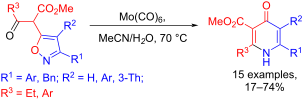

Graphical Abstract

Scheme 1: Approaches to the synthesis of alkyl 4-oxo-1,4-dihydropyridine-3-carboxylates.
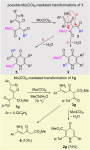
Scheme 2: Synthesis of 4-oxo-1,4-dihydropyridine-3-carboxylates.

Scheme 3: Synthesis of Isoxazoles 11–13.
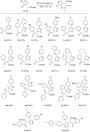
Scheme 4: Synthesis of isoxazoles 1.

Scheme 5: Synthesis of pyridones 2.
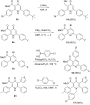
Scheme 6: Transformations of pyridones 2.
Photophysical, photostability, and ROS generation properties of new trifluoromethylated quinoline-phenol Schiff bases
- Inaiá O. Rocha,
- Yuri G. Kappenberg,
- Wilian C. Rosa,
- Clarissa P. Frizzo,
- Nilo Zanatta,
- Marcos A. P. Martins,
- Isadora Tisoco,
- Bernardo A. Iglesias and
- Helio G. Bonacorso
Beilstein J. Org. Chem. 2021, 17, 2799–2811, doi:10.3762/bjoc.17.191
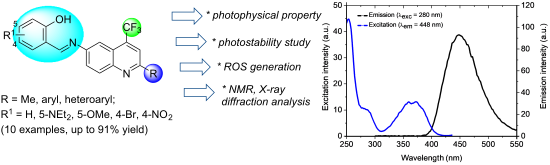

Graphical Abstract

Figure 1: Examples of structures and properties of Schiff bases of interest in the present study.

Scheme 1: General view for the present study.

Scheme 2: Synthesis of ((trifluoromethyl)quinolinyl)phenol Schiff bases 3aa–fa.

Scheme 3: Synthesis of trifluoromethylated quinolinyl-phenol Schiff bases 3bb–be.

Figure 2: ORTEP diagram of the crystal structure of (E)-2-(((2-phenyl-4-(trifluoromethyl)quinolin-6-yl)imino)...
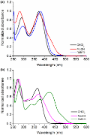
Figure 3: Normalized absorption spectra in the UV–vis region of compounds (a) 3ea and (b) 3be in CHCl3, MeOH ...

Figure 4: Normalized steady-state fluorescence emission spectra of compound 3aa (R = Ph, R1 = H) in CHCl3 (bl...

Figure 5: Comparative normalized steady-state fluorescence emission spectra of compounds 3bb and 3be in the t...

Figure 6: Photostability (%) plots of derivatives 3aa–fa and 3bb–be in DMSO solution after irradiation with w...

Figure 7: DPBF photooxidation assays by red-light irradiation with diode laser (λ = 660 nm) in the presence o...
The PIFA-initiated oxidative cyclization of 2-(3-butenyl)quinazolin-4(3H)-ones – an efficient approach to 1-(hydroxymethyl)-2,3-dihydropyrrolo[1,2-a]quinazolin-5(1H)-ones
- Alla I. Vaskevych,
- Nataliia O. Savinchuk,
- Ruslan I. Vaskevych,
- Eduard B. Rusanov,
- Oleksandr O. Grygorenko and
- Mykhailo V. Vovk
Beilstein J. Org. Chem. 2021, 17, 2787–2794, doi:10.3762/bjoc.17.189
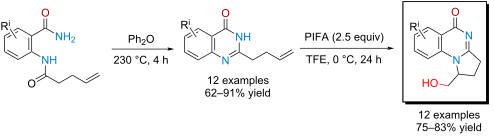

Graphical Abstract

Figure 1: Pyrrolo[1,2-a]quinazoline derivatives – analogs of vasicinone alkaloids and their biological activi...

Scheme 1: Synthetic approaches to 2,3-dihydropyrrolo[1,2-a]quinazolin-5(1H)-one derivatives.

Scheme 2: Plausible mechanism for the formation of 6.

Figure 2: X-ray crystal structure of compound 6f.
Cryogels: recent applications in 3D-bioprinting, injectable cryogels, drug delivery, and wound healing
- Luke O. Jones,
- Leah Williams,
- Tasmin Boam,
- Martin Kalmet,
- Chidubem Oguike and
- Fiona L. Hatton
Beilstein J. Org. Chem. 2021, 17, 2553–2569, doi:10.3762/bjoc.17.171
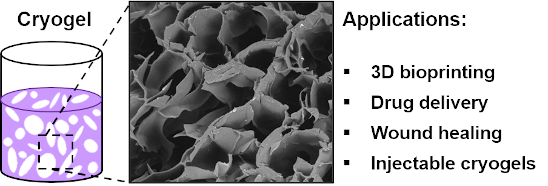

Graphical Abstract

Figure 1: Schematic representation of the process of aqueous cryogel formation, using (a) monomers/small mole...
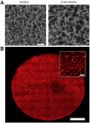
Figure 2: Microarchitecture of gelatin cryogels. (A) Surface and cross-sectional SEM micrographs of highly po...

Figure 3: Principle of 3D-cryogel printing. A) Illustration of 3D-printing of cryogels. B) Illustration of th...

Figure 4: Illustration of the production of the injectable multifunctional composite, comprised of alginate c...

Figure 5: Digital and SEM photographs of PETEGA cryogel at 20 °C (top) and 50 °C (bottom), synthesised via UV...
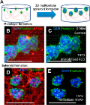
Figure 6: Cell morphology of T47D breast cancer cells cultured in HA cryogels. (A) Schematic representation o...

Figure 7: Preparation of PDMA/β-CD cryogel via cryogenic treatment and photochemical crosslinking in frozen s...

Figure 8: (A) Healing rate of wounds treated with autoclaved CG11 cryogels and those treated with 70% ethanol...

Figure 9: In vivo haemostatic capacity evaluation of the cryogels. Blood loss (a) and haemostatic time (b) in...
Isolation and characterization of new phenolic siderophores with antimicrobial properties from Pseudomonas sp. UIAU-6B
- Emmanuel T. Oluwabusola,
- Olusoji O. Adebisi,
- Fernando Reyes,
- Kojo S. Acquah,
- Mercedes De La Cruz,
- Larry L. Mweetwa,
- Joy E. Rajakulendran,
- Digby F. Warner,
- Deng Hai,
- Rainer Ebel and
- Marcel Jaspars
Beilstein J. Org. Chem. 2021, 17, 2390–2398, doi:10.3762/bjoc.17.156
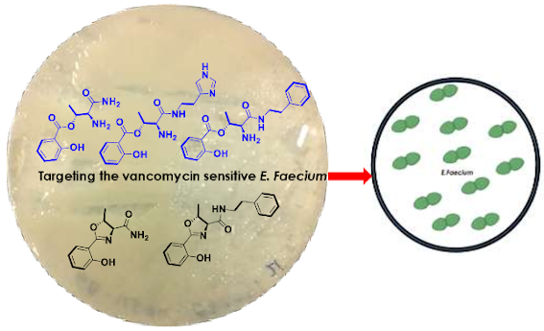

Graphical Abstract

Figure 1: Structures of the new phenolic siderophores 1–5, pseudomonine (6), and salicylic acid (7).

Figure 2: Key HMBC and 1H-1H COSY correlations.

Figure 3: Plausible biosynthetic hypotheses of compounds 1–5.
Structural effects of meso-halogenation on porphyrins
- Keith J. Flanagan,
- Maximilian Paradiz Dominguez,
- Zoi Melissari,
- Hans-Georg Eckhardt,
- René M. Williams,
- Dáire Gibbons,
- Caroline Prior,
- Gemma M. Locke,
- Alina Meindl,
- Aoife A. Ryan and
- Mathias O. Senge
Beilstein J. Org. Chem. 2021, 17, 1149–1170, doi:10.3762/bjoc.17.88
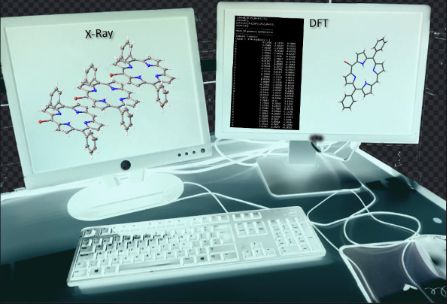

Graphical Abstract

Figure 1: 5-Halo-substituted porphyrins.

Figure 2: Expanded view (thermal ellipsoid) of compound 1 in the crystal showing (A) stacking, (B) tilted edg...

Figure 3: Expanded view (ball and stick) of compound 2 in the crystal showing (A) stacking, (B) bromine atoms...

Figure 4: Expanded view (ball and stick) of compound 3 in the crystal showing (A) stacking and (B) edge-on in...

Figure 5: Hirshfeld surfaces of compounds 1–3.

Figure 6: Contact percentages of compounds 1–3.

Figure 7: NSD charts for compounds 1–3.

Figure 8: Expanded view (thermal ellipsoid plot) of compound 2A showing (A) the edge-on and stacking interact...

Figure 9: 5-Halo-15-phenyl-substituted porphyrins.

Figure 10: Expanded view (thermal ellipsoid plot) of compound 4 showing (A) tilted alignment of porphyrin ring...

Figure 11: Expanded view (thermal ellipsoid plot) of compound 5 showing (A) porphyrin stacking and (B) Br···H ...

Figure 12: Expanded view (thermal ellipsoid plot) of compounds 6 (A and C) and 7 (B and D) showing (A) Br···H ...

Figure 13: 5,15-Di-halo-substituted porphyrins.

Figure 14: Expanded view (thermal ellipsoid plot) of compound 9 showing the Br···H interactions with (A) pyrro...

Figure 15: Expanded view (thermal ellipsoid plot) of compound 10 showing the (A) Br···H interactions with toly...

Figure 16: Expanded view (thermal ellipsoid plot) of compound 11 showing the (A) edge-on interactions, (B) edg...

Figure 17: Expanded view (thermal ellipsoid plot) of compound 13 showing (A) Br···H interactions with pyrrole ...

Figure 18: Expanded view (ball and stick) of compound 13A showing (A) Br···H interactions with pyrrole units a...

Figure 19: 5,10-Di-halo-substituted porphyrins.

Figure 20: Expanded view (ball and stick) of compound 16 showing (A) stacking, (B) head-to-tail alignment, (C)...

Figure 21: Honorable mentions of halogen-substituted porphyrins taken from the CSD database.

Figure 22: Series 1 – 5,15-di-halo-substituted porphyrins.

Figure 23: Series 2 – increasing number of halogen substituents.

Figure 24: Series 3 – 5,10-di-halo-substituted porphyrins.
Effective microwave-assisted approach to 1,2,3-triazolobenzodiazepinones via tandem Ugi reaction/catalyst-free intramolecular azide–alkyne cycloaddition
- Maryna O. Mazur,
- Oleksii S. Zhelavskyi,
- Eugene M. Zviagin,
- Svitlana V. Shishkina,
- Vladimir I. Musatov,
- Maksim A. Kolosov,
- Elena H. Shvets,
- Anna Yu. Andryushchenko and
- Valentyn A. Chebanov
Beilstein J. Org. Chem. 2021, 17, 678–687, doi:10.3762/bjoc.17.57
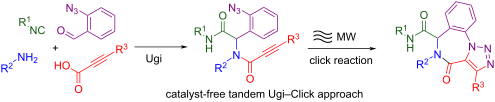

Graphical Abstract

Figure 1: Benzodiazepine-based azolo-containing drugs.

Figure 2: Novel potential 1,2,3-triazolobenziadiazepine drugs.

Scheme 1: Examples of synthesis of 1,2,3-triazolobenzodiazepines via tandem approach Ugi reaction/IAAC. Reage...

Scheme 2: Azide precursor synthesis.

Scheme 3: Synthesis of Ugi products 6, their structures and yields.

Figure 3: Code legend for Ugi products 6 and molecular structure (X-ray analysis) of compound 6aaa.

Scheme 4: Cyclization of Ugi-product 6aab with terminal alkyne fragment.

Figure 4: 1H NMR spectra of the reactant and the product of IAAC.

Figure 5: Molecular structure of compound 7aaa (X-ray analysis) and comparison of 1H NMR spectra of compounds ...

Scheme 5: The substrate scope of intermolecular cycloaddition.
Chan–Evans–Lam N1-(het)arylation and N1-alkеnylation of 4-fluoroalkylpyrimidin-2(1H)-ones
- Viktor M. Tkachuk,
- Oleh O. Lukianov,
- Mykhailo V. Vovk,
- Isabelle Gillaizeau and
- Volodymyr A. Sukach
Beilstein J. Org. Chem. 2020, 16, 2304–2313, doi:10.3762/bjoc.16.191


Graphical Abstract

Figure 1: Summary of the previous and present studies.

Scheme 1: Chan–Evans–Lam reaction of 4-trifluoromethylpyrimidin-2(1H)-one 1а with (het)aryl boronic acid 2b–w...

Scheme 2: Chan–Evans–Lam reaction of 4-trifluoromethylpyrimidin-2(1H)-one (1а) with (het)aryl- and alkenylbor...

Scheme 3: Chan–Evans–Lam reaction of pyrimidin-2(1H)-ones 1b–h with phenylboronic acid (2a).
Naphthalene diimide–amino acid conjugates as novel fluorimetric and CD probes for differentiation between ds-DNA and ds-RNA
- Annike Weißenstein,
- Myroslav O. Vysotsky,
- Ivo Piantanida and
- Frank Würthner
Beilstein J. Org. Chem. 2020, 16, 2032–2045, doi:10.3762/bjoc.16.170
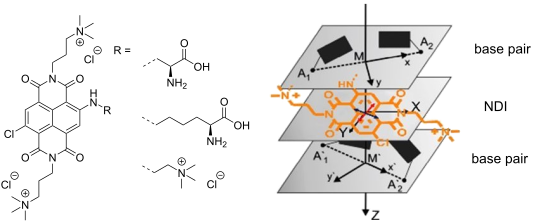

Graphical Abstract

Figure 1: Structures of investigated compounds stressing steric differences in linker length attached to the ...

Scheme 1: Synthesis of water-soluble naphthalene diimides 3a,b, and 5.

Figure 2: UV–vis absorption (solid line) and fluorescence spectra (dashed line) of NDI 3a,b, and 5 (c = 4.5 ×...

Figure 3: Calculations for Cl-NDI-NMe model compound (at the B3LYP/6-31+G** level of theory) in water (PCM). ...

Figure 4: (a) Melting curve of poly(dA-dT)2 alone and after the addition of NDI 3a,b, and 5 (r = 0.3 ([NDI]/[...

Figure 5: Changes in fluorescence intensity (spectra are normalized) of (a) 3a (c = 1.0 × 10⁻⁶ M), (b) 3b (c ...

Figure 6: Calorimetric titration of a poly(dG-dC)2 solution in sodium cacodylate buffer (pH 5.0) at 298 K wit...

Figure 7: CD titration of poly(dG-dC)2 (c = 2.0 × 10⁻⁵ M) with (a) 3a, (b) 3b, and (c) 5 with increasing mola...

Figure 8: Schematic representation of the alignment of the intercalating 3a (left) and 3b (right) between the...
Oxime radicals: generation, properties and application in organic synthesis
- Igor B. Krylov,
- Stanislav A. Paveliev,
- Alexander S. Budnikov and
- Alexander O. Terent’ev
Beilstein J. Org. Chem. 2020, 16, 1234–1276, doi:10.3762/bjoc.16.107
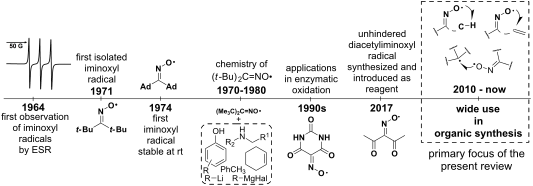

Graphical Abstract

Figure 1: Imine-N-oxyl radicals (IV) discussed in the present review and other classes of N-oxyl radicals (I–...
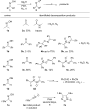
Figure 2: The products of decomposition of iminoxyl radicals generated from oximes by oxidation with Ag2O.

Scheme 1: Generation of oxime radicals and study of the kinetics of their decay by photolysis of the solution...

Scheme 2: Synthesis of di-tert-butyliminoxyl radical and its decomposition products.

Scheme 3: The proposed reaction pathway of the decomposition of di-tert-butyliminoxyl radical (experimentally...

Scheme 4: Monomolecular decomposition of the tert-butyl(triethylmethyl)oxime radical.

Scheme 5: The synthesis and stability of the most stable dialkyl oxime radicals – di-tert-butyliminoxyl and d...

Scheme 6: The formation of iminoxyl radicals from β-diketones under the action of NO2.

Scheme 7: Synthesis of the diacetyliminoxyl radical.

Scheme 8: Examples of long-living oxime radicals with electron-withdrawing groups and the conditions for thei...

Figure 3: The electronic structure iminoxyl radicals and their geometry compared to the corresponding oximes.

Figure 4: Bond dissociation enthalpies (kcal/mol) of oximes and N,N-disubstituted hydroxylamines calculated o...

Scheme 9: Examples demonstrating the low reactivity of the di-tert-butyliminoxyl radical towards the substrat...

Scheme 10: The reactions of di-tert-butyliminoxyl radical with unsaturated hydrocarbons involving hydrogen ato...

Scheme 11: Possible mechanisms of reaction of di-tert-butyliminoxyl radical with alkenes.

Scheme 12: Products of the reaction between di-tert-butyliminoxyl radical and phenol derivatives.

Scheme 13: The reaction of di-tert-butyliminoxyl radical with amines.

Scheme 14: Reaction of di-tert-butyliminoxyl radicals with organolithium reagents.

Scheme 15: Cross-dehydrogenative C–O coupling of 1,3-dicarbonyl compounds with oximes under the action of mang...

Scheme 16: Cross-dehydrogenative C–O coupling of 1,3-dicarbonyl compounds with oximes under the action of Cu(BF...

Scheme 17: Oxidative C–O coupling of benzylmalononitrile (47) with 3-(hydroxyimino)pentane-2,4-dione (19).

Scheme 18: The proposed mechanism of the oxidative coupling of benzylmalononitrile (47) with diacetyl oxime (19...

Scheme 19: Oxidative C–O coupling of pyrazolones with oximes under the action of Fe(ClO4)3.

Scheme 20: The reaction of diacetyliminoxyl radical with pyrazolones.

Scheme 21: Oxidative C–O coupling of oximes with acetonitrile, ketones, and esters.

Scheme 22: Intramolecular cyclizations of oxime radicals to form substituted isoxazolines or cyclic nitrones.

Scheme 23: TEMPO-mediated oxidative cyclization of oximes with C–H bond cleavage.

Scheme 24: Proposed reaction mechanism of oxidative cyclization of oximes with C–H bond cleavage.

Scheme 25: Selectfluor/Bu4NI-mediated C–H oxidative cyclization of oximes.

Scheme 26: Oxidative cyclization of N-benzyl amidoximes to 1,2,4-oxadiazoles.

Scheme 27: The formation of quinazolinone 73a from 5-phenyl-4,5-dihydro-1,2,4-oxadiazole 74 under air.

Scheme 28: DDQ-mediated oxidative cyclization of thiohydroximic acids.

Scheme 29: Plausible mechanism of the oxidative cyclization of thiohydroximic acids.

Scheme 30: Silver-mediated oxidative cyclization of α-halogenated ketoximes and 1,3-dicarbonyl compounds.

Scheme 31: Possible pathway of one-pot oxidative cyclization of α-halogenated ketoximes and 1,3-dicarbonyl com...

Scheme 32: T(p-F)PPT-catalyzed oxidative cyclization of oximes with the formation of 1,2,4-oxadiazolines.

Scheme 33: Intramolecular cyclization of iminoxyl radicals involving multiple C=C and N=N bonds.

Scheme 34: Oxidative cyclization of β,γ- and γ,δ-unsaturated oximes employing the DEAD or TEMPO/DEAD system wi...

Scheme 35: Cobalt-catalyzed aerobic oxidative cyclization of β,γ-unsaturated oximes.

Scheme 36: Manganese-catalyzed aerobic oxidative cyclization of β,γ-unsaturated oximes.

Scheme 37: Visible light photocatalytic oxidative cyclization of β,γ-unsaturated oximes.

Scheme 38: TBAI/TBHP-mediated radical cascade cyclization of the β,γ-unsaturated oximes.

Scheme 39: TBAI/TBHP-mediated radical cascade cyclization of vinyl isocyanides with β,γ-unsaturated oximes.

Scheme 40: tert-Butylnitrite-mediated oxidative cyclization of unsaturated oximes with the introduction of an ...

Scheme 41: Transformation of unsaturated oxime to oxyiminomethylisoxazoline via the confirmed dimeric nitroso ...

Scheme 42: tert-Butylnitrite-mediated oxidative cyclization of unsaturated oximes with the introduction of a n...

Scheme 43: Synthesis of cyano-substituted oxazolines from unsaturated oximes using the TBN/[RuCl2(p-cymene)]2 ...

Scheme 44: Synthesis of trifluoromethylthiolated isoxazolines from unsaturated oximes.

Scheme 45: Copper-сatalyzed oxidative cyclization of β,γ-unsaturated oximes with the introduction of an azido ...

Scheme 46: TBHP-mediated oxidative cascade cyclization of β,γ-unsaturated oximes and unsaturated N-arylamides.

Scheme 47: Copper-сatalyzed oxidative cyclization of unsaturated oximes with the introduction of an amino grou...

Scheme 48: TEMPO-mediated oxidative cyclization of unsaturated oximes followed by elimination.

Scheme 49: Oxidative cyclization of β,γ-unsaturated oximes with the introduction of a trifluoromethyl group.

Scheme 50: Oxidative cyclization of unsaturated oximes with the introduction of a nitrile group.

Scheme 51: Oxidative cyclization of β,γ-unsaturated oximes to isoxazolines with the introduction of a nitrile ...

Scheme 52: Oxidative cyclization of β,γ-unsaturated oximes to isoxazolines with the introduction of a sulfonyl...

Scheme 53: Oxidative cyclization of β,γ- and γ,δ-unsaturated oximes to isoxazolines with the introduction of a...

Scheme 54: Oxidative cyclization of β,γ-unsaturated oximes to isoxazolines with the introduction of a thiocyan...

Scheme 55: PhI(OAc)2-mediated oxidative cyclization of oximes with C–S and C–Se bond formation.

Scheme 56: PhI(OAc)2-mediated oxidative cyclization of unsaturated oximes accompanied by alkoxylation.

Scheme 57: PhI(OAc)2-mediated cyclization of unsaturated oximes to methylisoxazolines.

Scheme 58: Oxidative cyclization-alkynylation of unsaturated oximes.

Scheme 59: TEMPO-mediated oxidative cyclization of C-glycoside ketoximes to C-glycosylmethylisoxazoles.

Scheme 60: Silver-сatalyzed oxidative cyclization of β,γ-unsaturated oximes with formation of fluoroalkyl isox...

Scheme 61: Oxidative cyclization of β,γ-unsaturated oximes with the formation of haloalkyl isoxazolines.

Scheme 62: Cyclization of β,γ-unsaturated oximes into haloalkyl isoxazolines under the action of the halogenat...

Scheme 63: Synthesis of haloalkyl isoxazoles and cyclic nitrones via oxidative cyclization and 1,2-halogen shi...

Scheme 64: Electrochemical oxidative cyclization of diaryl oximes.

Scheme 65: Copper-сatalyzed cyclization and dioxygenation oximes containing a triple C≡C bond.

Scheme 66: Photoredox-catalyzed sulfonylation of β,γ-unsaturated oximes by sulfonyl hydrazides.

Scheme 67: Oxidative cyclization of β,γ-unsaturated oximes with introduction of sulfonate group.

Scheme 68: Ultrasound-promoted oxidative cyclization of β,γ-unsaturated oximes.
The charge-assisted hydrogen-bonded organic framework (CAHOF) self-assembled from the conjugated acid of tetrakis(4-aminophenyl)methane and 2,6-naphthalenedisulfonate as a new class of recyclable Brønsted acid catalysts
- Svetlana A. Kuznetsova,
- Alexander S. Gak,
- Yulia V. Nelyubina,
- Vladimir A. Larionov,
- Han Li,
- Michael North,
- Vladimir P. Zhereb,
- Alexander F. Smol'yakov,
- Artem O. Dmitrienko,
- Michael G. Medvedev,
- Igor S. Gerasimov,
- Ashot S. Saghyan and
- Yuri N. Belokon
Beilstein J. Org. Chem. 2020, 16, 1124–1134, doi:10.3762/bjoc.16.99
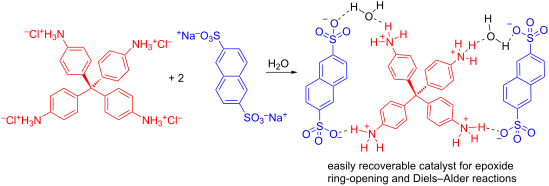

Graphical Abstract

Scheme 1: The synthesis of F-1.

Figure 1: View of the crystal structure of F-1 (F-1a phase), with representation of atoms by thermal ellipsoi...

Figure 2: View of the crystal structure of F-1 (F-1a’ phase), with representation of the atoms via thermal el...

Figure 3: SEM image of F-1.

Figure 4: SEM image of F-1 with an F-1a phase.

Figure 5: TGA-DSC analysis of a sample of F-1. The TGA plot is shown in green, the DSC curve is shown in blue...
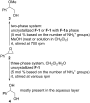
Scheme 2: Uncrystallized F-1 or F-1 with an F-1a phase promoted the two- and three-phase reactions of styrene...

Scheme 3: CAHOF F-1-promoted reactions of cyclohexene oxide (5) with alcohols and water.

Scheme 4: F-1-promoted Diels–Alder reaction.
Towards triptycene functionalization and triptycene-linked porphyrin arrays
- Gemma M. Locke,
- Keith J. Flanagan and
- Mathias O. Senge
Beilstein J. Org. Chem. 2020, 16, 763–777, doi:10.3762/bjoc.16.70
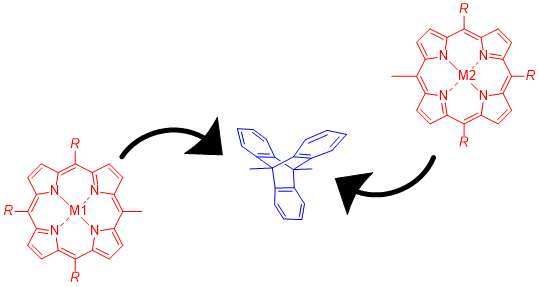

Graphical Abstract
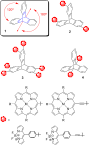
Figure 1: Triptycene as a scaffold and selected porphyrin and BODIPY arrays.

Scheme 1: Sonogashira cross-coupling reactions to form symmetric porphyrin and BODIPY triptycene-linked dyads....

Scheme 2: Sonogashira cross-coupling reactions to form a triptycene-substituted porphyrin monomer and an unsy...

Scheme 3: Synthesis of the triptycene-porphyrin-triptycene complex 18.

Figure 2: Single crystal X-ray structure of triptycene 5. (a) Molecular structure of 5 in the crystal with hy...
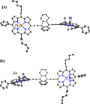
Figure 3: Single crystal X-ray structure of triptycene-linked zinc-nickel porphyrin dimer 16 showing the conf...

Figure 4: Views of the single crystal X-ray structure of triptycene-linked zinc-nickel porphyrin dimer 16 sho...

Figure 5: Expanded structure view of the triptycene-linked zinc-nickel porphyrin dimer 16 showing the repeati...

Figure 6: UV–vis of symmetric and unsymmetric triptycene porphyrin dimers 9 and 16, and the triptycene porphy...

Figure 7: Emission spectrum of symmetric and unsymmetric triptycene-linked porphyrin dimers 9 and 16, and a t...

Figure 8: Compounds used for spectroscopic comparisons.

Figure 9: UV–vis spectra of various porphyrin/BODIPY dimers with different linker groups in CHCl3.

Figure 10: Fluorescence emission spectrum of various porphyrin/BODIPY dimers with different linker groups in C...
Architecture and synthesis of P,N-heterocyclic phosphine ligands
- Wisdom A. Munzeiwa,
- Bernard Omondi and
- Vincent O. Nyamori
Beilstein J. Org. Chem. 2020, 16, 362–383, doi:10.3762/bjoc.16.35
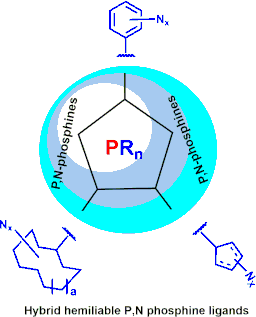

Graphical Abstract

Scheme 1: Synthesis of pyridylphosphine ligands.

Figure 1: Pyridylphosphine ligands.

Scheme 2: Synthesis of piperidyl- and oxazinylphosphine ligands.

Scheme 3: Synthesis of linear multi-chelate pyridylphosphine ligands.

Scheme 4: Synthesis of chiral acetal pyridylphosphine ligands.

Scheme 5: Synthesis of diphenylphosphine-substituted triazine ligands.
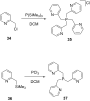
Scheme 6: Synthesis of (pyridine-2-ylmethyl)phosphine ligands.

Scheme 7: Synthesis of diphosphine pyrrole ligands.

Scheme 8: Synthesis of 4,5-diazafluorenylphosphine ligands.

Scheme 9: Synthesis of thioether-containing pyridyldiphosphine ligands starting from ethylene sulfide and dip...

Scheme 10: Synthesis of monoterpene-derived phosphine pyridine ligands.

Scheme 11: Synthesis of N-phenylphosphine-substituted imidazole ligands.

Scheme 12: Synthesis of triazol-4-ylphosphine ligands.

Scheme 13: Synthesis of phosphanyltriazolopyridines and product selectivity depending on the substituents’ eff...

Scheme 14: Synthesis of PTA-phosphine ligands.

Scheme 15: Synthesis of isomeric phosphine dipyrazole ligands by varying the reaction temperature.

Scheme 16: Synthesis of N-tethered phosphine imidazolium ligands (route A) and diphosphine imidazolium ligands...

Scheme 17: Synthesis of {1-[2-(pyridin-2-yl)- (R = CH) and {1-[2-(pyrazin-2-yl)quinazolin-4-yl]naphthalen-2-yl...

Scheme 18: Synthesis of oxazolylindolylphosphine ligands 102.

Scheme 19: Synthesis of pyrrolylphosphine ligands.

Scheme 20: Synthesis of phosphine guanidinium ligands.

Scheme 21: Synthesis of a polydentate aminophosphine ligand.

Scheme 22: Synthesis of quinolylphosphine ligands.

Scheme 23: Synthesis of N-(triazolylmethyl)phosphanamine ligands.

Figure 2: Triazolylphosphanamine ligands synthesized by Wassenaar’s method [22].

Scheme 24: Synthesis of oxazaphosphorines.

Scheme 25: Synthesis of paracyclophane pyridylphosphine ligands.

Scheme 26: Synthesis of triazolylphosphine ligands.

Figure 3: Click-phosphine ligands.

Scheme 27: Ferrocenyl pyridylphosphine imine ligands.

Scheme 28: Synthesis of phosphinooxazolines (PHOX).

Scheme 29: Synthesis of ferrocenylphosphine oxazoles.
Reversible photoswitching of the DNA-binding properties of styrylquinolizinium derivatives through photochromic [2 + 2] cycloaddition and cycloreversion
- Sarah Kölsch,
- Heiko Ihmels,
- Jochen Mattay,
- Norbert Sewald and
- Brian O. Patrick
Beilstein J. Org. Chem. 2020, 16, 111–124, doi:10.3762/bjoc.16.13
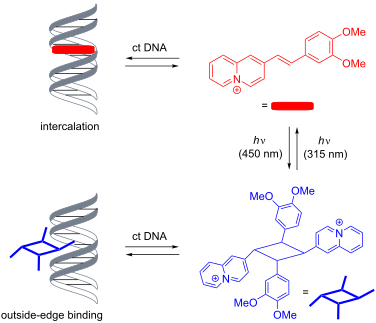

Graphical Abstract

Scheme 1: Synthesis of styrylquinolizinium derivatives 3a–d.

Figure 1: Absorption spectra and normalized emission spectrum (Abs. = 0.10, 3b: λex = 394 nm) of derivatives ...

Figure 2: Spectrophotometric titration upon the addition of ct DNA to the styrylquinolizinium derivatives 3a ...

Figure 3: Spectrofluorimetric titration upon the addition of ct DNA to the styrylquinolizinium derivatives 3a...
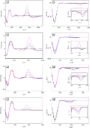
Figure 4: CD and LD spectra of the styryl derivatives 3a (A), 3b (B), 3c (C), and 3d (D) with ct DNA in BPE b...

Figure 5: Spectrophotometric monitoring of the irradiation of styrylquinolizinium derivatives 3a (A), 3b (B), ...

Figure 6: Absorption of the monomers (c = 20 µM, red) 3b (A) and 3c (B) and their dimers (black) 4b and 4c in...

Figure 7: Photometric monitoring of the photoreaction of 3b (c = 20 µM) to the dimer 4b by irradiation at ca....

Figure 8: ORTEP drawings of cyclobutane derivatives 4b (A) and 4c (B) in the solid state (thermal ellipsoids ...

Scheme 2: Possible pathways for the selective photodimerization of styrylquinolizinium derivatives 3b and 3c.

Figure 9: A) Spectrophotometric titration of ct DNA to dimer 4b in BPE buffer (cL = 20 µM, cct DNA = 1.45 mM, ...

Figure 10: A) Photometric and B) CD spectroscopic monitoring of the photoinduced switching (4b: λex = 315 nm, ...

Scheme 3: Photoinduced switching of the DNA binding properties of styrylquinolizinium compound 3b.
Anion-driven encapsulation of cationic guests inside pyridine[4]arene dimers
- Anniina Kiesilä,
- Jani O. Moilanen,
- Anneli Kruve,
- Christoph A. Schalley,
- Perdita Barran and
- Elina Kalenius
Beilstein J. Org. Chem. 2019, 15, 2486–2492, doi:10.3762/bjoc.15.241
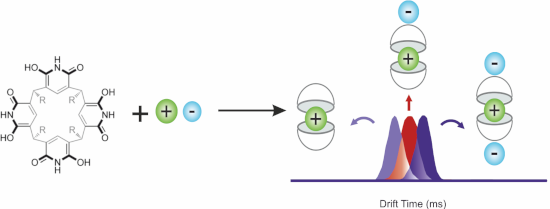

Graphical Abstract

Scheme 1: Structures of tetraisobutylpyridine[4]arene 1 and tetraisobutylresorcin[4]arene 2.
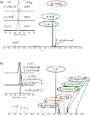
Figure 1: Spectra of 1 + Me4NPF6 1:3 in acetone in a) (+)ESI-MS and b) (−)ESI-MS. Insets showing arrival time...

Figure 2: (+)ESI-MS profile spectrum of the mixture of 1, 2 and TMAPF6 in acetonitrile (20 µM, 1:1:1). Inset ...

Figure 3: Calculated ESP surfaces (in au) superimposed on the total electron density (0.004 au) for 1 and 2: ...
Reactions of 2-carbonyl- and 2-hydroxy(or methoxy)alkyl-substituted benzimidazoles with arenes in the superacid CF3SO3H. NMR and DFT studies of dicationic electrophilic species
- Dmitry S. Ryabukhin,
- Alexey N. Turdakov,
- Natalia S. Soldatova,
- Mikhail O. Kompanets,
- Alexander Yu. Ivanov,
- Irina A. Boyarskaya and
- Aleksander V. Vasilyev
Beilstein J. Org. Chem. 2019, 15, 1962–1973, doi:10.3762/bjoc.15.191
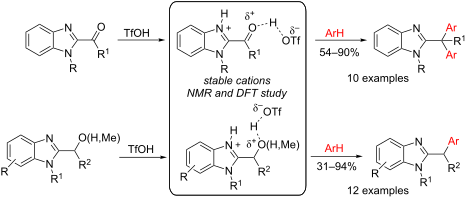

Graphical Abstract

Figure 1: Examples of some commercially available pharmaceuticals and agrochemicals containing the benzimidaz...

Figure 2: Formation of cationic species by protonation of 5-formyl-4-methylimidazole in TfOH and their reacti...

Figure 3: Benzimidazoles 1–8 used in this study.

Scheme 1: Reaction of 2-acetylbenzimidazole (2) with TfOH and benzene.

Scheme 2: Reactions of hydroxymethyl-substituted benzimidazole 7 and 8 with TfOH and benzene.

Scheme 3: Reaction mechanism of the formation of compounds 9–11.

Scheme 4: Reaction mechanism of the formation of compounds 12.
Alkylation of lithiated dimethyl tartrate acetonide with unactivated alkyl halides and application to an asymmetric synthesis of the 2,8-dioxabicyclo[3.2.1]octane core of squalestatins/zaragozic acids
- Herman O. Sintim,
- Hamad H. Al Mamari,
- Hasanain A. A. Almohseni,
- Younes Fegheh-Hassanpour and
- David M. Hodgson
Beilstein J. Org. Chem. 2019, 15, 1194–1202, doi:10.3762/bjoc.15.116
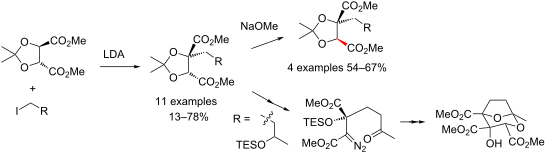

Graphical Abstract

Figure 1: Squalestatin S1/zaragozic acid A (1) and DDSQ (2).

Scheme 1: Carbonyl ylide cycloaddition–rearrangement to the squalestatin core [12,13].

Scheme 2: Tartrate alkylation strategy to cycloaddition substrate.

Scheme 3: Conversion of α-ketoester to α-diazoester.

Scheme 4: Seebach’s tartrate alkylation and rationalisation of stereoselectivity [17-19].

Scheme 5: Tartrate alkylation with a non-activated alkyl iodide.

Scheme 6: Alkylated tartrate to diazoester sequence.

Scheme 7: TES protection approach to the squalestatin core.

Scheme 8: Tartrate acetonide methylation.

Scheme 9: Tartrate alkylation with various alkyl halides.

Scheme 10: Rationalisation of dialkylation observations.

Scheme 11: Tartrate alkylation chemistry with more complex alkyl iodides [12,13].

Figure 2: Natural product examples containing the monoalkylated tartaric acid motif.

Scheme 12: Epimerisation of monoalkylated tartrates.
1,8-Bis(dimethylamino)naphthyl-2-ketimines: Inside vs outside protonation
- A. S. Antonov,
- A. F. Pozharskii,
- P. M. Tolstoy,
- A. Filarowski and
- O. V. Khoroshilova
Beilstein J. Org. Chem. 2018, 14, 2940–2948, doi:10.3762/bjoc.14.273
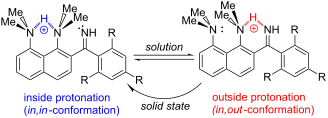

Graphical Abstract

Scheme 1: Protonation of DMAN.

Scheme 2: Protonation equilibria for 2 and 3.

Scheme 3: Protonation of imine 4a with perchloric acid.

Scheme 4: Synthesis of investigated substrates (yields obtained by paths a and b are denoted by a correspondi...

Scheme 5: Preparation of protonated forms of imines 4–7.

Figure 1: C=NH Signal regions of temperature-depending 1H NMR spectra for compounds 4a–7a, acetone-d6.

Scheme 6: E/Z-Isomerisation of ketimines 4a–7a.
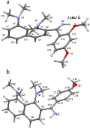
Figure 2: Molecular structure of imines 6a (a) and 4a (b). The H···O distance for 6a is shown.

Figure 3: Optimised geometry and energy difference ΔE = EE – EZ (kcal/mol) for imines 4a–7a (B3LYP/6-311+G(d,...

Figure 4: 1H NMR spectra of imines 4b–7b (4b’–7b’) in DMSO-d6, 25 °C (the signals of the forms protonated at ...

Scheme 7: Switching of protonation sites in imines 4b–7b.

Figure 5: Optimised geometries and energy differences ΔE = Eb’ – Eb (kcal/mol) for different sites of protona...

Figure 6: Molecular structure of protonated imines 4a·HClO4 (a) and 6b·EtOH (b).

Scheme 8: Protonation of the out-inverted dialkylamino group.

Scheme 9: Examples of proton sponges with stabilised in,out-conformation.

Figure 7: C=NH2+ Signal regions of temperature-depending spectra for compounds 4c–7c, acetone-d6.

Figure 8: Molecular structure of dication 6с.
Hypervalent iodine compounds for anti-Markovnikov-type iodo-oxyimidation of vinylarenes
- Igor B. Krylov,
- Stanislav A. Paveliev,
- Mikhail A. Syroeshkin,
- Alexander A. Korlyukov,
- Pavel V. Dorovatovskii,
- Yan V. Zubavichus,
- Gennady I. Nikishin and
- Alexander O. Terent’ev
Beilstein J. Org. Chem. 2018, 14, 2146–2155, doi:10.3762/bjoc.14.188
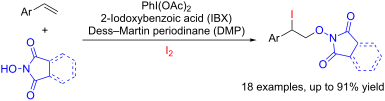

Graphical Abstract

Scheme 1: Difunctionalization of double C=C bond with the formation of C–O and C–I bonds.

Scheme 2: Iodo-oxyimidation of styrenes 1a–k with preparation of products 3aa–ka, 3ab–db, 3fb, 3hb, and 3kb.
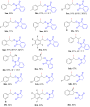
Figure 1: Scope of the iodo-oxyimidation of vinylarenes with I2/PhI(OAc)2 system. Reaction conditions: vinyla...

Figure 2: Molecular structure of 3ca. Atoms are presented as anisotropic displacement parameters (ADP) ellips...

Scheme 3: The proposed mechanism of iodo-oxyimidation of styrene (1a) using the NHPI/I2/PhI(OAc)2 system with...

Figure 3: CV curves of styrene (1a, purple), NHPI (2a, red), I2 (blue) and PhI(OAc)2 (green) in 0.1 M n-Bu4NBF...

Scheme 4: Gram-scale synthesis of compound 3aa.

Scheme 5: Synthetic utility of the iodo-oxyimides 3aa and 3ab.
Synthesis of pyrimido[1,6-a]quinoxalines via intermolecular trapping of thermally generated acyl(quinoxalin-2-yl)ketenes by Schiff bases
- Svetlana O. Kasatkina,
- Ekaterina E. Stepanova,
- Maksim V. Dmitriev,
- Ivan G. Mokrushin and
- Andrey N. Maslivets
Beilstein J. Org. Chem. 2018, 14, 1734–1742, doi:10.3762/bjoc.14.147
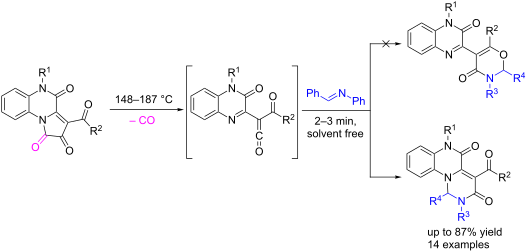

Graphical Abstract

Figure 1: Quinoxaline-based 6/6/6-angularly fused scaffolds and respective examples of biologically active co...

Figure 2: Synthetic routes towards the pyrimido[1,6-a]quinoxaline scaffold.

Figure 3: Acyl(quinoxalin-2-yl)ketene.

Scheme 1: Thermolysis of five-membered 2,3-dioxoheterocycles resulting in acyl(quinoxalin-2-yl)ketenes.

Figure 4: STA plot of thermolysis of PQT 1a. Blue solid curve: DSC; green solid curve: TG; greed dashed curve...

Scheme 2: Side-reactions concurring with intermolecular trapping of ketene generated from PQT 1a by benzalani...

Figure 5: Scope of the intermolecular trapping of ketenes generated from PQTs 1a–h by Schiff bases 2a–d under...

Scheme 3: Formation of furoquinoxalines 6a,b via intramolecular cyclization in ketenes generated from PQTs 1g,...

Figure 6: ORTEP drawing of compound 3g (CCDC 1834011) showing thermal ellipsoids at the 30% probability level....

Figure 7: ORTEP drawing of compound 3j (CCDC 1834012) showing thermal ellipsoids at the 30% probability level....
Natural and redesigned wasp venom peptides with selective antitumoral activity
- Marcelo D. T. Torres,
- Gislaine P. Andrade,
- Roseli H. Sato,
- Cibele N. Pedron,
- Tania M. Manieri,
- Giselle Cerchiaro,
- Anderson O. Ribeiro,
- Cesar de la Fuente-Nunez and
- Vani X. Oliveira Jr.
Beilstein J. Org. Chem. 2018, 14, 1693–1703, doi:10.3762/bjoc.14.144
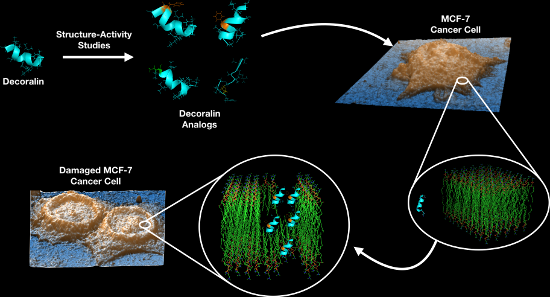

Graphical Abstract

Figure 1: Helical wheel projections of Dec-NH2 and its analogs, where the yellow circles refer to the hydroph...

Figure 2: MTT assays using Dec-NH2 and its synthetic analogs after 2 and 24 h of exposure to MCF-7 cancer cel...

Figure 3: MTT assays evaluating the toxicity of Dec-NH2 and its derivatives towards MCF-10A normal cells afte...

Figure 4: Cell death analysis using flow cytometry. Dot plot graphs from left to right, show cells treated wi...

Figure 5: Topological images of untreated MCF-7 cells (A) and cells treated for 24 h with 50 μmol L−1 of Dec-...
15N-Labelling and structure determination of adamantylated azolo-azines in solution
- Sergey L. Deev,
- Alexander S. Paramonov,
- Tatyana S. Shestakova,
- Igor A. Khalymbadzha,
- Oleg N. Chupakhin,
- Julia O. Subbotina,
- Oleg S. Eltsov,
- Pavel A. Slepukhin,
- Vladimir L. Rusinov,
- Alexander S. Arseniev and
- Zakhar O. Shenkarev
Beilstein J. Org. Chem. 2017, 13, 2535–2548, doi:10.3762/bjoc.13.250
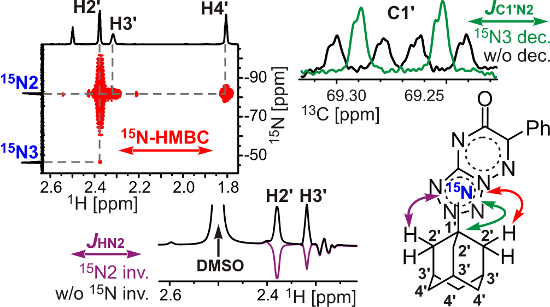

Graphical Abstract

Figure 1: (A) Adamantylated azoles and derivatives of 1,2,4-triazolo[5,1-c][1,2,4]triazine with antiviral act...

Scheme 1: Synthesis and adamantylation of 15N-labelled 13-15N2 and JHN and JCN data confirming the structures...

Scheme 2: Synthesis and adamantylation of 15N-labelled 20-15N2 and JHN and JCN data confirming the structures...

Scheme 3: Synthesis and adamantylation of 15N-labelled 23-15N2 and JHN and JCN data confirming the structure ...

Scheme 4: Isomerization of 15a in the presence of tetrazolo[1,5-b][1,2,4]triazin-7-one 13-15N2 and isotopic e...
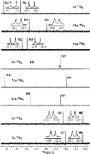
Figure 2: 1D 15N NMR spectra of 30–70 mM 13-15N2, 15a,b-15N2, 20-15N2, 21a,b-15N2, 23-15N2 and 24-15N2 in DMS...

Figure 3: Signals of the C1' and C6 atoms in the proton-decoupled 1D 13C NMR spectra of 30–42 mM 15a,b-15N2, ...
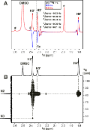
Figure 4: Detection and quantification of the 1H-15N spin–spin interactions in compound 15a-15N2 (DMSO-d6, 45...

Figure 5: ORTEP diagrams of the X-ray structures of compounds 15a-15N2 (a) and 15b-15N2 (b). For clarity, the...

Scheme 5: Mechanism of the isomerization of compounds 15a and 15b.
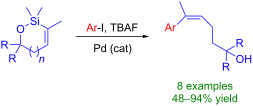
Synthesis of substituted Z-styrenes by Hiyama-type coupling of oxasilacycloalkenes: application to the synthesis of a 1-benzoxocane
- James R. Vyvyan,
- Courtney A. Engles,
- Scott L. Bray,
- Erik D. Wold,
- Christopher L. Porter and
- Mikhail O. Konev
Beilstein J. Org. Chem. 2017, 13, 2122–2127, doi:10.3762/bjoc.13.209

Graphical Abstract

Figure 1: Retrosynthetic analysis of heliannuol A.

Scheme 1: Hydrosilylation of alkynols.

Scheme 2: Hydrogenation of benzoxocane 24.
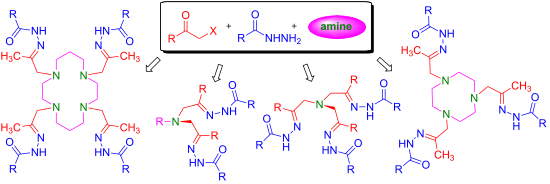
Construction of bis-, tris- and tetrahydrazones by addition of azoalkenes to amines and ammonia
- Artem N. Semakin,
- Aleksandr O. Kokuev,
- Yulia V. Nelyubina,
- Alexey Yu. Sukhorukov,
- Petr A. Zhmurov,
- Sema L. Ioffe and
- Vladimir A. Tartakovsky
Beilstein J. Org. Chem. 2016, 12, 2471–2477, doi:10.3762/bjoc.12.241

Graphical Abstract

Figure 1: Selected examples of polyhydrazones.

Scheme 1: Proposed approach to the synthesis of I.

Scheme 2: Synthesis of α-halogen-substituted hydrazones 1 from α-halocarbonyl compounds and acylhydrazines or...
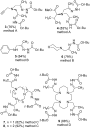
Figure 2: Structures of polyhydrazones 3-9. Methods: A: 1 equiv of amine, 2 equiv of 1a, 2 equiv of K2CO3; B;...

Scheme 3: Synthesis of a mixed triazole-hydrazone ligand 10.

Scheme 4: Cyclisation of 11b into 1,4,6,10-tetraazaadamantane derivative.

Figure 3: General view of 13b in representation of atoms with thermal ellipsoids at 50% probability level; al...
Protonated paramagnetic redox forms of di-o-quinone bridged with p-phenylene-extended TTF: A EPR spectroscopy study
- Nikolay O. Chalkov,
- Vladimir K. Cherkasov,
- Gleb A. Abakumov,
- Andrey G. Starikov and
- Viacheslav A. Kuropatov
Beilstein J. Org. Chem. 2016, 12, 2450–2456, doi:10.3762/bjoc.12.238

Graphical Abstract

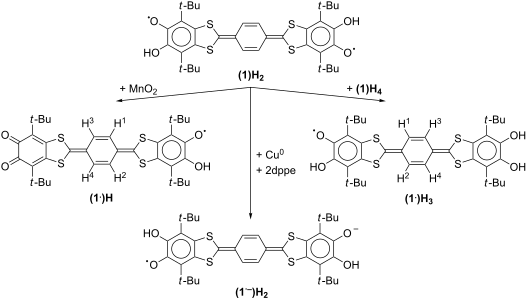
Figure 1: The structural formula of acceptor–donor–acceptor triad 1.

Figure 2: The EPR spectrum of (1·)H in CHCl3, 293 K: a) experimental and b) experimental + D2O.

Scheme 1: Disproportionation of the protonated semiquinones in solution.

Scheme 2: Paramagnetic reduced protonated derivatives of the quinone 2.

Figure 3: The EPR spectrum of (1·)H3 in CHCl3, 293 K: a) experimental, b) simulated, c) experimental + D2O an...

Figure 4: The EPR spectrum of (1·−)H2 THF, 293 K: a) experimental and b) experimental + D2O). Magnified side ...

Figure 5: The well-resolved EPR spectrum of (1·−)H2 in dimethoxyethane (diluted solution), 273 K: a) experime...
Superelectrophilic activation of 5-hydroxymethylfurfural and 2,5-diformylfuran: organic synthesis based on biomass-derived products
- Dmitry S. Ryabukhin,
- Dmitry N. Zakusilo,
- Mikhail O. Kompanets,
- Anton A.Tarakanov,
- Irina A. Boyarskaya,
- Tatiana O. Artamonova,
- Mikhail A. Khohodorkovskiy,
- Iosyp O. Opeida and
- Aleksander V. Vasilyev
Beilstein J. Org. Chem. 2016, 12, 2125–2135, doi:10.3762/bjoc.12.202

Graphical Abstract

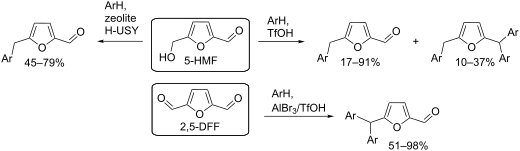
Figure 1: Formation of 5-HMF from D-glucose or D-fructose followed by oxidation to 2,5-DFF.

Scheme 1: Protonation of 5-HMF (1a) and 2,5-DFF (2) leading to cationic species A, B, C, D.

Figure 2: X-ray crystal structure of compounds 5a (a), and 5c (b) (ORTEP diagrams, ellipsoid contour of proba...
Rearrangements of organic peroxides and related processes
- Ivan A. Yaremenko,
- Vera A. Vil’,
- Dmitry V. Demchuk and
- Alexander O. Terent’ev
Beilstein J. Org. Chem. 2016, 12, 1647–1748, doi:10.3762/bjoc.12.162

Graphical Abstract
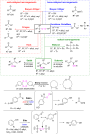
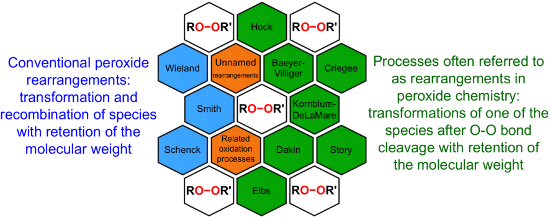
Figure 1: The named transformations considered in this review.

Scheme 1: The Baeyer–Villiger oxidation.

Scheme 2: The general mechanism of the peracid-promoted Baeyer–Villiger oxidation.

Scheme 3: General mechanism of the Lewis acid-catalyzed Baeyer–Villiger rearrangement.

Scheme 4: The theoretically studied mechanism of the BV oxidation reaction promoted by H2O2 and the Lewis aci...

Scheme 5: Proton movements in the transition states of the Baeyer–Villiger oxidation.

Scheme 6: The dependence of the course of the Baeyer–Villiger oxidation on the type of O–O-bond cleavage in t...
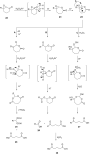
Scheme 7: The acid-catalyzed Baeyer–Villiger oxidation of cyclic epoxy ketones 22.

Scheme 8: Oxidation of isophorone oxide 29.

Scheme 9: Synthesis of acyl phosphate 32 from acyl phosphonate 31.

Scheme 10: Synthesis of aflatoxin B2 (36).

Scheme 11: The Baeyer–Villiger rearrangement of ketones 37 to lactones 38.

Scheme 12: Synthesis of 3,4-dimethoxybenzoic acid (40) via Baeyer–Villiger oxidation.

Scheme 13: Oxone transforms α,β-unsaturated ketones 43 into vinyl acetates 44.

Scheme 14: The Baeyer–Villiger oxidation of ketones 45 using diaryl diselenide and hydrogen peroxide.

Scheme 15: Baeyer–Villiger oxidation of (E)-2-methylenecyclobutanones.

Scheme 16: Oxidation of β-ionone (56) by H2O2/(BnSe)2 with formation of (E)-2-(2,6,6-trimethylcyclohex-1-en-1-...

Scheme 17: The mechanism of oxidation of ketones 58a–f by hydrogen peroxide in the presence of arsonated polys...

Scheme 18: Oxidation of ketone (58b) by H2O2 to 6-methylcaprolactone (59b) catalyzed by Pt complex 66·BF4.

Scheme 19: Oxidation of ketones 67 with H2O2 in the presence of [(dppb}Pt(µ-OH)]22+.

Scheme 20: The mechanism of oxidation of ketones 67 in the presence of [(dppb}Pt(µ-OH)]22+ and H2O2.

Scheme 21: Oxidation of benzaldehydes 69 in the presence of the H2O2/MeReO3 system.

Scheme 22: Oxidation of acetophenones 72 in the presence of the H2O2/MeReO3 system.

Scheme 23: Baeyer–Villiger oxidation of 2-adamantanone (45c) in the presence of Sn-containing mesoporous silic...

Scheme 24: Aerobic Baeyer–Villiger oxidation of ketones 76 using metal-free carbon.

Scheme 25: A regioselective Baeyer-Villiger oxidation of functionalized cyclohexenones 78 into a dihydrooxepin...

Scheme 26: The oxidation of aldehydes and ketones 80 by H2O2 catalyzed by Co4HP2Mo15V3O62.

Scheme 27: The cleavage of ketones 82 with hydrogen peroxide in alkaline solution.

Scheme 28: Oxidation of ketones 85 to esters 86 with H2O2–urea in the presence of KHCO3.

Scheme 29: Mechanism of the asymmetric oxidation of cyclopentane-1,2-dione 87a with the Ti(OiPr)4/(+)DET/t-BuO...

Scheme 30: The oxidation of cis-4-tert-butyl-2-fluorocyclohexanone (93) with m-chloroperbenzoic acid.

Scheme 31: The mechanism of the asymmetric oxidation of 3-substituted cyclobutanone 96a in the presence of chi...

Scheme 32: Enantioselective Baeyer–Villiger oxidation of cyclic ketones 98.

Scheme 33: Regio- and enantioselective Baeyer–Villiger oxidation of cyclic ketones 101.

Scheme 34: The proposed mechanism of the Baeyer–Villiger oxidation of acetal 105f.

Scheme 35: Synthesis of hydroxy-10H-acridin-9-one 117 from tetramethoxyanthracene 114.

Scheme 36: The Baeyer–Villiger oxidation of the fully substituted pyrrole 120.

Scheme 37: The Criegee rearrangement.

Scheme 38: The mechanism of the Criegee reaction of a peracid with a tertiary alcohol 122.

Scheme 39: Criegee rearrangement of decaline ethylperoxoate 127 into ketal 128.

Scheme 40: The ionic cleavage of 2-methoxy-2-propyl perester 129.

Scheme 41: The Criegee rearrangement of α-methoxy hydroperoxide 136.
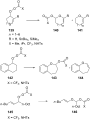
Scheme 42: Synthesis of enol esters and acetals via the Criegee rearrangement.

Scheme 43: Proposed mechanism of the transformation of 1-hydroperoxy-2-oxabicycloalkanones 147a–d.

Scheme 44: Transformation of 3-hydroxy-1,2-dioxolanes 151 into diketone derivatives 152.

Scheme 45: Criegee rearrangement of peroxide 153 with the mono-, di-, and tri-O-insertion.

Scheme 46: The sequential Criegee rearrangements of adamantanes 157a,b.

Scheme 47: Synthesis of diaryl carbonates 160a–d from triarylmethanols 159a–d through successive oxygen insert...

Scheme 48: The synthesis of sesquiterpenes 162 from ketone 161 with a Criegee rearrangement as one key step.

Scheme 49: Synthesis of trans-hydrindan derivatives 164, 165.

Scheme 50: The Hock rearrangement.

Scheme 51: The general scheme of the cumene process.

Scheme 52: The Hock rearrangement of aliphatic hydroperoxides.
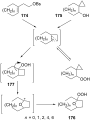
Scheme 53: The mechanism of solvolysis of brosylates 174a–c and spiro cyclopropyl carbinols 175a–c in THF/H2O2....

Scheme 54: The fragmentation mechanism of hydroperoxy acetals 178 to esters 179.

Scheme 55: The acid-catalyzed rearrangement of phenylcyclopentyl hydroperoxide 181.

Scheme 56: The peroxidation of tertiary alcohols in the presence of a catalytic amount of acid.

Scheme 57: The acid-catalyzed reaction of bicyclic secondary alcohols 192 with hydrogen peroxide.

Scheme 58: The photooxidation of 5,6-disubstituted 3,4-dihydro-2H-pyrans 196.

Scheme 59: The oxidation of tertiary alcohols 200a–g, 203a,b, and 206.

Scheme 60: Transformation of functional peroxide 209 leading to 2,3-disubstitued furans 210 in one step.

Scheme 61: The synthesis of carbazoles 213 via peroxide rearrangement.

Scheme 62: The construction of C–N bonds using the Hock rearrangement.

Scheme 63: The synthesis of moiety 218 from 217 which is a structural motif in the antitumor–antibiotic of CC-...

Scheme 64: The in vivo oxidation steps of cholesterol (219) by singlet oxygen.

Scheme 65: The proposed mechanism of the rearrangement of cholesterol-5α-OOH 220.

Scheme 66: Photochemical route to artemisinin via Hock rearrangement of 223.

Scheme 67: The Kornblum–DeLaMare rearrangement.

Scheme 68: Kornblum–DeLaMare transformation of 1-phenylethyl tert-butyl peroxide (225).

Scheme 69: The synthesis 4-hydroxyenones 230 from peroxide 229.

Scheme 70: The Kornblum–DeLaMare rearrangement of peroxide 232.

Scheme 71: The reduction of peroxide 234.

Scheme 72: The Kornblum–DeLaMare rearrangement of endoperoxide 236.

Scheme 73: The rearrangement of peroxide 238 under Kornblum–DeLaMare conditions.

Scheme 74: The proposed mechanism of rearrangement of peroxide 238.

Scheme 75: The Kornblum–DeLaMare rearrangement of peroxides 242a,b.

Scheme 76: The base-catalyzed rearrangements of bicyclic endoperoxides having electron-withdrawing substituent...

Scheme 77: The base-catalyzed rearrangements of bicyclic endoperoxides 249a,b having electron-donating substit...

Scheme 78: The base-catalyzed rearrangements of bridge-head substituted bicyclic endoperoxides 251a,b.

Scheme 79: The Kornblum–DeLaMare rearrangement of hydroperoxide 253.

Scheme 80: Synthesis of β-hydroxy hydroperoxide 254 from endoperoxide 253.

Scheme 81: The amine-catalyzed rearrangement of bicyclic endoperoxide 263.

Scheme 82: The base-catalyzed rearrangement of meso-endoperoxide 268 into 269.

Scheme 83: The photooxidation of 271 and subsequent Kornblum–DeLaMare reaction.

Scheme 84: The Kornblum–DeLaMare rearrangement as one step in the oxidation reaction of enamines.

Scheme 85: The Kornblum–DeLaMare rearrangement of 3,5-dihydro-1,2-dioxenes 284, 1,2-dioxanes 286, and tert-but...

Scheme 86: The Kornblum–DeLaMare rearrangement of epoxy dioxanes 290a–d.

Scheme 87: Rearrangement of prostaglandin H2 292.

Scheme 88: The synthesis of epicoccin G (297).

Scheme 89: The Kornblum–DeLaMare rearrangement used in the synthesis of phomactin A.

Scheme 90: The Kornblum–DeLaMare rearrangement in the synthesis of 3H-quinazolin-4-one 303.

Scheme 91: The Kornblum–DeLaMare rearrangement in the synthesis of dolabriferol (308).

Scheme 92: Sequential transformation of 3-substituted 2-pyridones 309 into 3-hydroxypyridine-2,6-diones 311 in...

Scheme 93: The Kornblum–DeLaMare rearrangement of peroxide 312 into hydroxy enone 313.

Scheme 94: The Kornblum–DeLaMare rearrangement in the synthesis of polyfunctionalized carbonyl compounds 317.

Scheme 95: The Kornblum–DeLaMare rearrangement in the synthesis of (Z)-β-perfluoroalkylenaminones 320.

Scheme 96: The Kornblum–DeLaMare rearrangement in the synthesis of γ-ketoester 322.

Scheme 97: The Kornblum–DeLaMare rearrangement in the synthesis of diterpenoids 326 and 328.

Scheme 98: The synthesis of natural products hainanolidol (331) and harringtonolide (332) from peroxide 329.

Scheme 99: The synthesis of trans-fused butyrolactones 339 and 340.

Scheme 100: The synthesis of leucosceptroid C (343) and leucosceptroid P (344) via the Kornblum–DeLaMare rearra...

Scheme 101: The Dakin oxidation of arylaldehydes or acetophenones.

Scheme 102: The mechanism of the Dakin oxidation.

Scheme 103: A solvent-free Dakin reaction of aromatic aldehydes 356.

Scheme 104: The organocatalytic Dakin oxidation of electron-rich arylaldehydes 358.

Scheme 105: The Dakin oxidation of electron-rich arylaldehydes 361.

Scheme 106: The Dakin oxidation of arylaldehydes 358 in water extract of banana (WEB).

Scheme 107: A one-pot approach towards indolo[2,1-b]quinazolines 364 from indole-3-carbaldehydes 363 through th...

Scheme 108: The synthesis of phenols 367a–c from benzaldehydes 366a-c via acid-catalyzed Dakin oxidation.

Scheme 109: Possible transformation paths of the highly polarized boric acid coordinated H2O2–aldehyde adduct 3...

Scheme 110: The Elbs oxidation of phenols 375 to hydroquinones.

Scheme 111: The mechanism of the Elbs persulfate oxidation of phenols 375 affording p-hydroquinones 376.

Scheme 112: Oxidation of 2-pyridones 380 under Elbs persulfate oxidation conditions.

Scheme 113: Synthesis of 3-hydroxy-4-pyridone (384) via an Elbs oxidation of 4-pyridone (382).

Scheme 114: The Schenck rearrangement.

Scheme 115: The Smith rearrangement.

Scheme 116: Three main pathways of the Schenck rearrangement.

Scheme 117: The isomerization of hydroperoxides 388 and 389.

Scheme 118: Trapping of dioxacyclopentyl radical 392 by oxygen.

Scheme 119: The hypothetical mechanism of the Schenck rearrangement of peroxide 394.

Scheme 120: The autoxidation of oleic acid (397) with the use of labeled isotope 18O2.

Scheme 121: The rearrangement of 18O-labeled hydroperoxide 400 under an atmosphere of 16O2.

Scheme 122: The rearrangement of the oleate-derived allylic hydroperoxides (S)-421 and (R)-425.

Scheme 123: Mechanisms of Schenck and Smith rearrangements.

Scheme 124: The rearrangement and cyclization of 433.

Scheme 125: The Wieland rearrangement.

Scheme 126: The rearrangement of bis(triphenylsilyl) 439 or bis(triphenylgermyl) 441 peroxides.

Scheme 127: The oxidative transformation of cyclic ketones.

Scheme 128: The hydroxylation of cyclohexene (447) in the presence of tungstic acid.

Scheme 129: The oxidation of cyclohexene (447) under the action of hydrogen peroxide.

Scheme 130: The reaction of butenylacetylacetone 455 with hydrogen peroxide.

Scheme 131: The oxidation of bridged 1,2,4,5-tetraoxanes.

Scheme 132: The proposed mechanism for the oxidation of bridged 1,2,4,5-tetraoxanes.

Scheme 133: The rearrangement of ozonides.

Scheme 134: The acid-catalyzed oxidative rearrangement of malondialdehydes 462 under the action of H2O2.

Scheme 135: Pathways of the Lewis acid-catalyzed cleavage of dialkyl peroxides 465 and ozonides 466.

Scheme 136: The mechanism of the transformation of (tert-butyldioxy)cyclohexanedienones 472.

Scheme 137: The synthesis of Vitamin K3 from 472a.

Scheme 138: Proposed mechanism for the transformation of 478d into silylated endoperoxide 479d.

Scheme 139: The rearrangement of hydroperoxide 485 to form diketone 486.

Scheme 140: The base-catalyzed rearrangement of cyclic peroxides 488a–g.

Scheme 141: Synthesis of chiral epoxides and aldols from peroxy hemiketals 491.

Scheme 142: The multistep transformation of (R)-carvone (494) to endoperoxides 496a–e.

Scheme 143: The decomposition of anthracene endoperoxide 499.

Scheme 144: Synthesis of esters 503 from aldehydes 501 via rearrangement of peroxides 502.

Scheme 145: Two possible paths for the base-promoted decomposition of α-azidoperoxides 502.

Scheme 146: The Story decomposition of cyclic diperoxide 506a.

Scheme 147: The Story decomposition of cyclic triperoxide 506b.

Scheme 148: The thermal rearrangement of endoperoxides A into diepoxides B.

Scheme 149: The transformation of peroxide 510 in the synthesis of stemolide (511).

Scheme 150: The possible mechanism of the rearrangement of endoperoxide 261g.

Scheme 151: The photooxidation of indene 517.

Scheme 152: The isomerization of ascaridole (523).

Scheme 153: The isomerization of peroxide 525.

Scheme 154: The thermal transformation of endoperoxide 355.

Scheme 155: The photooxidation of cyclopentadiene (529) at a temperature higher than 0 °C.

Scheme 156: The thermal rearrangement of endoperoxides 538a,b.

Scheme 157: The transformation of peroxides 541.

Scheme 158: The thermal rearrangements of strained cyclic peroxides.

Scheme 159: The thermal rearrangement of diacyl peroxide 551 in the synthesis of C4-epi-lomaiviticin B core 553....

Scheme 160: The 1O2 oxidation of tryptophan (554) and rearrangement of dioxetane intermediate 555.

Scheme 161: The Fe(II)-promoted cleavage of aryl-substituted bicyclic peroxides.

Scheme 162: The proposed mechanism of the Fe(II)-promoted rearrangement of 557a–c.

Scheme 163: The reaction of dioxolane 563 with Fe(II) sulfate.

Scheme 164: Fe(II)-promoted rearrangement of 1,2-dioxane 565.

Scheme 165: Fe(II) cysteinate-promoted rearrangement of 1,2-dioxolane 568.

Scheme 166: The transformation of 1,2-dioxanes 572a–c under the action of FeCl2.

Scheme 167: Fe(II) cysteinate-promoted transformation of tetraoxane 574.

Scheme 168: The CoTPP-catalyzed transformation of bicyclic endoperoxides 600a–d.

Scheme 169: The CoTPP-catalyzed transformation of epoxy-1,2-dioxanes.

Scheme 170: The Ru(II)-catalyzed reactions of 1,4-endoperoxide 261g.

Scheme 171: The Ru(II)-catalyzed transformation as a key step in the synthesis of elyiapyrone A (610) from 1,4-...

Scheme 172: Peroxides with antimalarial activity.

Scheme 173: The interaction of iron ions with artemisinin (616).

Scheme 174: The interaction of FeCl2 with 1,2-dioxanes 623, 624.

Scheme 175: The mechanism of reaction 623 and 624 with Fe(II)Cl2.

Scheme 176: The reaction of bicyclic natural endoperoxides G3-factors 631–633 with FeSO4.

Scheme 177: The transformation of terpene cardamom peroxide 639.
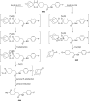
Scheme 178: The different ways of the cleavage of tetraoxane 643.

Scheme 179: The LC–MS analysis of interaction of tetraoxane 646 with iron(II)heme 647.

Scheme 180: The rearrangement of 3,6-epidioxy-1,10-bisaboladiene (EDBD, 649).

Scheme 181: Easily oxidized substrates.

Scheme 182: Biopathway of synthesis of prostaglandins.

Scheme 183: The reduction and rearrangements of isoprostanes.

Scheme 184: The partial mechanism for linoleate 658 oxidation.

Scheme 185: The transformation of lipid hydroperoxide.

Scheme 186: The acid-catalyzed cleavage of the product from free-radical oxidation of cholesterol (667).

Scheme 187: Two pathways of catechols oxidation.

Scheme 188: Criegee-like or Hock-like rearrangement of the intermediate hydroperoxide 675 in dioxygenase enzyme...

Scheme 189: Carotinoides 679 cleavage by carotenoid cleavage dioxygenases.
Strecker degradation of amino acids promoted by a camphor-derived sulfonamide
- M. Fernanda N. N. Carvalho,
- M. João Ferreira,
- Ana S. O. Knittel,
- Maria da Conceição Oliveira,
- João Costa Pessoa,
- Rudolf Herrmann and
- Gabriele Wagner
Beilstein J. Org. Chem. 2016, 12, 732–744, doi:10.3762/bjoc.12.73
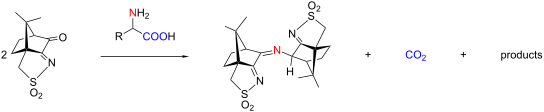

Graphical Abstract

Figure 1: Camphor and some camphor derivatives.

Scheme 1: Formation of 2 from reaction of oxoimine 1 with amino acids (H2NCH(R)COOH: R = H, CH3, CH2Ph, CH2CH...

Figure 2: ESI mass spectrum of 2 (positive ion mode).

Figure 3: 1H NMR spectrum of 2 in CD3CN at T = −20 °C.

Figure 4: 13C NMR spectrum of 2 in CD3CN at T = −20 °C.

Figure 5: Optimized structure of 2 ((S)-3A isomer) with labeling scheme.

Figure 6: NOESY spectrum (detail) showing the cross peak between H3A and H10A (see Supporting Information File 1, Figure S6 for the full s...
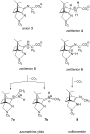
Figure 7: Upper row: anion 3 and zwitterion 4 which are stable upon geometry optimization. Middle row: zwitte...

Figure 8: Intramolecular reactions of non-zwitterionic ground state 6g to 11 (top) or 8 (bottom). The activat...

Figure 9: Transition-state geometry and salient bond distances along the IRC path for the reaction of 6g → 11...

Figure 10: Transition-state geometry and salient bond distances along the IRC path for the reaction of 6g → 8....
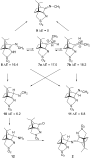
Figure 11: Potential products 7–11 of the Strecker degradation together with the reaction of compound 10 to gi...

Figure 12: ESI(+) tandem mass spectrum of the intermediate 12 (m/z 229) and proposed fragment ions.
2-Hetaryl-1,3-tropolones based on five-membered nitrogen heterocycles: synthesis, structure and properties
- Yury A. Sayapin,
- Inna O. Tupaeva,
- Alexandra A. Kolodina,
- Eugeny A. Gusakov,
- Vitaly N. Komissarov,
- Igor V. Dorogan,
- Nadezhda I. Makarova,
- Anatoly V. Metelitsa,
- Valery V. Tkachev,
- Sergey M. Aldoshin and
- Vladimir I. Minkin
Beilstein J. Org. Chem. 2015, 11, 2179–2188, doi:10.3762/bjoc.11.236
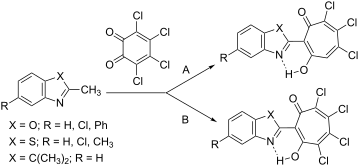

Graphical Abstract

Scheme 1: 1,3-Tropolones 2–4 prepared by the reaction of o-chloranil with methylene active compounds.

Scheme 2: General scheme of the synthesis of 2-(2-hetaryl)-5,6,7-trichloro-1,3-tropolones 5 and 2-(2-hetaryl)...

Scheme 3: The mechanism for the formation of 5,6,7-trichloro-1,3-tropolones 5 and 4,5,6,7-tetrachloro-1,3-tro...

Figure 1: Molecular structure of 2-(3,3-dimethylindolyl)-5,6,7-trichloro-1,3-tropolone 5g. Thermal ellipsoids...

Figure 2: Molecular structure of 2-(5-chlorobenzothiazolyl)-4,5,6,7-tetrachloro-1,3-tropolone 6e. Thermal ell...

Scheme 4:
The fast prototropic N–H···O ![[Graphic 3]](/bjoc/content/inline/1860-5397-11-236-i8.png?max-width=637&scale=1.18182) N···H–O equilibrium in solutions of 2-hetaryl-5,6,7-trichloro- and 4,...
N···H–O equilibrium in solutions of 2-hetaryl-5,6,7-trichloro- and 4,...

Scheme 5: Two reaction paths for coupling 2-hetaryl-1,3-tropolones 5 and 6 with alcohols.

Figure 3: Molecular structure of 2-(3,3-dimethylindolyl)-5,7-dichloro-6-ethoxy-1,3-tropolone 13. Selected bon...

Figure 4: Molecular structure of 2-(2-ethoxycarbonyl-6-hydroxy-3,4,5-trichlorophenyl)benzoxazole 11b. Selecte...

Figure 5: Electronic absorption (1, 2), fluorescence emission (λexc = 350 nm) (3, 4) and fluorescence excitat...
Advances in the synthesis of functionalised pyrrolotetrathiafulvalenes
- Luke J. O’Driscoll,
- Sissel S. Andersen,
- Marta V. Solano,
- Dan Bendixen,
- Morten Jensen,
- Troels Duedal,
- Jess Lycoops,
- Cornelia van der Pol,
- Rebecca E. Sørensen,
- Karina R. Larsen,
- Kenneth Myntman,
- Christian Henriksen,
- Stinne W. Hansen and
- Jan O. Jeppesen
Beilstein J. Org. Chem. 2015, 11, 1112–1122, doi:10.3762/bjoc.11.125
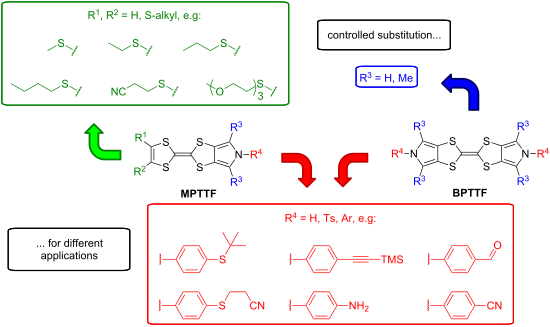

Graphical Abstract

Figure 1: The sequential, reversible oxidation of TTF (1) to its stable radical cation (2) and dication (3) s...

Figure 2: Structures and possible substitution positions of MPTTFs (4) and BPTTFs (5).

Scheme 1: Large-scale synthesis of 6. Reagents and conditions: a) PhMe, reflux, 19 h, 74%; b) LiBr, NaBH4, TH...

Scheme 2: Preparation of 7. Reagents and conditions: a) TsCl, Et3N, DMAP, MeCN, rt → reflux, 3.5 h, 82%; b) (...

Scheme 3: Homo and cross-coupling reactions of 6 or 7 afford BPTTFs and MPTTFs, respectively. Reagents and co...

Scheme 4: Deprotection and methylation of cyanoethyl-protected thiol moieties on MPTTFs as reported by Jeppes...

Scheme 5: Deprotection and alkylation of cyanoethyl-protected thiol moieties on MPTTFs using CsOH·H2O or DBU....

Scheme 6: Deprotection and N-arylation of tosylated MPTTFs. Reagents and conditions: a) NaOMe, THF, MeOH, ref...

Scheme 7: Deprotection and N,N-diarylation of tosylated BPTTFs. Reagents and conditions: a) NaOMe, THF, MeOH,...
2-(1-Hydroxypropyn-2-yl)-1-vinylpyrroles: the first successful Favorsky ethynylation of pyrrolecarbaldehydes
- A. V. Ivanov,
- V. S. Shcherbakova,
- I. A. Ushakov,
- L. N. Sobenina,
- O. V. Petrova,
- A. I. Mikhaleva and
- B. A. Trofimov
Beilstein J. Org. Chem. 2015, 11, 228–232, doi:10.3762/bjoc.11.25
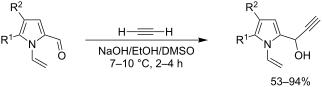

Graphical Abstract

Scheme 1: The reaction of pyrrole-2-carbaldehyde with acetylene.

Scheme 2: Synthesis of 2-phenyl-5-[1-(5-phenyl-1H-pyrrol-2-yl)-2-propynyl]-1-vinylpyrrole (3).
Cross-dehydrogenative coupling for the intermolecular C–O bond formation
- Igor B. Krylov,
- Vera A. Vil’ and
- Alexander O. Terent’ev
Beilstein J. Org. Chem. 2015, 11, 92–146, doi:10.3762/bjoc.11.13
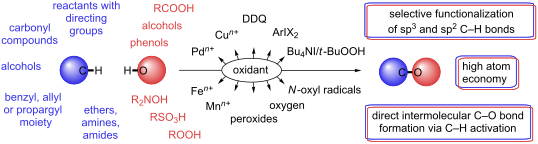

Graphical Abstract

Scheme 1: Cross-dehydrogenative coupling.

Scheme 2: Cross-dehydrogenative C–O coupling.

Scheme 3: Regioselective ortho-acetoxylation of meta-substituted arylpyridines and N-arylamides.

Scheme 4: ortho-Acyloxylation and alkoxylation of arenes directed by pyrimidine, benzoxazole, benzimidazole a...

Scheme 5: Cu(OAc)2/AgOTf/O2 oxidative system in the ortho-alkoxylation of arenes.
Scheme 6: Pd(OAc)2/persulfate oxidative system in the ortho-alkoxylation and acetoxylation of arenes with nit...
Scheme 7: ortho-Acetoxylation and methoxylation of O-methyl aryl oximes, N-phenylpyrrolidin-2-one, and (3-ben...

Scheme 8: Ruthenium-catalyzed ortho-acyloxylation of acetanilides.

Scheme 9: Acetoxylation and alkoxylation of arenes with amide directing group using Pd(OAc)2/PhI(OAc)2 oxidat...

Scheme 10: Alkoxylation of azoarenes, 2-aryloxypyridines, picolinamides, and N-(1-methyl-1-(pyridin-2-yl)ethyl...

Scheme 11: Acetoxylation of compounds containing picolinamide and quinoline-8-amine moieties using the Pd(OAc)2...

Scheme 12: (CuOH)2CO3 catalyzed oxidative ortho-etherification using air as oxidant.

Scheme 13: Copper-catalyzed aerobic alkoxylation and aryloxylation of arenes containing pyridine-N-oxide moiet...

Scheme 14: Cobalt-catalyzed aerobic alkoxylation of arenes and alkenes containing pyridine N-oxide moiety.

Scheme 15: Non-symmetric double-fold C–H ortho-acyloxylation.

Scheme 16: N-nitroso directed ortho-alkoxylation of arenes.

Scheme 17: Selective alkoxylation and acetoxylation of alkyl groups.

Scheme 18: Acetoxylation of 2-alkylpyridines and related compounds.

Scheme 19: Acyloxylation and alkoxylation of alkyl fragments of substrates containing amide or sulfoximine dir...

Scheme 20: Palladium-catalyzed double sp3 C–H alkoxylation of N-(quinolin-8-yl)amides for the synthesis of sym...

Scheme 21: Copper-catalyzed acyloxylation of methyl groups of N-(quinolin-8-yl)amides.

Scheme 22: One-pot acylation and sp3 C–H acetoxylation of oximes.

Scheme 23: Possible mechanism of oxidative esterification catalyzed by N-heterocyclic nucleophilic carbene.

Scheme 24: Oxidative esterification employing stoichiometric amounts of aldehydes and alcohols.

Scheme 25: Selective oxidative coupling of aldehydes with alcohols in the presence of amines.

Scheme 26: Iodine mediated oxidative esterification.

Scheme 27: Oxidative C–O coupling of benzyl alcohols with methylarenes under the action of Bu4NI/t-BuOOH syste...

Scheme 28: Oxidative coupling of methyl- and ethylarenes with aromatic aldehydes under the action of Bu4NI/t-B...

Scheme 29: Cross-dehydrogenative C–O coupling of aldehydes with t-BuOOH in the presence of Bu4NI.

Scheme 30: Bu4NI-catalyzed α-acyloxylation reaction of ethers and ketones with aldehydes and t-BuOOH.

Scheme 31: Oxidative coupling of aldehydes with N-hydroxyimides and hexafluoroisopropanol.

Scheme 32: Oxidative coupling of alcohols with N-hydroxyimides.

Scheme 33: Oxidative coupling of aldehydes and primary alcohols with N-hydroxyimides using (diacetoxyiodo)benz...

Scheme 34: Proposed mechanism of the oxidative coupling of aldehydes and N-hydroxysuccinimide under action of ...

Scheme 35: Oxidative coupling of aldehydes with pivalic acid (172).

Scheme 36: Oxidative C–O coupling of aldehydes with alkylarenes using the Cu(OAc)2/t-BuOOH system.

Scheme 37: Copper-catalyzed acyloxylation of C(sp3)-H bond adjacent to oxygen in ethers using benzyl alcohols.

Scheme 38: Oxidative C–O coupling of aromatic aldehydes with cycloalkanes.

Scheme 39: Ruthenium catalyzed cross-dehydrogenative coupling of primary and secondary alcohols.

Scheme 40: Cross-dehydrogenative C–O coupling reactions of β-dicarbonyl compounds with sulfonic acids, acetic ...

Scheme 41: Acyloxylation of ketones, aldehydes and β-dicarbonyl compounds using carboxylic acids and Bu4NI/t-B...

Scheme 42: Acyloxylation of ketones using Bu4NI/t-BuOOH system.

Scheme 43: Cross-dehydrogenative C–O coupling of β-dicarbonyl compounds and their heteroanalogues with N-hydro...

Scheme 44: Cross-dehydrogenative C–O coupling of β-dicarbonyl compounds and their heteroanalogues with t-BuOOH....

Scheme 45: Oxidative C–O coupling of 2,6-dialkylphenyl-β-keto esters and thioesters with tert-butyl hydroxycar...

Scheme 46: α’-Acyloxylation of α,β-unsaturated ketones using KMnO4.

Scheme 47: Possible mechanisms of the acetoxylation at the allylic position of alkenes by Pd(OAc)2.

Scheme 48: Products of the oxidation of terminal alkenes by Pd(II)/AcOH/oxidant system.

Scheme 49: Acyloxylation of terminal alkenes with carboxylic acids.

Scheme 50: Synthesis of linear E-allyl esters by cross-dehydrogenative coupling of terminal alkenes wih carbox...

Scheme 51: Pd(OAc)2-catalyzed acetoxylation of Z-vinyl(triethylsilanes).

Scheme 52: α’-Acetoxylation of α-acetoxyalkenes with copper(II) chloride in acetic acid.

Scheme 53: Oxidative acyloxylation at the allylic position of alkenes and at the benzylic position of alkylare...

Scheme 54: Copper-catalyzed alkoxylation of methylheterocyclic compounds using di-tert-butylperoxide as oxidan...

Scheme 55: Oxidative C–O coupling of methylarenes with β-dicarbonyl compounds or phenols.

Scheme 56: Copper-catalyzed esterification of methylbenzenes with cyclic ethers and cycloalkanes.

Scheme 57: Oxidative C–O coupling of carboxylic acids with toluene catalyzed by Pd(OAc)2.

Scheme 58: Oxidative acyloxylation at the allylic position of alkenes with carboxylic acids using the Bu4NI/t-...

Scheme 59: Cross-dehydrogenative C–O coupling of carboxylic acids with alkylarenes using the Bu4NI/t-BuOOH sys...

Scheme 60: Oxidative C–O cross-coupling of methylarenes with ethyl or isopropylarenes.

Scheme 61: Phosphorylation of benzyl C–H bonds using the Bu4NI/t-BuOOH oxidative system.

Scheme 62: Selective C–H acetoxylation of 2,3-disubstituted indoles.

Scheme 63: Acetoxylation of benzylic position of alkylarenes using DDQ as oxidant.

Scheme 64: C–H acyloxylation of diarylmethanes, 3-phenyl-2-propen-1-yl acetate and dimethoxyarene using DDQ.

Scheme 65: Cross-dehydrogenative C–O coupling of 1,3-diarylpropylenes and 1,3-diarylpropynes with alcohols.

Scheme 66: One-pot azidation and C–H acyloxylation of 3-chloro-1-arylpropynes.

Scheme 67: Cross-dehydrogenative C–O coupling of 1,3-diarylpropylenes, (E)-1-phenyl-2-isopropylethylene and is...

Scheme 68: Cross-dehydrogenative C–O coupling of alkylarenes and related compounds with N-hydroxyphthalimide.

Scheme 69: Acetoxylation at the benzylic position of alkylarenes mediated by N-hydroxyphthalimide.

Scheme 70: C–O coupling of methylarenes with aromatic carboxylic acids employing the NaBrO3/NaHSO3 system.

Scheme 71: tert-Butyl peroxidation of allyl, propargyl and benzyl ethers catalyzed by Fe(acac)3.

Scheme 72: Cross-dehydrogenative C–O coupling of ethers with carboxylic acids mediated by Bu4NI/t-BuOOH system....

Scheme 73: Oxidative acyloxylation of dimethylamides and dioxane with 2-aryl-2-oxoacetic acids accompanied by ...

Scheme 74: tert-Butyl peroxidation of N-benzylamides and N-allylbenzamide using the Bu4NI/t-BuOOH system.

Scheme 75: Cross-dehydrogenative C–O coupling of aromatic carboxylic acids with ethers using Fe(acac)3 as cata...

Scheme 76: Cross-dehydrogenative C–O coupling of cyclic ethers with 2-hydroxybenzaldehydes using iron carbonyl...
Scheme 77: Cross-dehydrogenative C–O coupling of ethers with β-dicarbonyl compounds and phenols using copper c...

Scheme 78: Cross-dehydrogenative C–O coupling of 2-hydroxybenzaldehyde with dioxane catalyzed by Cu2(BPDC)2(BP...

Scheme 79: Ruthenium chloride-catalyzed acyloxylation of β-lactams.

Scheme 80: Ruthenium-catalyzed tert-butyl peroxydation amides and acetoxylation of β-lactams.

Scheme 81: PhI(OAc)2-mediated α,β-diacetoxylation of tertiary amines.

Scheme 82: Electrochemical oxidative methoxylation of tertiary amines.

Scheme 83: Cross-dehydrogenative C–O coupling of ketene dithioacetals with carboxylic acids in the presence of...

Scheme 84: Cross-dehydrogenative C–O coupling of enamides with carboxylic acids using iodosobenzene as oxidant....

Scheme 85: Oxidative alkoxylation, acetoxylation, and tosyloxylation of acylanilides using PhI(O(O)CCF3)2 in t...

Scheme 86: Proposed mechanism of the oxidative C–O coupling of actetanilide with O-nucleophiles in the presenc...

Scheme 87: Three-component coupling of aldehydes, anilines and alcohols involving oxidative intermolecular C–O...

Scheme 88: Oxidative coupling of phenols with alcohols.

Scheme 89: 2-Acyloxylation of quinoline N-oxides with arylaldehydes in the presence of the CuOTf/t-BuOOH syste...

Scheme 90: Cross-dehydrogenative C–O coupling of azoles with primary alcohols.

Scheme 91: Oxidation of dipyrroles to dipyrrins and subsequent oxidative alkoxylation in the presence of Na3Co...

Scheme 92: Oxidative dehydrogenative carboxylation of alkanes and cycloalkanes to allylic esters.

Scheme 93: Pd-catalyzed acetoxylation of benzene.
The unexpected influence of aryl substituents in N-aryl-3-oxobutanamides on the behavior of their multicomponent reactions with 5-amino-3-methylisoxazole and salicylaldehyde
- Volodymyr V. Tkachenko,
- Elena A. Muravyova,
- Sergey M. Desenko,
- Oleg V. Shishkin,
- Svetlana V. Shishkina,
- Dmytro O. Sysoiev,
- Thomas J. J. Müller and
- Valentin A. Chebanov
Beilstein J. Org. Chem. 2014, 10, 3019–3030, doi:10.3762/bjoc.10.320
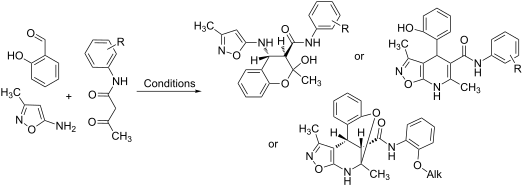

Graphical Abstract

Scheme 1: Some three-component reactions involving N-aryl-3-oxobutanamides.

Scheme 2: Some Biginelli-type three-component condensations with salicylaldehyde.

Scheme 3: Three-component heterocyclization of 5-amino-3-methylisoxazole (1), salicylaldehyde (2) and N-(2-me...

Figure 1: The possible structure of an intermediate complex in reactions forming the heterocycles 6.

Scheme 4: Possible pathways for the three-component reaction of 5-amino-3-methylisoxazole (1), salicylaldehyd...

Figure 2: Alternative structures 5a and 5'a for dihydroisoxazolopyridine 5a and selected NOESY correlations.

Figure 3: Alternative structures 6a, 6'a and 6''a for compound 6a.

Figure 4: Selected data from NOESY experiments and relative stereochemistry of stereogenic centers at positio...
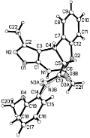
Figure 5: Molecular structure of compound 6a according to X-ray diffraction data.
4-Hydroxy-6-alkyl-2-pyrones as nucleophilic coupling partners in Mitsunobu reactions and oxa-Michael additions
- Michael J. Burns,
- Thomas O. Ronson,
- Richard J. K. Taylor and
- Ian J. S. Fairlamb
Beilstein J. Org. Chem. 2014, 10, 1159–1165, doi:10.3762/bjoc.10.116


Graphical Abstract

Figure 1: The phacelocarpus 2-pyrones 1 and 2.

Scheme 1: Generalised O-functionalisation of 6-alkyl-4-hydroxy-2-pyrones 3.

Scheme 2: Synthesis of alkylated 2-pyrones 3b–e.

Scheme 3: Michael addition of 3a to allene 8 and internal alkyne 10.
Domino reactions of 2H-azirines with acylketenes from furan-2,3-diones: Competition between the formation of ortho-fused and bridged heterocyclic systems
- Alexander F. Khlebnikov,
- Mikhail S. Novikov,
- Viktoriia V. Pakalnis,
- Roman O. Iakovenko and
- Dmitry S. Yufit
Beilstein J. Org. Chem. 2014, 10, 784–793, doi:10.3762/bjoc.10.74


Graphical Abstract

Scheme 1: Reactions of furan-2,3-diones 1 and azirines 2.

Figure 1: Molecular structures of compounds 3а, 4b.

Scheme 2: The route of formation of compounds 3 and possible intermediates in route to compounds 4 and 5.

Figure 2: Energy profiles for the reactions of azirines 2a,c and acylketene 6a, as well as acylketene 6a with...

Scheme 3: Possible intermediates in routes to compounds 4 and 5.

Figure 3: Energy profiles for the reactions of dihydropyrazine 11a with acylketene 6a, as well as acylketene ...

Figure 4: Energy profiles for the reactions of azirines 2a,c with protonated azirines 14a,c. Relative free en...

Scheme 4: Isodesmic equation for evaluation of relative basicity of azirines 2c,a.

Scheme 5: Reaction of furandione 1a with azirine 2d.

Figure 5: Molecular structure of compound 17.

Scheme 6: Reaction of furandione 1d with azirine 2a.

Scheme 7: Reactions of compounds 3d and 18a with methanol.
Synthesis and biological activity of N-substituted-tetrahydro-γ-carbolines containing peptide residues
- Nadezhda V. Sokolova,
- Valentine G. Nenajdenko,
- Vladimir B. Sokolov,
- Daria V. Vinogradova,
- Elena F. Shevtsova,
- Ludmila G. Dubova and
- Sergey O. Bachurin
Beilstein J. Org. Chem. 2014, 10, 155–162, doi:10.3762/bjoc.10.13
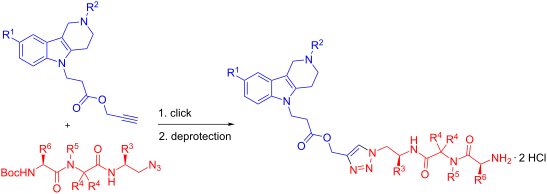

Graphical Abstract

Figure 1: Structures of dimebon and SS peptides.

Scheme 1: Synthesis of starting N-substituted tetrahydro-γ-carbolines 3a–d.

Scheme 2: Synthesis of peptides 5 through the Ugi reaction.
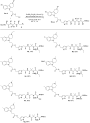
Scheme 3: Synthesis of N-substituted tetrahydro-γ-carbolines containing protected peptide residues.
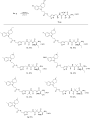
Scheme 4: Synthesis of dihydrochloride salts 7a–g.
Synthesis of five- and six-membered cyclic organic peroxides: Key transformations into peroxide ring-retaining products
- Alexander O. Terent'ev,
- Dmitry A. Borisov,
- Vera A. Vil’ and
- Valery M. Dembitsky
Beilstein J. Org. Chem. 2014, 10, 34–114, doi:10.3762/bjoc.10.6
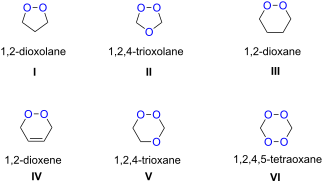

Graphical Abstract

Figure 1: Five and six-membered cyclic peroxides.

Figure 2: Artemisinin and semi-synthetic derivatives.

Scheme 1: Synthesis of 3-hydroxy-1,2-dioxolanes 3a–c.

Scheme 2: Synthesis of dioxolane 6.

Scheme 3: Photooxygenation of oxazolidines 7a–d with formation of spiro-fused oxazolidine-containing dioxolan...

Scheme 4: Oxidation of cyclopropanes 10a–e and 11a–e with preparation of 1,2-dioxolanes 12a–e.

Scheme 5: VO(acac)2-catalyzed oxidation of silylated bicycloalkanols 13a–c.

Scheme 6: Mn(II)-catalyzed oxidation of cyclopropanols 15a–g.

Scheme 7: Oxidation of aminocyclopropanes 20a–c.

Scheme 8: Synthesis of aminodioxolanes 24.
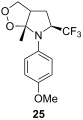
Figure 3: Trifluoromethyl-containing dioxolane 25.

Scheme 9: Synthesis of 1,2-dioxolanes 27a–e by the oxidation of cyclopropanes 26a–e.

Scheme 10: Photoinduced oxidation of methylenecyclopropanes 28.

Scheme 11: Irradiation-mediated oxidation.

Scheme 12: Application of diazene 34 for dioxolane synthesis.

Scheme 13: Mn(OAc)3-catalyzed cooxidation of arylacetylenes 37a–h and acetylacetone with atmospheric oxygen.
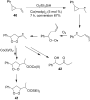
Scheme 14: Peroxidation of (2-vinylcyclopropyl)benzene (40).

Scheme 15: Peroxidation of 1,4-dienes 43a,b.

Scheme 16: Peroxidation of 1,5-dienes 46.

Scheme 17: Peroxidation of oxetanes 53a,b.

Scheme 18: Peroxidation of 1,6-diene 56.

Scheme 19: Synthesis of 3-alkoxy-1,2-dioxolanes 62a,b.

Scheme 20: Synthesis of spiro-bis(1,2-dioxolane) 66.

Scheme 21: Synthesis of dispiro-1,2-dioxolanes 68, 70, 71.

Scheme 22: Synthesis of spirohydroperoxydioxolanes 75a,b.

Scheme 23: Synthesis of spirohydroperoxydioxolane 77 and dihydroperoxydioxolane 79.

Scheme 24: Ozonolysis of azepino[4,5-b]indole 80.

Scheme 25: SnCl4-mediated fragmentation of ozonides 84a–l in the presence of allyltrimethylsilane.

Scheme 26: SnCl4-mediated fragmentation of bicyclic ozonide 84m in the presence of allyltrimethylsilane.

Scheme 27: MCl4-mediated fragmentation of alkoxyhydroperoxides 96 in the presence of allyltrimethylsilane.

Scheme 28: SnCl4-catalyzed reaction of monotriethylsilylperoxyacetal 108 with alkene 109.

Scheme 29: SnCl4-catalyzed reaction of triethylsilylperoxyacetals 111 with alkenes.

Scheme 30: Desilylation of tert-butyldimethylsilylperoxy ketones 131a,b followed by cyclization.

Scheme 31: Deprotection of peroxide 133 followed by cyclization.

Scheme 32: Asymmetric peroxidation of methyl vinyl ketones 137a–e.

Scheme 33: Et2NH-catalyzed intramolecular cyclization.

Scheme 34: Synthesis of oxodioxolanes 143a–j.

Scheme 35: Haloperoxidation accompanied by intramolecular ring closure.

Scheme 36: Oxidation of triterpenes 149a–d with Na2Cr2O7/N-hydroxysuccinimide.

Scheme 37: Curtius and Wolff rearrangements to form 1,2-dioxolane ring-retaining products.

Scheme 38: Oxidative desilylation of peroxide 124.

Scheme 39: Synthesis of dioxolane 158, a compound containing the aminoquinoline antimalarial pharmacophore.

Scheme 40: Diastereomers of plakinic acid A, 162a and 162b.

Scheme 41: Ozonolysis of alkenes.

Scheme 42: Cross-ozonolysis of alkenes 166 with carbonyl compounds.

Scheme 43: Ozonolysis of the bicyclic cyclohexenone 168.

Scheme 44: Cross-ozonolysis of enol ethers 172a,b with cyclohexanone.

Scheme 45: Griesbaum co-ozonolysis.

Scheme 46: Reactions of aryloxiranes 177a,b with oxygen.

Scheme 47: Intramolecular formation of 1,2,4-trioxolane 180.

Scheme 48: Formation of 1,2,4-trioxolane 180 by the reaction of 1,5-ketoacetal 181 with H2O2.

Scheme 49: 1,2,4-Trioxolane 186 with tetrazole fragment.

Scheme 50: 1,2,4-Trioxolane 188 with a pyridine fragment.

Scheme 51: 1,2,4-Trioxolane 189 with pyrimidine fragment.

Scheme 52: Synthesis of aminoquinoline-containing 1,2,4-trioxalane 191.

Scheme 53: Synthesis of arterolane.

Scheme 54: Oxidation of diarylheptadienes 197a–c with singlet oxygen.

Scheme 55: Synthesis of hexacyclinol peroxide 200.

Scheme 56: Oxidation of enone 201 and enenitrile 203 with singlet oxygen.

Scheme 57: Synthesis of 1,2-dioxanes 207 by oxidative coupling of carbonyl compounds 206 and alkenes 205.

Scheme 58: 1,2-Dioxanes 209 synthesis by co-oxidation of 1,5-dienes 208 and thiols.

Scheme 59: Synthesis of bicyclic 1,2-dioxanes 212 with aryl substituents.

Scheme 60: Isayama–Mukaiyama peroxysilylation of 1,5-dienes 213 followed by desilylation under acidic conditio...

Scheme 61: Synthesis of bicycle 218 with an 1,2-dioxane ring.

Scheme 62: Intramolecular cyclization with an oxirane-ring opening.

Scheme 63: Inramolecular cyclization with the oxetane-ring opening.

Scheme 64: Intramolecular cyclization with the attack on a keto group.

Scheme 65: Peroxidation of the carbonyl group in unsaturated ketones 228 followed by cyclization of hydroperox...

Scheme 66: CsOH and Et2NH-catalyzed cyclization.

Scheme 67: Preparation of peroxyplakoric acid methyl ethers A and D.

Scheme 68: Hg(OAc)2 in 1,2-dioxane synthesis.

Scheme 69: Reaction of 1,4-diketones 242 with hydrogen peroxide.

Scheme 70: Inramolecular cyclization with oxetane-ring opening.

Scheme 71: Inramolecular cyclization with MsO fragment substitution.

Scheme 72: Synthesis of 1,2-dioxane 255a, a structurally similar compound to natural peroxyplakoric acids.

Scheme 73: Synthesis of 1,2-dioxanes based on the intramolecular cyclization of hydroperoxides containing C=C ...

Scheme 74: Use of BCIH in the intramolecular cyclization.

Scheme 75: Palladium-catalyzed cyclization of δ-unsaturated hydroperoxides 271a–e.

Scheme 76: Intramolecular cyclization of unsaturated peroxyacetals 273a–d.

Scheme 77: Allyltrimethylsilane in the synthesis of 1,2-dioxanes 276a–d.

Scheme 78: Intramolecular cyclization using the electrophilic center of the peroxycarbenium ion 279.

Scheme 79: Synthesis of bicyclic 1,2-dioxanes.

Scheme 80: Preparation of 1,2-dioxane 286.

Scheme 81: Di(tert-butyl)peroxalate-initiated radical cyclization of unsaturated hydroperoxide 287.

Scheme 82: Oxidation of 1,4-betaines 291a–d.

Scheme 83: Synthesis of aminoquinoline-containing 1,2-dioxane 294.

Scheme 84: Synthesis of the sulfonyl-containing 1,2-dioxane.

Scheme 85: Synthesis of the amido-containing 1,2-dioxane 301.

Scheme 86: Reaction of singlet oxygen with the 1,3-diene system 302.

Scheme 87: Synthesis of (+)-premnalane А and 8-epi-premnalane A.

Scheme 88: Synthesis of the diazo group containing 1,2-dioxenes 309a–e.

Figure 4: Plakortolide Е.

Scheme 89: Synthesis of 6-epiplakortolide Е.

Scheme 90: Application of Bu3SnH for the preparation of tetrahydrofuran-containing bicyclic peroxides 318a,b.

Scheme 91: Application of Bu3SnH for the preparation of lactone-containing bicyclic peroxides 320a–f.

Scheme 92: Dihydroxylation of the double bond in the 1,2-dioxene ring 321 with OsO4.

Scheme 93: Epoxidation of 1,2-dioxenes 324.

Scheme 94: Cyclopropanation of the double bond in endoperoxides 327.

Scheme 95: Preparation of pyridazine-containing bicyclic endoperoxides 334a–c.

Scheme 96: Synthesis of 1,2,4-trioxanes 337 by the hydroperoxidation of unsaturated alcohols 335 with 1O2 and ...

Scheme 97: Synthesis of sulfur-containing 1,2,4-trioxanes 339.

Scheme 98: BF3·Et2O-catalyzed synthesis of the 1,2,4-trioxanes 342a–g.

Scheme 99: Photooxidation of enol ethers or vinyl sulfides 343.

Scheme 100: Synthesis of tricyclic peroxide 346.

Scheme 101: Reaction of endoperoxides 348a,b derived from cyclohexadienes 347a,b with 1,4-cyclohexanedione.

Scheme 102: [4 + 2]-Cycloaddition of singlet oxygen to 2Н-pyrans 350.

Scheme 103: Synthesis of 1,2,4-trioxanes 354 using peroxysilylation stage.

Scheme 104: Epoxide-ring opening in 355 with H2O2 followed by the condensation of hydroxy hydroperoxides 356 wi...

Scheme 105: Peroxidation of unsaturated ketones 358 with the H2O2/CF3COOH/H2SO4 system.

Scheme 106: Synthesis of 1,2,4-trioxanes 362 through Et2NH-catalyzed intramolecular cyclization.

Scheme 107: Reduction of the double bond in tricyclic peroxides 363.

Scheme 108: Horner–Wadsworth–Emmons reaction in the presence of peroxide group.

Scheme 109: Reduction of ester group by LiBH4 in the presence of 1,2,4-trioxane moiety.

Scheme 110: Reductive amination of keto-containing 1,2,4-trioxane 370.

Scheme 111: Reductive amination of keto-containing 1,2,4-trioxane and a Fe-containing moiety.

Scheme 112: Acid-catalyzed reactions of Н2О2 with ketones and aldehydes 374.

Scheme 113: Cyclocondensation of carbonyl compounds 376a–d using Me3SiOOSiMe3/CF3SO3SiMe3.

Scheme 114: Peroxidation of 4-methylcyclohexanone (378).

Scheme 115: Synthesis of symmetrical tetraoxanes 382a,b from aldehydes 381a,b.

Scheme 116: Synthesis of unsymmetrical tetraoxanes using of MeReO3.

Scheme 117: Synthesis of symmetrical tetraoxanes using of MeReO3.

Scheme 118: Synthesis of symmetrical tetraoxanes using of MeReO3.

Scheme 119: MeReO3 in the synthesis of symmetrical tetraoxanes with the use of aldehydes.

Scheme 120: Preparation of unsymmmetrical 1,2,4,5-tetraoxanes with high antimalarial activity.

Scheme 121: Re2O7-Catalyzed synthesis of tetraoxanes 398.

Scheme 122: H2SO4-Catalyzed synthesis of steroidal tetraoxanes 401.

Scheme 123: HBF4-Catalyzed condensation of bishydroperoxide 402 with 1,4-cyclohexanedione.

Scheme 124: BF3·Et2O-Catalyzed reaction of gem-bishydroperoxides 404 with enol ethers 405 and acetals 406.

Scheme 125: HBF4-Catalyzed cyclocondensation of bishydroperoxide 410 with ketones.

Scheme 126: Synthesis of symmetrical and unsymmetrical tetraoxanes 413 from benzaldehydes 412.

Scheme 127: Synthesis of bridged 1,2,4,5-tetraoxanes 415a–l from β-diketones 414a–l and H2O2.

Scheme 128: Dimerization of zwitterions 417.

Scheme 129: Ozonolysis of verbenone 419.

Scheme 130: Ozonolysis of O-methyl oxime 424.

Scheme 131: Peroxidation of 1,1,1-trifluorododecan-2-one 426 with oxone.

Scheme 132: Intramolecular cyclization of dialdehyde 428 with H2O2.

Scheme 133: Tetraoxanes 433–435 as by-products in peroxidation of ketals 430–432.

Scheme 134: Transformation of triperoxide 436 in diperoxide 437.

Scheme 135: Preparation and structural modifications of tetraoxanes.

Scheme 136: Structural modifications of steroidal tetraoxanes.

Scheme 137: Synthesis of 1,2,4,5-tetraoxane 454 containing the fluorescent moiety.

Scheme 138: Synthesis of tetraoxane 458 (RKA182).
Tandem dinucleophilic cyclization of cyclohexane-1,3-diones with pyridinium salts
- Mostafa Kiamehr,
- Firouz Matloubi Moghaddam,
- Satenik Mkrtchyan,
- Volodymyr Semeniuchenko,
- Linda Supe,
- Alexander Villinger,
- Peter Langer and
- Viktor O. Iaroshenko
Beilstein J. Org. Chem. 2013, 9, 1119–1126, doi:10.3762/bjoc.9.124
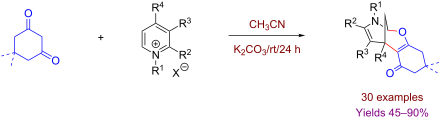

Graphical Abstract

Scheme 1: Reagents and conditions: (i) CH3CN, K2CO3, rt, 24 h.

Scheme 2: Synthesis of compounds 3–8. Reagents and conditions: (i): CH3CN, K2CO3, rt, 24 h. In the case of 3-...
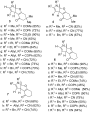
Figure 1: Synthesized compounds 3, 4, 6, 7.

Figure 2: Plausible reaction mechanism.

Scheme 3: The influence of K+ on the product free energy.
Zanthoxoaporphines A–C: Three new larvicidal dibenzo[de,g]quinolin-7-one alkaloids from Zanthoxylum paracanthum (Rutaceae)
- Fidelis N. Samita,
- Louis P. Sandjo,
- Isaiah O. Ndiege,
- Ahmed Hassanali and
- Wilber Lwande
Beilstein J. Org. Chem. 2013, 9, 447–452, doi:10.3762/bjoc.9.47
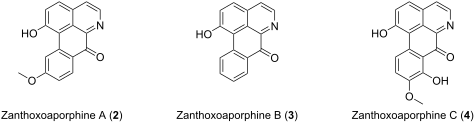

Graphical Abstract

Figure 1: Known compound sesamin (1) isolated from methylene extract of stem bark of Z. paracanthum.

Figure 2: COSY, HMBC and NOE correlations of compounds 2, 3 and 4.
Computational evidence for intramolecular hydrogen bonding and nonbonding X···O interactions in 2'-haloflavonols
- Tânia A. O. Fonseca,
- Matheus P. Freitas,
- Rodrigo A. Cormanich,
- Teodorico C. Ramalho,
- Cláudio F. Tormena and
- Roberto Rittner
Beilstein J. Org. Chem. 2012, 8, 112–117, doi:10.3762/bjoc.8.12
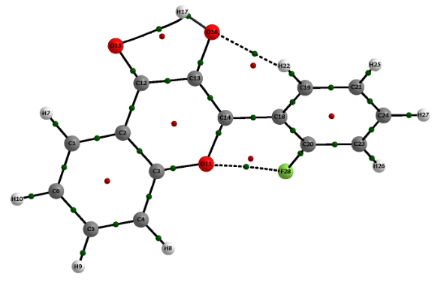

Graphical Abstract

Figure 1: 2'-Haloflavonols and the α and β torsional angles.

Figure 2: Stable conformers of 2'-fluoroflavonol.
Continuous-flow enantioselective α-aminoxylation of aldehydes catalyzed by a polystyrene-immobilized hydroxyproline
- Xacobe C. Cambeiro,
- Rafael Martín-Rapún,
- Pedro O. Miranda,
- Sonia Sayalero,
- Esther Alza,
- Patricia Llanes and
- Miquel A. Pericàs
Beilstein J. Org. Chem. 2011, 7, 1486–1493, doi:10.3762/bjoc.7.172
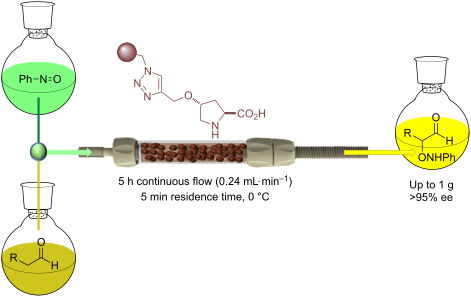

Graphical Abstract

Scheme 1: Proline-catalyzed direct enantioselective α-aminoxylation of aldehydes.

Figure 1: Polystyrene-immobilized hydroxyproline 1a.

Scheme 2: Preparation of the immobilized catalysts 1a and 1b.

Scheme 3: Direct enantioselective α-aminoxylation of propanal catalyzed by resins 1a and 1b.

Figure 2: Experimental setup for the continuous-flow α-aminoxylation of aldehydes.
Synthesis and redox behavior of new ferrocene- π-extended- dithiafulvalenes: An approach for anticipated organic conductors
- Abdelwareth A. O. Sarhan,
- Omar F. Mohammed and
- Taeko Izumi
Beilstein J. Org. Chem. 2009, 5, No. 6, doi:10.3762/bjoc.5.6
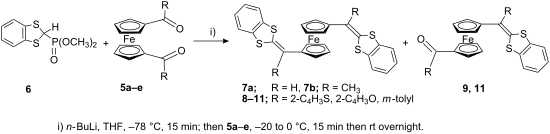

Graphical Abstract

Figure 1: Donors and acceptor compounds.

Scheme 1: Synthesis of π-extended dithiafulvalenes 7a and 7b. i) n-BuLi/THF, −78 °C, 15 min, then rt, overnig...

Scheme 2: Synthesis of π-extended dithiafulvalenes 8 and 9. i) 6, n-BuLi, THF, −78 °C, 15 min; then, 5c, −78 ...

Scheme 3: Synthesis of π-extended dithiafulvalenes 10. i) 6, n-BuLi, THF, −78 °C, 15 min; then 5d, −20 to 0 °...

Scheme 4: Synthesis of π-extended dithiafulvalenes 11 and dithiafulvalene 12. i) 6, n-BuLi, THF, −78 °C, 15 m...

Figure 2: Cyclic voltammetry (CV) of compounds 8, 10 and 11 in CH2Cl2 at scan rate 100 mV.
An easy synthesis of 5-functionally substituted ethyl 4-amino- 1-aryl- pyrazolo- 3-carboxylates: interesting precursors to sildenafil analogues
- Said A. S. Ghozlan,
- Khadija O. Badahdah and
- Ismail A. Abdelhamid
Beilstein J. Org. Chem. 2007, 3, No. 15, doi:10.1186/1860-5397-3-15
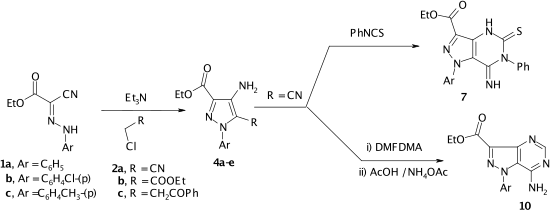

Graphical Abstract

Scheme 1: synthesis of Ethyl 4-amino-5-substituted-1-aryl-1H-pyrazole-3-carboxylates (4)

Scheme 2: Reactivity of pyrazole 4b with phenylisothiocyanate and acetic anhydride

Scheme 3: Conversion of pyrazole 4b Ethyl into pyrazolo[4,3-d]pyrimidine-3-carboxylate 10

Scheme 4: Conversion of arylhydrazononitriles 1 into 3-Amino-4-arylhydrazono-4H-isoxazol-5-one
Investigation of acetyl migrations in furanosides
- O. P. Chevallier and
- M. E. Migaud
Beilstein J. Org. Chem. 2006, 2, No. 14, doi:10.1186/1860-5397-2-14
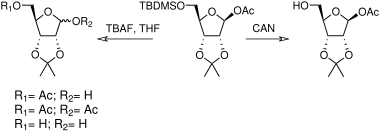

Graphical Abstract

Scheme 1: Acetyl migration products upon TBAF/THF treatment

Scheme 2: Synthesis of riboside 1. a) 2,2-Dimethoxypropane, p-toluenesulfonic acid, acetone (65%); b) TBDMSCl...

Scheme 3: Synthesis of xyloside 2 and riboside 3. a) i) acetone, p-toluenesulfonic acid, CuSO4; ii) HCl 0.2 M...

Scheme 4: Synthesis of arabinoside 4. a) HSEt, 6M aq HCl (85%); b) TBDPSCl, imidazole, DMAP, DMF (94%); c) Hg...

Scheme 5: Synthesis of riboside 5. a) BnBr, NaH, THF (82%); b) TBAF, THF (84%); c) PivCl, pyridine/DCM, DMAP ...

Scheme 6: Alkoxide promoted transesterification.
Colchitaxel, a coupled compound made from microtubule inhibitors colchicine and paclitaxel
- Karunananda Bombuwala,
- Thomas Kinstle,
- Vladimir Popik,
- Sonal O. Uppal,
- James B. Olesen,
- Jose Viña and
- Carol A. Heckman
Beilstein J. Org. Chem. 2006, 2, No. 13, doi:10.1186/1860-5397-2-13
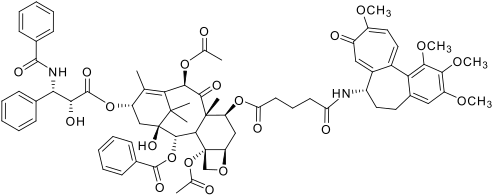

Graphical Abstract

Scheme 1: Reagents and conditions for synthesis of N-glutaryl-deacetylcolchicine. The reagents used at each s...

Scheme 2: Reagents and conditions for protection of paclitaxel and coupling to N-glutaryl-deacetylcolchicine ...

Figure 1: Microtubule arrangement as visualized by immunofluorescence localization of β-tubulin. Cells were t...

Figure 2: Projections of a VRO showing + ends localized by antibody against EB1 in a control cell. Cell was t...

Figure 3: Projections of a VRO showing + ends localized by antibody against EB1 in colchitaxel-treated cell. ...

Figure 4: Microtubule arrangement as visualized by immunofluorescence localization of β-tubulin. Cells were t...



